

Looking for a shipping company from Sharjah to Khobar that handles equipment and spare parts the way a workshop would? At Al Basmah International Shipping we collect from our branch in Industrial Area 18 or from your warehouse anywhere in Sharjah, pack the cargo in wooden crates or bolt it to skids, and send it by road through Al Ghuwaifat – Al Batha to Khobar in roughly 2 to 4 days including clearance. Pickup trucks travel with it in enclosed carriers, and we deliver to the Al Thuqbah workshops and the Dammam industrial cities. Send photos and weights of the items on WhatsApp +971557643821 and you’ll get the price.
Stops in this guide16 sectionsShowHide
The equipment shipment file
- Collection: Sharjah branch – Industrial Area 18, or from your site in the industrial areas and free zones.
- Packing: wooden crates for precision parts, bolted skids for pumps and motors, protection against humidity and rust.
- Transport: open flatbed for large heavy pieces, closed trailer (12 – 13.6 m) for cargo that needs cover, dynas for small loads.
- Timing: about 2 – 4 days by road, about 1 – 2 days by air for urgent parts.
- Commercial papers: commercial invoice, packing list, certificate of origin, a SABER certificate where the product requires it, and the consignee’s commercial registration.
- Pickups: enclosed carrier, prices start from 4,100 AED.
What do we ship from Sharjah to Khobar?
Most of what leaves Sharjah for Khobar is working cargo rather than household furniture: parts for oil, gas and contracting projects, stock for spare-parts shops, and workshop tools moving with their owners. Sharjah is a big wholesale market for valves, pumps and pipe fittings, and Khobar, with Dammam and Dhahran next door, uses these parts every day in plants and maintenance sites. We’ve built our process around this kind of shipment: real weight, heavy irregular pieces, and commercial paperwork that has to be right before the truck moves.
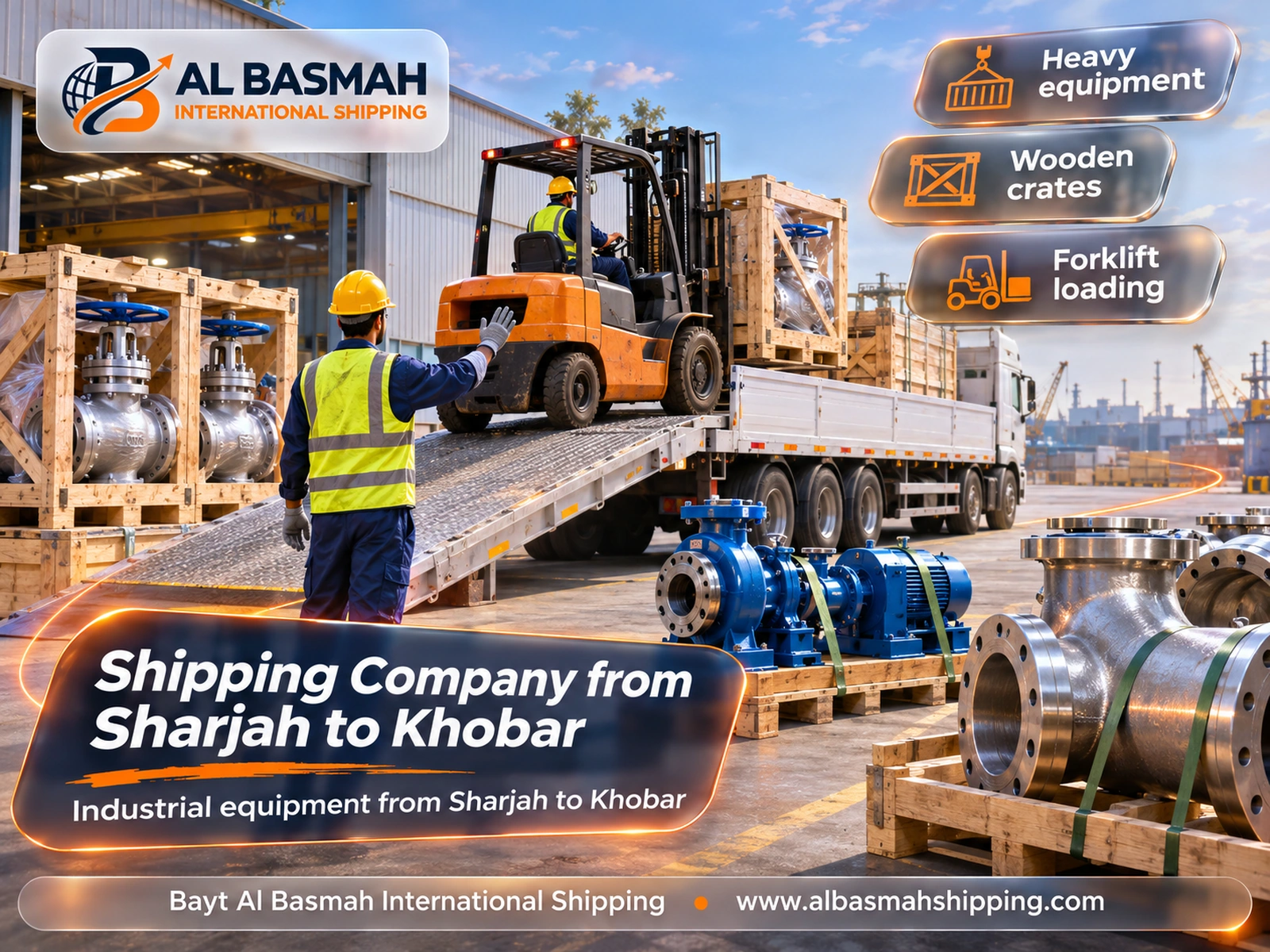
- Valves of every type: gate, ball, butterfly and check valves; small sizes in crates, large ones on their own skids.
- Pumps and motors: centrifugal and submersible pumps, electric motors and gearboxes, bolted to timber bases.
- Pipe fittings and flanges: elbows, tees, reducers, flanges, gaskets and bolts, in crates divided by size.
- Workshop tools: welding machines, air compressors, small generators, presses, tool racks, cutting and grinding equipment.
- Vehicle and equipment spare parts: shop stock or orders for specific workshops in Al Thuqbah.
- Pickup trucks: shipped in enclosed carriers, sometimes on the same trip as the company’s cargo.
- Personal effects and furniture: for engineers and technicians relocating to the Eastern Province, in a shared truck or alongside the company shipment.
Collection areas in Sharjah
Our Industrial Area 18 branch is the closest consolidation point for most suppliers. You can drop your goods there so we can inspect, pack and weigh them before loading. If the items are heavy or numerous we send the truck to your site, and we ask you first to confirm that the supplier has a forklift or overhead crane, because a one-ton pump isn’t loaded by hand. If you also ship to other Saudi cities, see the Sharjah to Saudi Arabia shipping guide.
Industrial areas
Industrial Areas 1 to 18, Al Sajaa Industrial Area, and the workshops and warehouses along Emirates Road.
Free zones
Hamriyah Free Zone and Sharjah Airport International Free Zone (SAIF Zone), with the free-zone exit paperwork in order.
Residential areas
Al Nahda, Al Taawun, Al Majaz, Al Khan, Al Qasimia, Muwaileh and Al Rahmaniya.
Industrial Area 18 branch
Direct drop-off, weighing, photos and packing before loading, and consolidation of several suppliers into one load.
Many clients buy from more than one supplier in the industrial areas: valves from one shop, flanges from another, a pump from a third dealer. In that case we suggest delivering everything to the branch, where we match it against the packing list and put it in one shipment file, instead of paying collection from three locations. If goods leave a free zone, ask the supplier for the zone’s exit document with the invoice, because the gate won’t release them without it.
Crates and skids: how we pack equipment for the road
The road to Khobar is long. It runs through desert heat and then into the very humid air of the eastern coast, a mix that can put surface rust on bare steel within days. So we don’t just wrap a part in plastic; the method depends on the item’s weight and sensitivity:
- Closed wooden crates: for small and medium valves, sensors, pressure gauges and control panels, with padding against rubbing and desiccant bags inside.
- Skids: for pumps, motors and gearboxes. The item is bolted or strapped to the base so it doesn’t shift under braking or on bends.
- Machined-surface protection: plastic caps on flange faces and pipe openings, and a coat of rust-preventive oil on exposed parts before wrapping.
- Drain the fluids: pumps, compressors and generators are drained of oil and fuel as far as possible; fluids in equipment cause leaks and holds at inspection.
- Clear markings: weight, lifting points, this-way-up, and a crate number that matches the packing list, on at least two sides of each piece.
Photograph every item before its crate is closed and send the photos with the packing list. If a customs officer asks about a particular crate, the photo and crate number save a lot of opening and searching.
Open flatbed or closed trailer?
This is the question equipment owners ask most, and the answer depends on three things: the item’s dimensions, how sensitive it is to dust and humidity, and how it can be loaded and unloaded at each end. An open flatbed is loaded from the side or from above by crane, so it suits large pieces that won’t fit through a trailer door, such as a tank, a machine frame or a long bundle of pipes, as long as it is covered with a tight tarpaulin and properly lashed. A closed trailer protects the cargo from sun, dust and rain, suits crates, skids and packed spare parts, and is usually loaded from the rear by forklift.
| Load | Suitable vehicle | Note |
|---|---|---|
| A few crates and spare parts | Small closed dyna (about 3 tons) | Enough for shop and small-workshop orders |
| Several skids and workshop equipment | 5- or 7-ton dyna | Useful when the delivery point is inside a tight industrial street |
| A mid-sized warehouse order | 10-ton lorry | Gets into most industrial streets in Al Thuqbah |
| A full project load | Closed trailer 12 – 13.6 m | Protects crates, rear-loaded |
| Long or oversized pieces | Open flatbed with tarpaulin and lashing | Needs a side or overhead crane at both ends |
Not sure? Send us the longest dimension, the heaviest piece and a photo of the unloading spot in Khobar, and we’ll suggest the vehicle. For small scattered parts, the shared truck remains the cheaper option if you can accept waiting a few extra days for it to fill; a dedicated truck leaves on your date.
The road route from Sharjah to Khobar
The truck leaves Sharjah towards Abu Dhabi and then west to Al Ghuwaifat on the UAE side, then crosses to Al Batha in Saudi Arabia, where customs clearance is done electronically through the Fasah platform. After Al Batha it heads to Al Ahsa (Hofuf) and then north along the eastern highway to Dammam and Khobar. The distance from Sharjah is a little longer than from Dubai, roughly 900 to 1,000 km depending on the starting point. Most of the time on this trip isn’t spent driving but waiting at the border, which is why having the papers ready before loading is what really sets the speed.
- Sharjah: collection, packing, weighing and list matching.
- Al Ghuwaifat: UAE exit procedures.
- Al Batha: inspection, clearance through Fasah and payment of any charges due.
- Al Ahsa and the eastern highway: on to Dammam and Khobar.
- Khobar: coordination with the receiver, crane ready, delivery.
If your real destination is a warehouse in Dammam rather than Khobar, the process is almost the same with a slightly different last leg; see the Sharjah to Dammam shipping guide.
How long does a shipment take from Sharjah to Khobar and nearby?
The times below are approximate, include clearance, and start from the day the truck moves, not the day you book. A shared truck may add a few days before departure while it fills.
| Destination | Road freight (approx.) | Notes |
|---|---|---|
| Khobar districts: Al Thuqbah, Al Aqrabiyah, Al Khobar Al Shamaliyah and Al Janubiyah, Al Rakah | 2 – 4 days | Most equipment shipments unload in Al Thuqbah |
| Dhahran | 2 – 4 days | Some sites need advance entry permits from the receiver |
| Dammam and its industrial cities | 2 – 4 days | Delivery to the First and Second Industrial Cities in Dammam |
| Al Ahsa (Hofuf) | 2 – 3 days | On the way, before Khobar |
| Jubail | 3 – 5 days | Further north past Dammam |
Shipping pickup trucks from Sharjah to Khobar
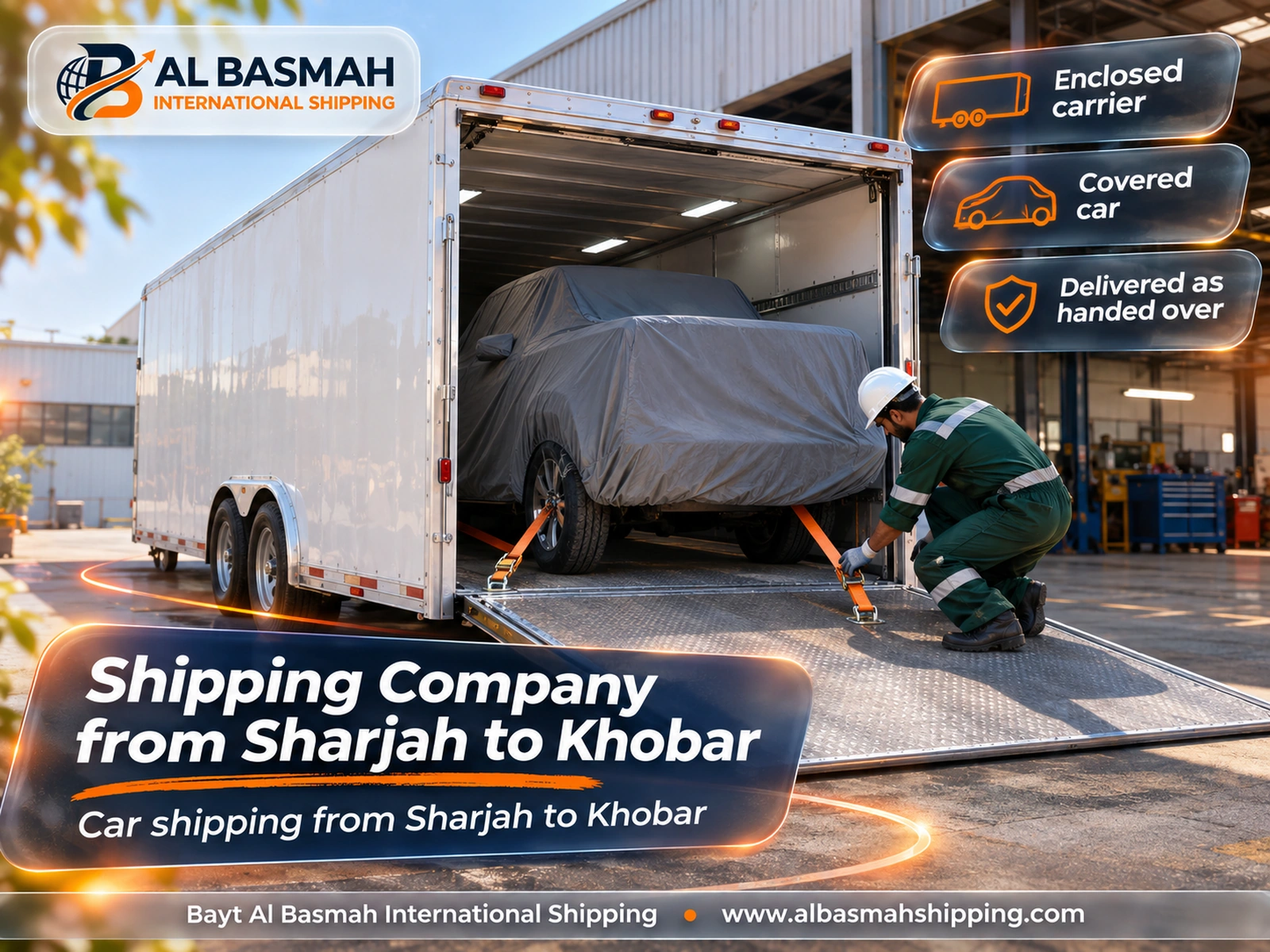
For many companies a pickup is a work tool before it’s a car, and it often moves with the technician or supervisor relocating to the Eastern Province. We ship it inside an enclosed car carrier that keeps off road dust and heat, strapped down by the wheels rather than the body. The load bed must arrive completely empty: no tools, no spare parts, no boxes. The vehicle is inspected as a vehicle, and anything inside is treated as undeclared goods that can hold up the whole car. If you want tools to travel with the pickup, put them in the cargo shipment with their papers and they’ll arrive on the same trip or close to it.
- Vehicle registration (mulkiya) in the owner’s name or with a clear authorisation.
- Export certificate and plate cancellation from the RTA or the roads authority of the emirate where the car is registered.
- Owner’s passport and ID.
- Age: imported used passenger cars must not be more than 5 years old from the model year, counted back excluding the current year. Send us the model year before anything else.
- Special cases, such as modified vehicles or cars registered to a company, are checked with you before booking.
Air freight from Sharjah to Khobar for urgent parts
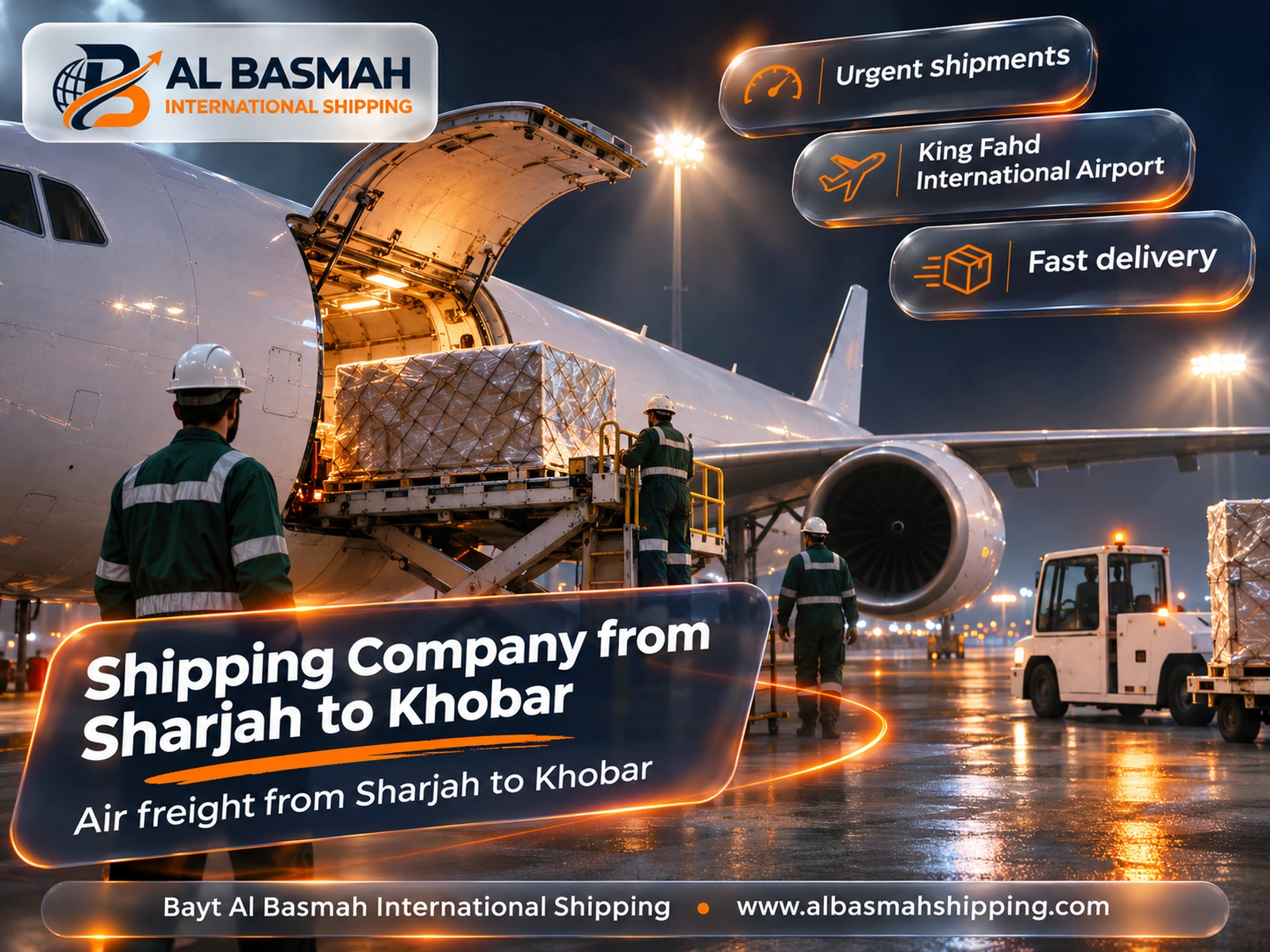
When a pump stops on a production site, nobody waits for a truck. For urgent parts we fly the shipment from Sharjah or Dubai airport to King Fahd International Airport in Dammam, then by road to Khobar, usually in about 1 to 2 days including clearance. Air freight is charged on actual or volumetric weight, whichever is higher; volumetric weight is length × width × height in cm divided by 6000. A 100 × 80 × 60 cm crate, for example, has a volumetric weight of 80 kg even if it only weighs 40, so we keep crates as tight as possible before weighing.
- Good for air: sensors, electronic boards, mechanical seals, small urgent spare parts and documents.
- Not good for air: furniture and large heavy pieces; the cost by air can’t be justified.
- Restricted by air: lithium batteries, liquids, perfumes and any chemicals or oils; send us the product name before packing.
Required documents
Commercial goods and equipment
Most delays on equipment shipments come from a missing paper, not a truck. Before loading we go through these documents with you one by one:
- Commercial invoice giving each item’s description, quantity, value and country of origin, in clear words rather than the supplier’s internal codes.
- Packing list matching crate and skid numbers and the weight of each.
- Certificate of origin: goods of UAE (GCC) origin with a GCC certificate of origin are exempt from customs duty; goods originally imported from outside the GCC are treated according to their origin.
- SABER certificate: many products must be registered on the SABER platform, which issues a product certificate of conformity and then a shipment certificate for each consignment, depending on the product’s category and customs code. We check each item’s status before loading, not at the border.
- Consignee’s commercial registration in Saudi Arabia: commercial goods need a consignee holding a CR.
- VAT: 15% VAT applies on imports into Saudi Arabia, so include it in the cost of the goods.
Personal effects for relocating staff
If furniture or personal belongings of a relocating employee go with the equipment, you’ll need the owner’s passport and Saudi ID or iqama or residence visa, plus a detailed contents list in Arabic or English. New items in commercial quantities are treated as goods and are dutiable.
Cars
Registration, export certificate and plate cancellation, the owner’s passport and ID, and a car empty of belongings. Details are in the pickup section above.
Prohibited and restricted items
Narcotics, alcohol, pork products, weapons and ammunition without permits, counterfeit goods and gambling tools are not allowed in. Drones and some medicines need prior permits, and soil and plants are restricted. For workshop shipments in particular, tell us in advance about any gas cylinders, paints, solvents or chemicals, as they need special handling and may not be accepted in the same load.
Warning: Counterfeit parts, or parts carrying a non-genuine brand, are seized at the border and can hold up the entire shipment. Buy from sources that give you a clear invoice showing brand and origin.
Prices start from
These are starting prices, not a final quote; the final price depends on volume, weight, delivery city, packing and documents.
| Service | Price starts from |
|---|---|
| Household goods and furniture in a shared truck | 90 AED per cubic metre |
| Small parcels by road | 45 AED |
| Sedan on an open carrier | 2,000 AED |
| SUV on an open carrier | 2,750 AED |
| Car or pickup on an enclosed carrier | 4,100 AED |
| Equipment on a dedicated flatbed or trailer | Send the details on WhatsApp and get the price |
| Air freight for urgent parts | Send the details on WhatsApp and get the price |
| Sea containers for large loads | Send the details on WhatsApp and get the price |
What raises or lowers the cost of shipping equipment?
- Weight versus volume: steel is heavy and compact, so weight rather than space may decide how many trucks you need.
- Out-of-gauge dimensions: a piece wider than the trailer needs a flatbed and special lashing.
- Packing: building wooden crates costs more than skids, but it saves you damaged parts.
- Lifting equipment: if neither supplier nor receiver has a crane, an outside crane is added.
- Shared or dedicated truck: shared is cheaper but waits to fill; dedicated runs on your date.
- Number of collection points: consolidating at the Industrial Area 18 branch cuts collection from several sites.
- Complete documents: a missing certificate or invoice means days at the border, and waiting costs money.
How to ship from Sharjah to Khobar, step by step
- Send the parts list, approximate weight, photos and the Khobar delivery address on WhatsApp +971557643821.
- We suggest the right vehicle (dyna, lorry, trailer or flatbed) and send you the price.
- We review the documents: invoice, packing list, certificate of origin, SABER status for each item, and the consignee’s CR.
- You drop the goods at Industrial Area 18 or we collect from your site; we pack, weigh and photograph.
- Loading and departure; the team updates you on WhatsApp at each stage: departure, border, release from clearance.
- We agree the unloading time and crane availability with the receiver in Khobar.
- Delivery, with crate numbers checked against the list.
Delivery in Khobar: Al Thuqbah and the industrial areas
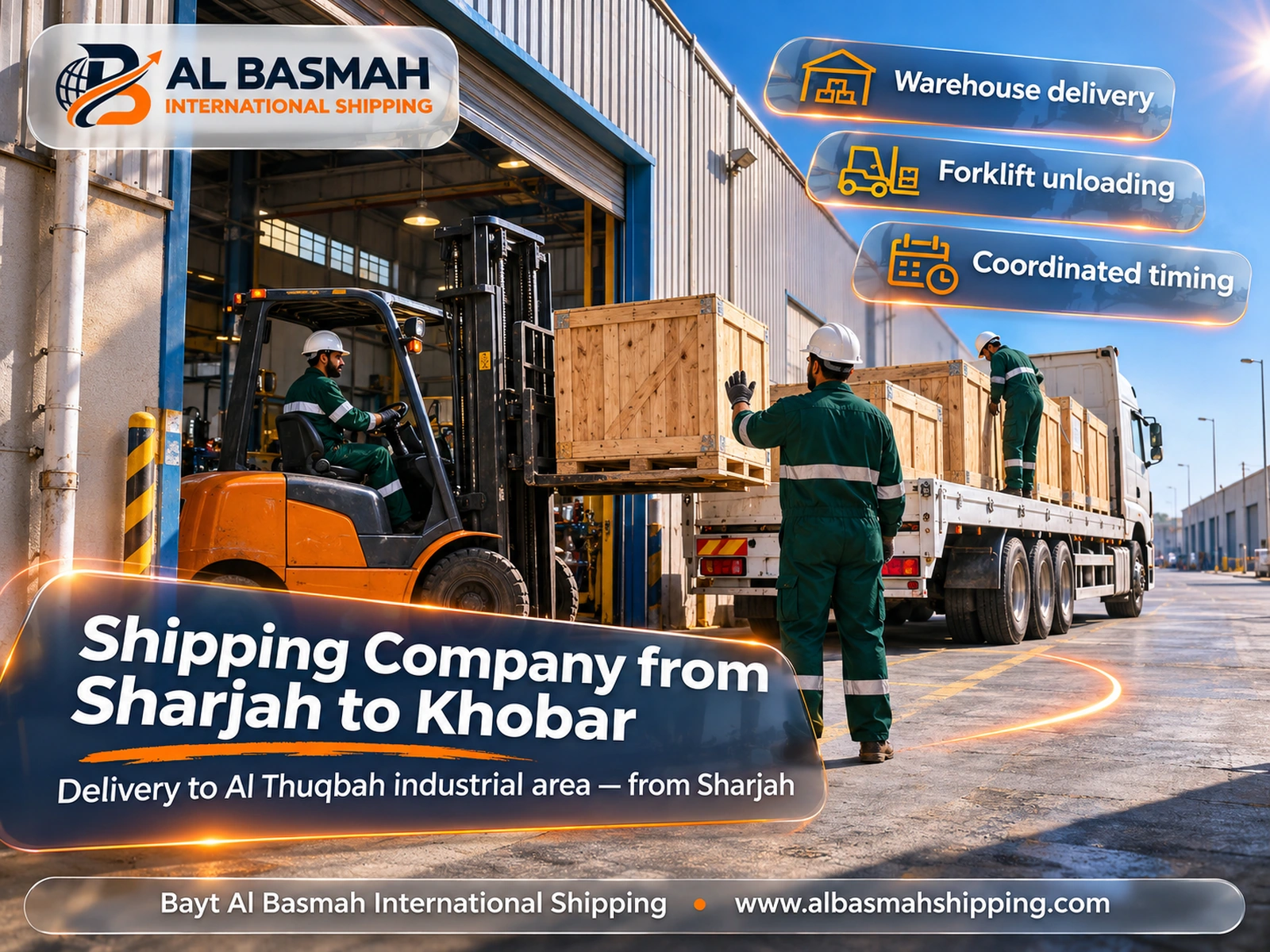
Most equipment shipments from Sharjah unload in the Al Thuqbah industrial area, where workshops and spare-parts shops stand side by side, or go straight to the First or Second Industrial City in nearby Dammam. Streets inside Al Thuqbah are busy during the day, and some workshops can’t take a long trailer at their door, so for the last stretch we may switch to a smaller dyna or agree an early unloading time with the receiver. Before arrival we ask the receiver two things: do you have a forklift that can take the heaviest piece, and who will sign for the delivery?
Belongings of relocating staff usually go to residential districts such as Al Ulaya, Al Rakah and Al Khobar Al Shamaliyah, or into gated residential compounds. Compounds need gate access arranged in advance and sometimes don’t let large trucks in, so we move the goods from the gate to the villa in a smaller truck, coordinated with the receiver before arrival.
For very large loads, such as project equipment filling several containers, sea freight is a real option: from Jebel Ali or Khalifa Port to King Abdulaziz Port in Dammam, right next to Khobar. For ordinary cargo, homes and cars, road remains the usual way because it is faster and reaches the door directly.
Field tips before you book
- Describe each item on the invoice the way a customs officer will understand it: “4-inch steel ball valve” is better than the supplier’s code.
- Don’t mix used and new parts in one crate without saying so; each is treated differently.
- If the receiver needs to inspect a part on arrival, ask for the inspector to be there at unloading.
- Used equipment should be cleaned of oil, mud and dust before packing.
- Ask the team about optional insurance for high-value shipments.
- Khobar is humid most of the year; don’t open crates outdoors and leave them open.
If you’re weighing Sharjah against Dubai as a starting point, or want the full picture for every emirate, see the complete UAE to Khobar guide and the Dubai to Khobar guide.
Frequently asked questions
How long does shipping from Sharjah to Khobar take?
Roughly 2 to 4 days by road from the day the truck leaves, including clearance at Al Batha. A shared truck may add a few days before departure, and air freight usually takes 1 to 2 days.
Do I need a SABER certificate to ship valves and pumps?
It depends on the product’s category and customs code; many products need a product certificate of conformity and a shipment certificate through SABER. Send us the item list and we’ll check each one before loading.
Are UAE goods exempt from customs duty in Saudi Arabia?
Goods of UAE origin with a GCC certificate of origin are exempt from customs duty, but 15% VAT applies on imports.
When should I choose a flatbed instead of a closed trailer?
When the piece is too long, wide or tall for the trailer door, or can only be loaded from above by crane. It is then covered with a tight tarpaulin.
Can I load tools in the pickup’s bed?
No; the vehicle ships completely empty. Put the tools in the cargo shipment with their papers and they’ll arrive on the same trip or close to it.
Do you deliver inside the Dammam industrial cities?
Yes, we deliver in Al Thuqbah industrial area and in the First and Second Industrial Cities in Dammam, after agreeing the time and crane availability with the receiver.
How do I know where my shipment is?
The team sends you a WhatsApp update at each stage: loading, arrival at the border, release from clearance and arrival in Khobar.
Is sea freight better for large project equipment?
If the load fills several containers or includes very heavy pieces, sea freight from Jebel Ali or Khalifa Port to King Abdulaziz Port in Dammam is a real option. Send the details and we’ll compare road and sea for you.
You can also request a price from the site through the quote page.
Get your parts list ready and send it now
Photos, weights and the Khobar delivery address are enough to open your shipment file.
Tags: Sharjah to Khobar shipping, shipping company from Sharjah to Khobar, industrial equipment shipping to Khobar, spare parts shipping to Khobar, valve and pump shipping, pickup truck shipping to Saudi Arabia, car shipping from Sharjah, Al Thuqbah delivery, Al Thuqbah industrial area, Dammam industrial city, Sharjah Industrial Area 18, SABER certificate, Fasah platform, Al Batha border, air freight to Khobar, UAE to Saudi road freight, closed trailer, flatbed shipping