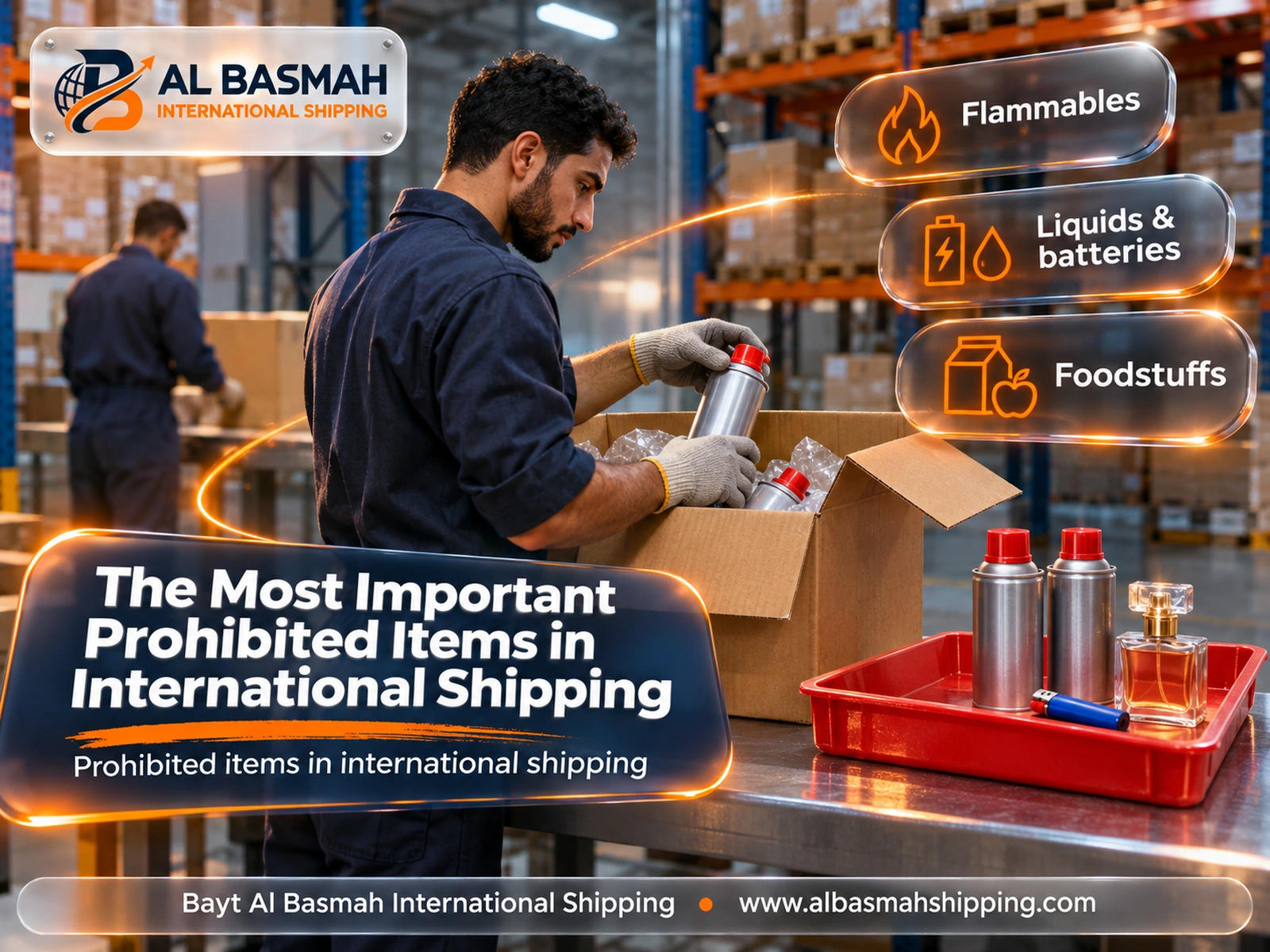
The main prohibited items in international shipping are drugs, firearms and ammunition, explosives and fireworks, counterfeit goods, toxic and radioactive materials, large amounts of cash without authorisation, and most live animals. None of these can travel by any mode. Alongside them is a longer list of restricted items that are accepted on conditions, chiefly lithium batteries, perfumes, aerosols, medicines, food and plants. Air freight is the strictest, and the destination country’s own laws can ban things another country allows.
Stops in this guide12 sectionsShowHide
Before you seal the box
- Make sure nothing in the carton is on the outright banned list, even a small item forgotten in a bag pocket.
- Set aside loose batteries, power banks, perfumes and aerosols and tell the company about them before booking.
- Ask about the rules of the destination country specifically; what one country allows another may confiscate.
- Write an honest, detailed contents list, not just “personal effects”.
- If you are unsure about an item, photograph it and send it on WhatsApp +971557643821 before packing.
Prohibited items versus restricted items
A prohibited item is refused whatever paperwork you have. A restricted item is accepted once its conditions are met: approved packaging, a government permit, a limited quantity or a particular mode of transport. Many of the problems we hear about come from treating restricted items as freely allowed, such as perfume bottles tucked among clothes or a power bank left in a bag.
| Point | Prohibited items | Restricted items |
|---|---|---|
| Can they be shipped? | No, by any mode | Yes, on conditions |
| Examples | Drugs, weapons, fireworks, counterfeit goods | Lithium batteries, perfumes, aerosols, medicines, food |
| What is needed? | Nothing makes them acceptable | Special packing, a permit, a dangerous goods declaration or a different mode |
| If found | Confiscation, possibly followed by legal action | Held until conditions are met, or returned at the sender’s cost |
| Who decides? | International law and both countries’ laws | The carrier, transport rules and the destination country |
Items banned by almost every country
Carriers refuse these on practically every mode, and most of the countries we ship to ban them too:
- Narcotics and psychotropic substances, and any medicine containing controlled substances without a prescription and permit.
- Firearms, their parts and ammunition, banned blades, and replica guns that look real.
- Explosives, fireworks, firecrackers and flares.
- Counterfeit goods carrying fake brand names.
- Cash, traveller’s cheques and bullion without declaration and special arrangements.
- Radioactive, toxic and infectious materials and hazardous waste.
- Most live animals, and products made from endangered species such as ivory.
- Printed or other material that breaches public order or morals in the destination country.
- Gambling equipment in countries that ban it.
Restricted items and the conditions they need
| Item | Why it is restricted | What makes it shippable |
|---|---|---|
| Lithium batteries and power banks | Can ignite if damaged or short-circuited | Special packing and labels, limits on mode and state of charge |
| Perfumes and liquid deodorants | Contain flammable alcohol | A dangerous goods declaration and set quantities, or sea or road freight |
| Aerosols | Pressurised cans that can burst with pressure and heat changes | Shipped as dangerous goods or left out of air shipments |
| Medicines | Controlled by health ministries | A prescription and a reasonable personal quantity, or an import permit |
| Food | Public health and food safety | Factory packaging, sometimes certificates, and refrigerated transport for sensitive items |
| Plants, seeds and soil | Stopping the spread of pests and crop diseases | A phytosanitary certificate, or a total ban in some countries |
| Gold and fine jewellery | High value and anti-money-laundering rules | A value declaration and special arrangements with the carrier |
| Alcoholic drinks | National laws and carrier limits | Banned outright in Saudi Arabia and some other countries |
| Antiques and archaeological items | Protection of cultural heritage | Proof of origin and export permits |
| Two-way radios and drones | Security and frequency regulation | Approval from the telecoms or security authority in the destination country |
Food and medicines that need a set temperature follow a different route altogether, explained in our guide to refrigerated shipping from the UAE for all goods.
Why air freight is the strictest
An aircraft has no way to deal with a fire or a leak in flight, so cargo is subject to the dangerous goods regulations issued by the International Air Transport Association (IATA), based on the technical instructions of the International Civil Aviation Organization. Something that rides in a truck or a container without issue may be refused on a plane, or need a special declaration signed by a trained shipper.
Batteries and electronics
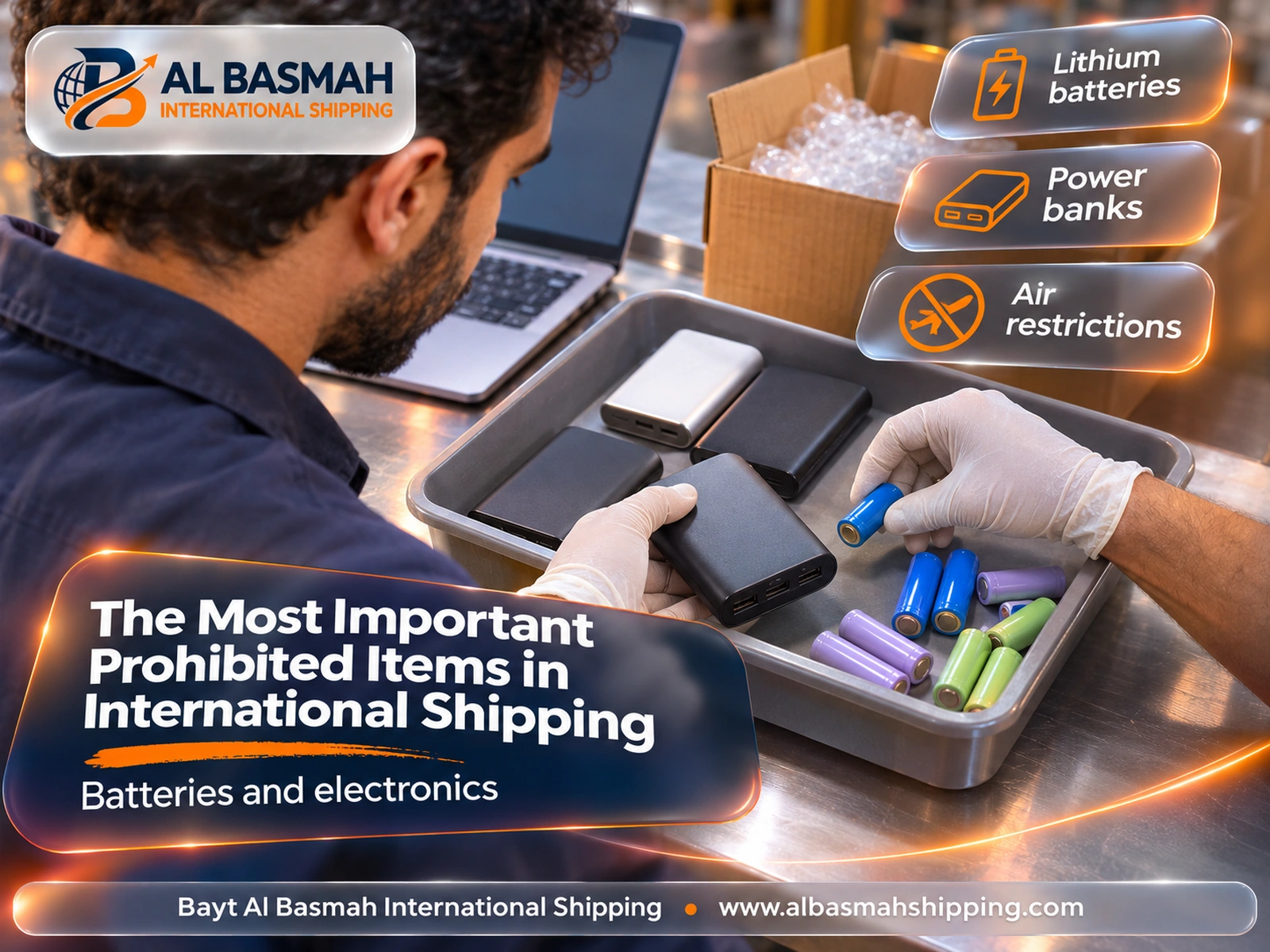
Air rules separate three situations. Loose batteries, which include power banks, are the most restricted: standalone lithium-ion batteries (UN3480) are forbidden as cargo on passenger aircraft and only travel on cargo aircraft, with special packing and labels and a state of charge no higher than 30%. Batteries packed in the same box as their device (UN3481) and batteries installed inside a device, such as a phone or laptop, are accepted more easily, though with limits on quantity and packing. Swollen, damaged or recalled batteries are refused by air entirely.
- Ship phones and laptops fully switched off, not in sleep mode.
- Do not put power banks in an air shipment without telling the company first.
- E-scooters, e-bikes and their large batteries usually go by sea or road.
- Tape over the terminals of spare batteries and bag each one separately.
Perfumes, liquids and aerosols

Transport rules class perfume as a Class 3 flammable liquid (UN1266) because of its alcohol, and aerosols as Class 2 compressed gas (UN1950). That does not make them impossible to ship. It means that flying them needs a dangerous goods declaration, approved packing and a carrier willing to accept them, all of which add cost. For a commercial quantity of perfume going to the Gulf, road freight is usually simpler and cheaper. The modes are compared in our air vs sea vs land freight guide.
Other items people forget about for air: lighters and matches, nail polish and remover, paints and solvents, gas cylinders even when empty, dry ice, and the strong magnets inside large speakers.
Restrictions by transport mode
| Item | Air | Sea | Road (Gulf and neighbouring countries) |
|---|---|---|---|
| Loose batteries and power banks | Heavily restricted | Accepted under dangerous goods rules | Accepted on conditions |
| Commercial quantities of perfume | Dangerous goods declaration | Accepted with a declaration | Often the simplest option |
| Aerosols | Restricted | Accepted on conditions | Accepted on conditions |
| Furniture and household goods | Accepted | Accepted | Accepted |
| Generator or lawnmower | After draining and cleaning the fuel system | After draining the fuel | After draining the fuel |
| Gas cylinders | Banned | Banned in household shipments | Banned in household shipments |
| Car | Not usual | Accepted with minimal fuel and the battery handled as the carrier instructs | Accepted |
At sea, dangerous goods fall under the International Maritime Dangerous Goods (IMDG) Code, and a container carrying them needs a declaration and placards on its sides. In household furniture shipments we always ask customers to remove strong cleaning chemicals, paints, pesticides and fuel before loading.
Examples of destination country rules
Every country keeps its own list and it changes from time to time. The examples below illustrate the idea; the final word belongs to the customs authority of the destination country at the time of shipping.
Saudi Arabia
Bans alcohol, pork products, gambling equipment and material against public morals. Medicines, cosmetics and food are subject to Food and Drug Authority requirements, and some wireless devices need conformity approval.
Egypt
Drones and some wireless communication devices need prior approval from the relevant authorities, and medicines beyond personal use need a permit.
Australia
Its biosecurity rules are among the strictest anywhere: food, plants, seeds and wooden products must be declared, and soil on shoes, bicycles or garden tools can hold a shipment for cleaning or treatment.
UAE (on export)
Bans narcotics and internationally prohibited items, and requires permits to export some goods such as licensed weapons and antiquities.
If you are shipping to the Gulf, our UAE to Saudi Arabia shipping guide explains what the land route requires.
What happens at inspection if a banned item is found
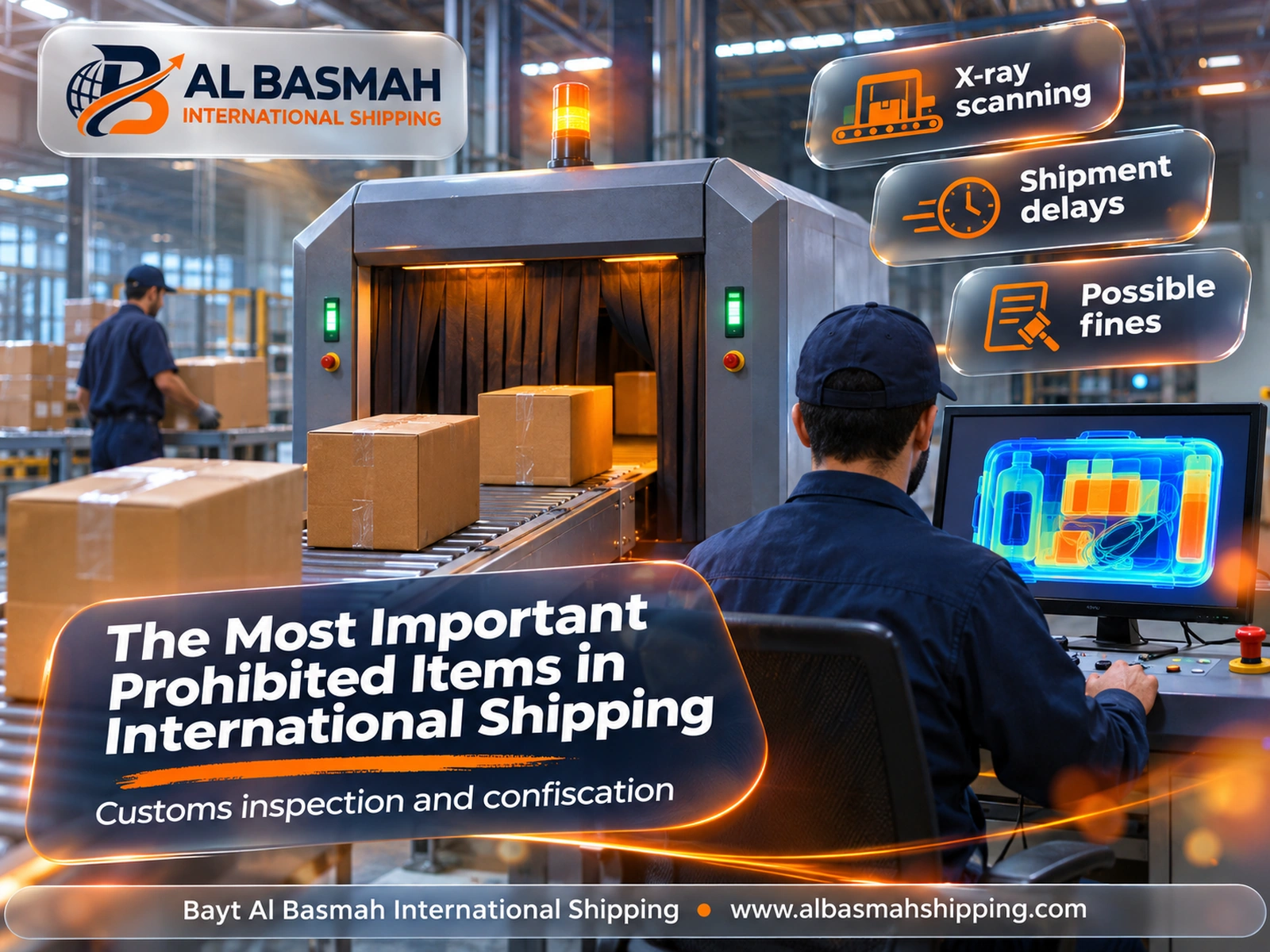
Shipments go through X-ray at the export point and on arrival, and they may be opened by hand at random or on suspicion. If an undeclared item shows up, one or more of the following happens:
- The item is removed and confiscated or destroyed, and the rest continues if possible.
- The whole shipment is held until the sender or receiver provides the required documents.
- The shipment is returned to the country of origin at the sender’s cost.
- A customs fine is applied according to the type and value of the breach.
- For legally banned items, the case is referred to the authorities and the owner is held accountable.
- Other shipments consolidated in the same container or on the same pallet are delayed too.
Warning: The owner of a shipment is responsible for what is inside it. Writing a false description to get past inspection does not protect the shipment; it turns a problem that a document could have solved into a false declaration offence.
The effect on arrival times is covered in detail in our guide to avoiding international shipment delays.
The honest contents list and how to write it
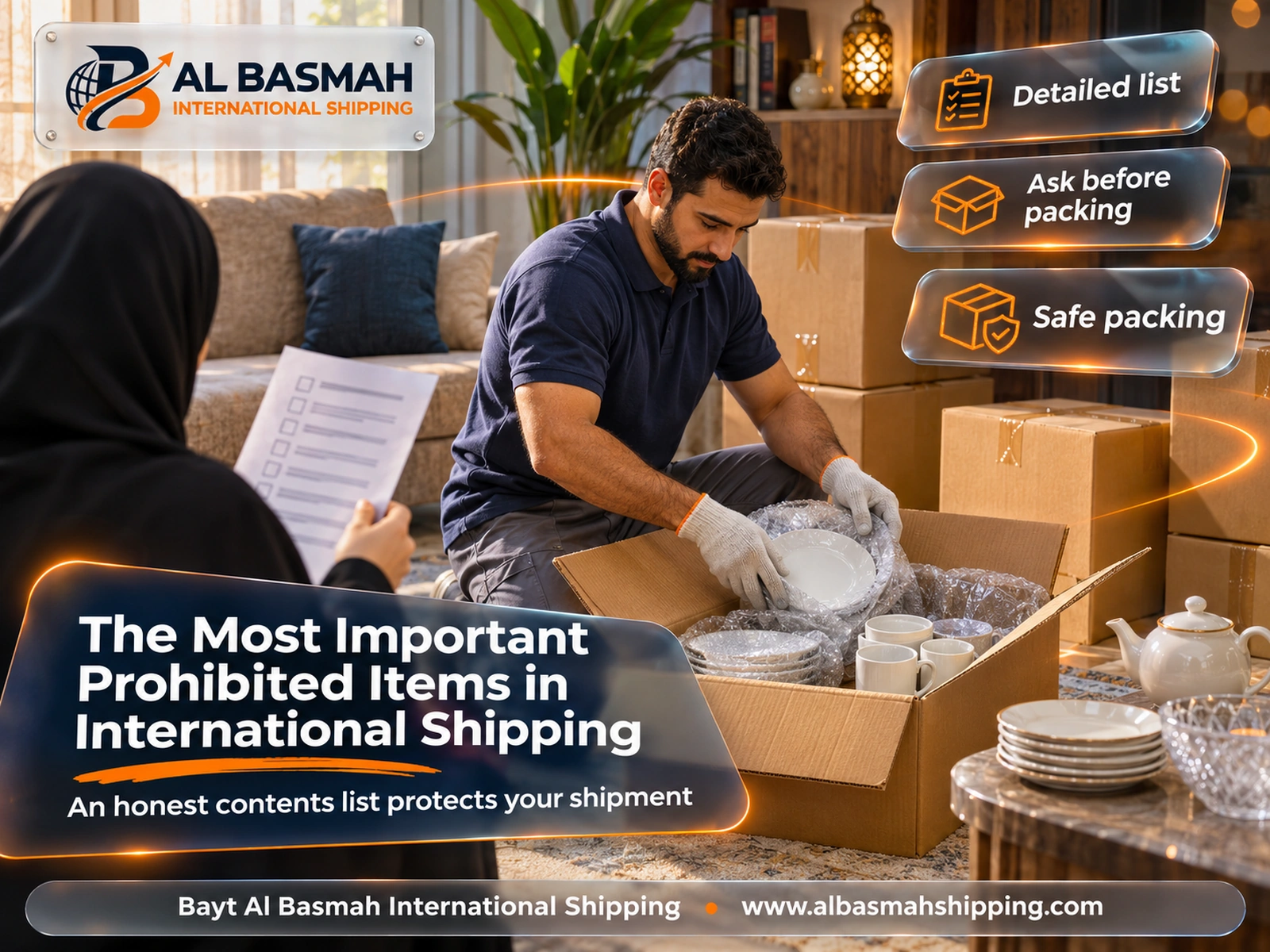
The packing list is the first thing a customs officer reads. A vague entry such as “miscellaneous items” invites an inspection, while a precise one speeds up release. Number your cartons and write down, for each number, its contents, the number of pieces and an approximate value.
| Carton no. | Weak description | Clear description |
|---|---|---|
| 1 | Kitchen stuff | 24 ceramic plates, 12 glass cups, 4 stainless steel pots |
| 2 | Electronics | 1 used laptop with internal battery, charger, keyboard |
| 3 | Clothes | 30 used men’s garments, 4 pairs of shoes |
| 4 | Cosmetics | 6 sealed skin creams, no perfumes or aerosols |
- Use clear names for the contents, in Arabic and English where possible.
- Name every device that contains a battery.
- Put one copy of the list inside the first carton and one with the documents.
- Match the values on the list with the commercial invoice if the shipment is commercial.
From our branch experience: most of the banned items we find at collection were never meant to be there: a lighter in a kitchen drawer, an aerosol in a suitcase, a power bank in a coat pocket. Open the drawers and check the pockets before packing.
Common mistakes that lead to confiscation or delay
- Relying on the list for a country you shipped to before and assuming it applies everywhere.
- Hiding perfumes among clothes to avoid the extra cost of air freight.
- Sending large quantities of medicine without a prescription or permit.
- Sending home-made food to countries with strict health rules.
- Leaving fuel in generators and motorbikes.
- Declaring a token value far below the real one.
What decides the price of shipping restricted items
| Factor | Effect on the price |
|---|---|
| Classification of the item | Dangerous goods need a declaration and special handling |
| Transport mode | Air for dangerous goods costs more than sea or road |
| Approved packaging | Special containers and labels are added to the bill |
| Quantity and weight | Charged on chargeable weight, as explained in our volumetric weight guide |
| Permits in the destination country | Government fees and the time needed to obtain them |
| Destination | How many carriers accept the item on that route |
How Al Basmah International Shipping helps
We go through the contents of your shipment before packing, at our Dubai branch (Deira, Port Saeed Street), our Sharjah branch (Industrial Area 18) or when we collect from your home. We tell you what can fly, what should move to road or sea, and what needs a document before it can leave, and we write the contents list with you.
- Questionable items checked before booking, not after.
- The right mode suggested for each part of the shipment.
- Packing that keeps devices and liquids apart from everything else.
- The contents list and documents prepared for the destination country.
- Updates on WhatsApp at every stage, and an immediate message if customs asks for clarification.
Frequently asked questions about prohibited items in international shipping
Can I send a phone or laptop by air?
In most cases yes, if the battery is inside the device and in good condition, and the device is switched off and well packed. Spare batteries and power banks are the items under the tightest limits.
Are perfumes prohibited in international shipping?
They are restricted rather than prohibited, because they are flammable. They can fly with a dangerous goods declaration and special packing, or go by road or sea on easier terms.
What if a banned item was in the carton without my knowledge?
The item may be confiscated and the shipment delayed, and responsibility stays with the sender. That is why we check the contents with you before the cartons are sealed.
Can I ship medicines to Saudi Arabia or Egypt?
Personal medicines with a prescription in reasonable quantities are usually accepted. Large quantities or controlled medicines need a permit from the health authority in the destination country.
Can food be shipped?
Factory-sealed, non-perishable food is easiest, while temperature-sensitive items need refrigerated transport. Some countries, Australia among them, require any food to be declared.
Do the rules differ between air and sea?
Yes. Air is stricter on flammable and pressurised items and batteries, while sea freight accepts many of them with a dangerous goods declaration.
How do I know whether an item is restricted in the destination country?
Send its name, a photo and the destination on WhatsApp, and we check it against the destination’s rules and the carrier’s conditions before you pack it.
Ask us before you pack
Photograph anything you are unsure about and send it with the destination, and we tell you what can be shipped and how.
Tags: prohibited items in international shipping, restricted items shipping, banned items shipping, shipping lithium batteries, shipping perfume internationally, shipping aerosols, dangerous goods air freight, packing list, customs inspection, shipping restrictions Saudi Arabia, shipping restrictions Egypt, air freight from the UAE, sea freight from the UAE, shipping from Dubai, Al Basmah International Shipping