

Before signing with an international shipping company, get four things in writing: an inventory with an estimated volume, a price that states what it covers and what it leaves out, a signed receipt listing the number of pieces and their condition, and payment stages tied to the work being done. Then ask how the goods will travel (road, sea or air), how long each stage takes, who handles customs at the destination, and whether optional insurance is available for your goods. Those papers and answers are what protect you if something changes after you pay, and this guide puts them in one list you can tick off line by line.
Stops in this guide12 sectionsShowHide
Your list before paying
- A written inventory of items and boxes with an estimated volume in cubic metres or kilos.
- An itemised price: packing, loading, transport, clearance, delivery and any charges paid at the destination.
- A collection receipt signed by both sides describing the condition of fragile items.
- A deposit on booking and the rest tied to clear stages, not everything up front.
- A direct question about optional insurance and what it covers, asked before loading.
This list does not cover the signs of a good company; that is the subject of the guide on how to choose a reliable international shipping company. Here we assume you have narrowed it down to one or two shippers and only the signing and payment step is left, and you want to know exactly what to ask for, what to put in writing and what to keep.
Pre-signing checklist: a table to print and review
Print this table or save it on your phone and mark every line that is still open. Each empty line is a question that should be answered in writing, on WhatsApp or on paper, before any money moves.
| Item | What to ask for exactly | Why it matters |
|---|---|---|
| Company identity | Trading name, branch address, the number you will deal with | You know who you pay and where to go if you need to follow up |
| Inventory | List of items and boxes with rough sizes of large pieces | The basis of the price and your reference on delivery |
| Shipping mode | Road, sea (full container or shared space) or air | Sets the transit time, price and packing method |
| Scope | Door to door, or only to the port or warehouse | Many disputes start when the customer assumed delivery was included |
| Clearance | Who clears in the UAE, who clears at destination, which documents you supply | Customs is where shipments most often stop |
| Timing | An estimate per stage: consolidation, sailing or road, clearance, delivery | You plan your move or stock on realistic numbers |
| Payment | Amount of each instalment and when it is due | You never pay for a stage that has not started |
| Insurance | Is it available, what does it cover, how is it calculated | A decision to make before loading, not after |
| Restricted items | What cannot go in your shipment and what needs a permit | One prohibited item can hold up the whole consignment |
| Update channel | A fixed WhatsApp number for news at every stage | You know where your goods are without chasing staff |
Before the survey
Draft a room-by-room list and decide what you will leave or sell.
Before the price
Photograph large pieces and note their dimensions; a price built on photos beats a guess.
Before paying
Check that price, inventory and timing sit in one message you can refer back to.
Before loading
Sign the receipt only after reading the piece count and the condition notes.
Questions to ask the shipping company before booking
The short answer: ask about anything that could change the price or the timing after you book. Vague questions such as “are you a good company?” tell you nothing. Questions that force a number or a written condition are the ones that reveal how the job will really run.

- Is the price final for this inventory, and what raises it if the volume grows on loading day?
- For sea freight, is it my own container or space in a shared one? When does the shared container close?
- Are port or border charges at the destination included, or do I pay them there?
- Who receives the goods at the destination, and do they deliver to the house or warehouse door?
- Which documents do you need from me, and how many days before loading?
- Do you dismantle and pack, or do I hand over packed items? What materials do you use for glass and marble?
- If the goods are held at customs or the port, who pays storage and demurrage?
- What happens if I find damage on delivery, and within how many days must I report it?
Write the answers down or ask for them in a message. A quick verbal answer on a call is forgotten within a week; a WhatsApp message stays as a shared reference if memories differ.
Survey and volume estimate before you sign
Never sign a price that was not based on a survey, whether a home visit or a video call walking through every room. Volume drives the sea price (per cubic metre) and the air price (the higher of actual and volumetric weight), and any guess at this stage turns into a difference on the invoice later.

- Open wardrobes, store rooms and the balcony during the survey; that is where the forgotten volume hides.
- Say clearly what will not be shipped, so it does not go into the count and then cause an argument.
- Ask for the estimate as a number, not a description like “a medium load”.
- For small air shipments, work out volumetric weight yourself (length × width × height in cm ÷ 6000), as the volumetric weight guide explains.
Worked example: how the numbers move after a survey
A family in Sharjah is moving a two-bedroom flat to Riyadh. On the first call they put the volume at about 15 cubic metres. During the video survey a store room turned up with two bicycles, boxes of toys and a window AC unit, plus a spare bed in the children’s room. After the survey the volume stood at roughly 22 cubic metres, seven more than first stated and almost half again. Had they booked on the first figure, the surprise would have come on loading day, with the truck outside and no time to negotiate.
The same logic by air: a carton of clothes measuring 60 × 50 × 50 cm weighs 14 kg on the scale. Its volumetric weight is 150,000 ÷ 6000 = 25 kg, so it is charged at 25, not 14. That is a number you can know before paying, not after.
What the receipt or agreement should contain
A good receipt is short but complete: who handed over, who received, what was handed over, in what condition and where it is going. If any of these is missing, ask for it to be added before the truck leaves your door or warehouse.
| Receipt item | Example entry | Note |
|---|---|---|
| Sender and consignee details | Name, phone, address at destination | Add a backup number for a relative at the destination |
| Piece count | 38 cartons + 9 large furniture items | The first thing you check on delivery |
| Fragile items described | Dining table with glass top, 65-inch TV | Note what needs a wooden crate |
| Condition notes | Old scratch on the left wardrobe door | Protects you and the company from unfair claims |
| Mode and destination | Road to Riyadh, delivery to the door | Avoids confusion between port and house |
| Amount paid and balance | Deposit on booking, balance before delivery | Keep a photo of the receipt and the transfer proof |
| Signatures | Customer and company representative | A clear photo on your phone works as your copy |
Tip: photograph valuable items from all four sides before packing, then again once wrapped with their number label. Two photos per item settle almost any question on delivery.
Payment stages: when to pay and how much
The short answer: pay in stages that follow the work. A deposit on confirmation covers the space booking and packing, and the balance falls due at an agreed point such as loading or arrival, before handover. Paying everything up front before anyone touches your goods weakens your position if the date or volume changes.
- Ask for each instalment and its stage to be written in the same message as the price.
- Transfer to an account in the company’s name and keep proof of each payment.
- Ask what is refunded if you cancel before loading, and get the answer in writing.
- Any charges paid at the destination should be known now by name, even if the final amount is not.
Warning: If you are asked to transfer the full amount to a personal number “to speed up the booking”, or offered a reduction for paying immediately, stop and ask for the branch address, then visit it. A genuine company loses nothing when you pay in stages.
What decides your price before you sign
There is no single fixed price per destination; the figure is the sum of several factors, and knowing them helps you read any price you receive and compare offers on the same basis.
| Factor | How it affects the price | What to do |
|---|---|---|
| Volume or weight | Sea charged per m³ or per tonne, whichever is higher; air on the higher of actual and volumetric weight | Accurate inventory and survey |
| Shipping mode | Air is faster and dearer per kilo, road suits the Gulf, sea suits long distance and large loads | Choose by urgency and size |
| Destination and entry point | Some ports and borders carry more charges and procedures | Ask about destination charges by name |
| Packing | Wooden crates for glass and marble add cost and weight | Specify the items that really need them |
| Delivery at destination | A high floor without a lift or a narrow street changes the cost | Describe the delivery spot precisely |
| Optional insurance | Usually added as a percentage of the declared value | Ask the team before loading |
Getting a price is simple: send the details on WhatsApp and you will receive the price, or use the quote page on the site.
Handover and condition notes on delivery
On arrival, do not sign for the goods until you have counted the pieces and opened anything you are unsure about. Your signature means you received that count in the stated condition, so take your time even if the crew is in a hurry.
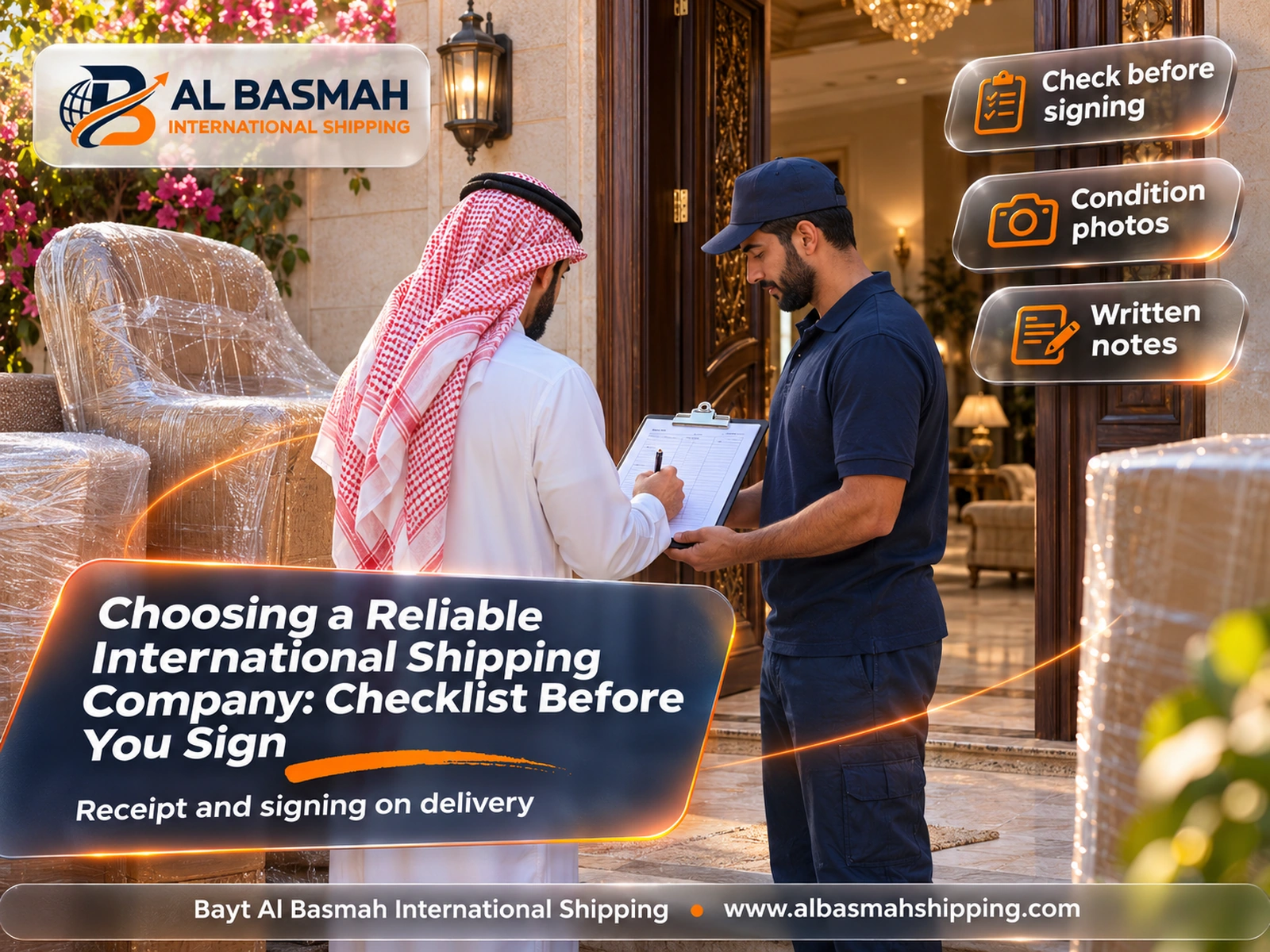
- Match the carton and item count against the loading receipt, line by line.
- Check the items listed as fragile first, then any carton that is dented or damp.
- Write any remark on the delivery sheet itself before signing, and photograph it.
- Report any remark to the company on WhatsApp the same day, with photos.
If you cannot receive the goods straight away because the new home is not ready, ask about short-term storage before you sign. In the UAE this can be arranged through furniture storage in the UAE before or after shipping.
Optional insurance: ask before loading
Cargo insurance is an option you request and value yourself, not something to assume is included. Ask the team about optional insurance: what it covers, whether it includes breakage or only loss, how you declare the value of your goods and what proof is needed if damage occurs.

A working rule: the higher the value, the longer the distance and the more times the goods are handled, the more this question matters. Electronics, antiques and paintings deserve their own list with declared values.
Where air freight fits in your checklist
Air freight suits the urgent, light part of a move: documents, clothes for the first weeks, small devices, trade samples. Before booking it, ask about chargeable weight (the higher of actual and volumetric), items airlines restrict such as certain batteries, flammable liquids and perfume in quantity, and whether pickup is at the airport or delivery is to your door.
Many families split the load: furniture by road to the Gulf or by sea to distant countries, and two or three cartons by air so the household essentials do not have to wait. See the full comparison in air vs sea vs land freight, and check the list of prohibited items before you pack.
Common mistakes before signing
- Comparing two prices that do not cover the same thing: a price to the port and a price to the door are not equal even when the numbers look close.
- Relying on talk: a verbal promise of wooden crating or delivery to the fifth floor disappears at the first disagreement.
- Late documents: a passport, residence visa or commercial invoice arriving late pushes back the whole loading date.
- Leaving items off the list: an undeclared piece may be refused at loading or change the volume.
- Signing on delivery without counting: once signed, a missing carton is hard to prove.
Warning: Do not put cash, jewellery or original official papers inside furniture cartons. Carry them with you; they normally fall outside what is shipped.
How Al Basmah International Shipping handles this checklist
At Al Basmah International Shipping we start with the inventory: a home survey or a video call, then a price sent on WhatsApp stating the mode, the destination and what the price includes. We dismantle, pack and load, record the piece count and condition notes on the collection receipt, and send you a WhatsApp update at each stage: loading, departure, arrival and delivery.
Two branches to visit
Dubai – Deira – Port Saeed Street, and Sharjah – Industrial Area 18.
Three modes
Road to the Gulf and neighbouring countries, sea in a full or shared container, air for urgent goods.
Orders around the clock
Send your inventory and photos on WhatsApp at any time.
Optional insurance
Ask the team before loading and they will explain what can be arranged for your goods.
We ship from every emirate to every country, and one of the most requested routes is shipping from the UAE to Saudi Arabia by road.
Frequently asked questions
What is the most important paper to get before signing with an international shipping company?
The written inventory together with the price in one message. It links the amount you pay to what you actually hand over, and every other paper builds on it.
Should I pay the full amount when booking?
It is better to pay in stages: a deposit on confirmation and the balance at an agreed point. Ask for the stages and amounts in writing before transferring.
Is a video call enough instead of a home visit?
Usually yes, if you walk through every room and open wardrobes and store rooms. What matters is that the estimated volume is written down as a number afterwards.
What should go in the condition notes?
Old scratches and breaks, items that do not work, and glass pieces. A short note with a photo is enough and prevents disputes.
Is insurance automatically included in the shipping price?
Do not assume so. Ask the team about optional insurance, what it covers and how it is calculated, and decide before loading.
How will I know where my shipment is after I pay?
The team sends you WhatsApp updates at each stage, and you can ask at any time on the same number.
What do I do if I find damage on delivery?
Write it on the delivery sheet before signing, photograph it and send the photos to the company the same day.
Prepare your list and send it now
Send the details on WhatsApp and you will receive the price, with what it covers and the payment stages in writing.
Tags: before signing with an international shipping company, shipping checklist, questions to ask a shipper, collection receipt, household inventory, video survey, shipping payment stages, optional cargo insurance, shipping from the UAE, shipping from Dubai, shipping from Sharjah, shipping to Saudi Arabia, air freight, sea freight, road freight, volumetric weight, Al Basmah International Shipping