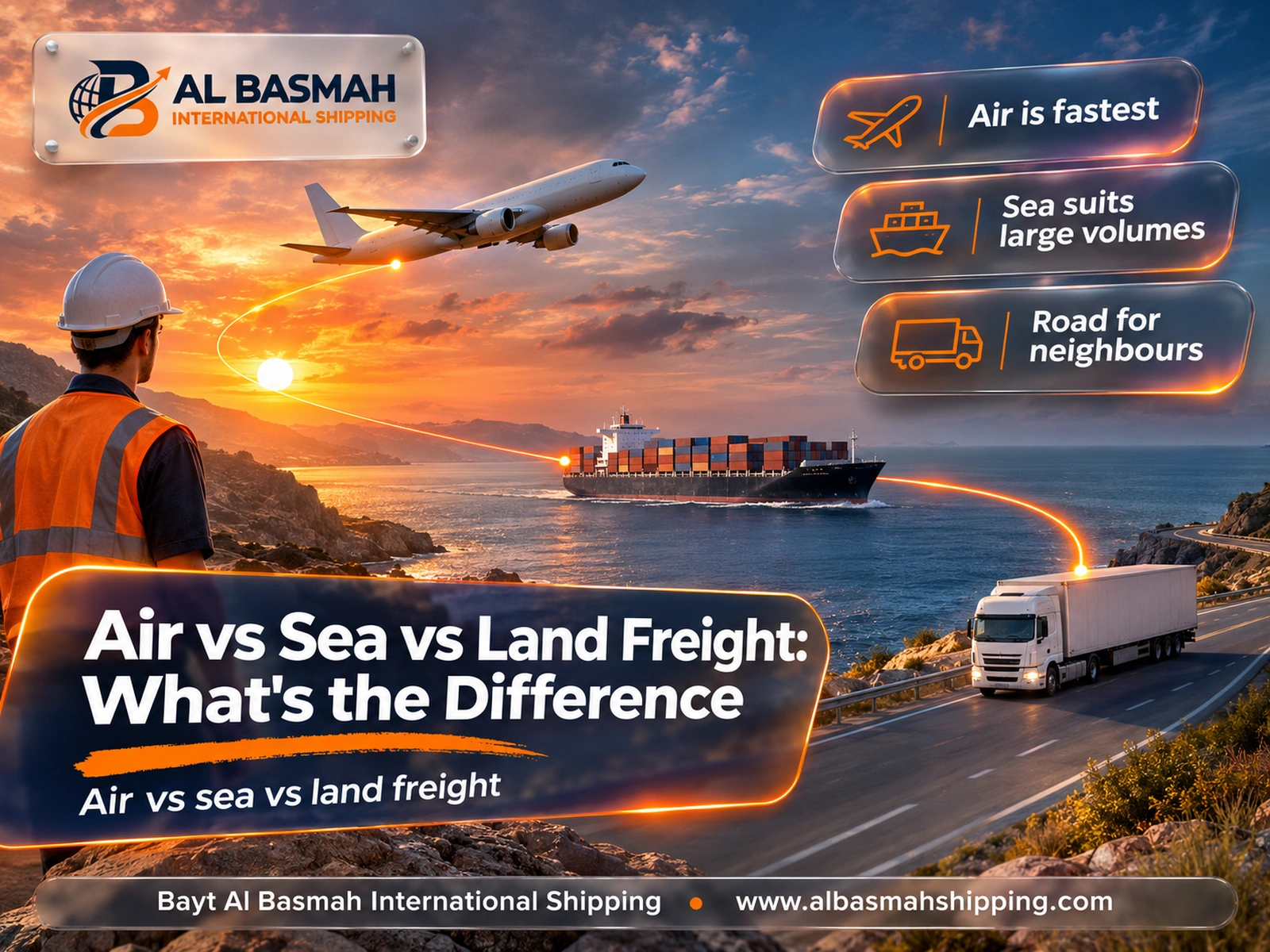
The difference in air vs sea vs land freight comes down to three things: time, cost and size. Air is the fastest and the most expensive per kilo, and it suits light, urgent shipments. Sea is the slowest and the cheapest for large volumes such as a whole household or commercial goods going far. Land sits between them and is the natural choice from the UAE to Saudi Arabia, the Gulf and countries linked to them by road: quicker than sea, cheaper than air, and delivered to the door by a single truck.
Stops in this guide11 sectionsShowHide
This guide puts the three modes in one table, then shows when each one wins, using shipments we send from Dubai and Sharjah: cartons to Riyadh by road, furniture to Egypt by sea, documents and urgent spare parts by air. At the end you will see the same shipment calculated three ways, and when combining modes is the answer.
Pick your shipping method
- Urgent and light (documents, spare parts, permitted medicines): air.
- Large or heavy to a distant country (household furniture, commercial goods): sea, full or shared container.
- To Saudi Arabia, the Gulf and road-linked countries: land by truck.
- Charging differs: air on the higher of actual and volumetric weight, shared sea per cubic metre or tonne, a full container at its own rate.
- When one mode is not enough: combine two.
The full comparison table
These are the core differences as they show up on real shipments from the UAE. Timings are approximate and vary with country, customs and departure schedule:
| Criterion | Air freight | Sea freight | Land freight |
|---|---|---|---|
| Speed | Fastest: usually a few days | Slowest: weeks depending on distance | Middle: days to neighbouring countries |
| Cost per kilo | Highest | Lowest for large volumes | Moderate |
| Suitable size | Small and light | Very large, up to full containers | From a few cartons to a full truck |
| Basis of charge | Higher of actual and volumetric weight (÷6000) | Shared: per m³ or per tonne, whichever is higher; full: container rate | By volume or weight; volumetric divisor depends on the carrier |
| Destinations | Any country with an airport | Any country with a port, then inland transport | Road-linked countries only |
| Example from the UAE | Official papers to London | Household furniture to Egypt | Cartons and furniture to Riyadh |
| Restrictions | Strict on batteries, liquids and aerosols | Fewer, with dangerous-goods rules | Moderate, varying by border crossing |
| Handling | Several transfers between terminal and aircraft | Little in a full container | Little: often one truck |
| Transport document | Air waybill | Bill of lading | Road consignment note and truck manifest |
Air freight: when does it win?
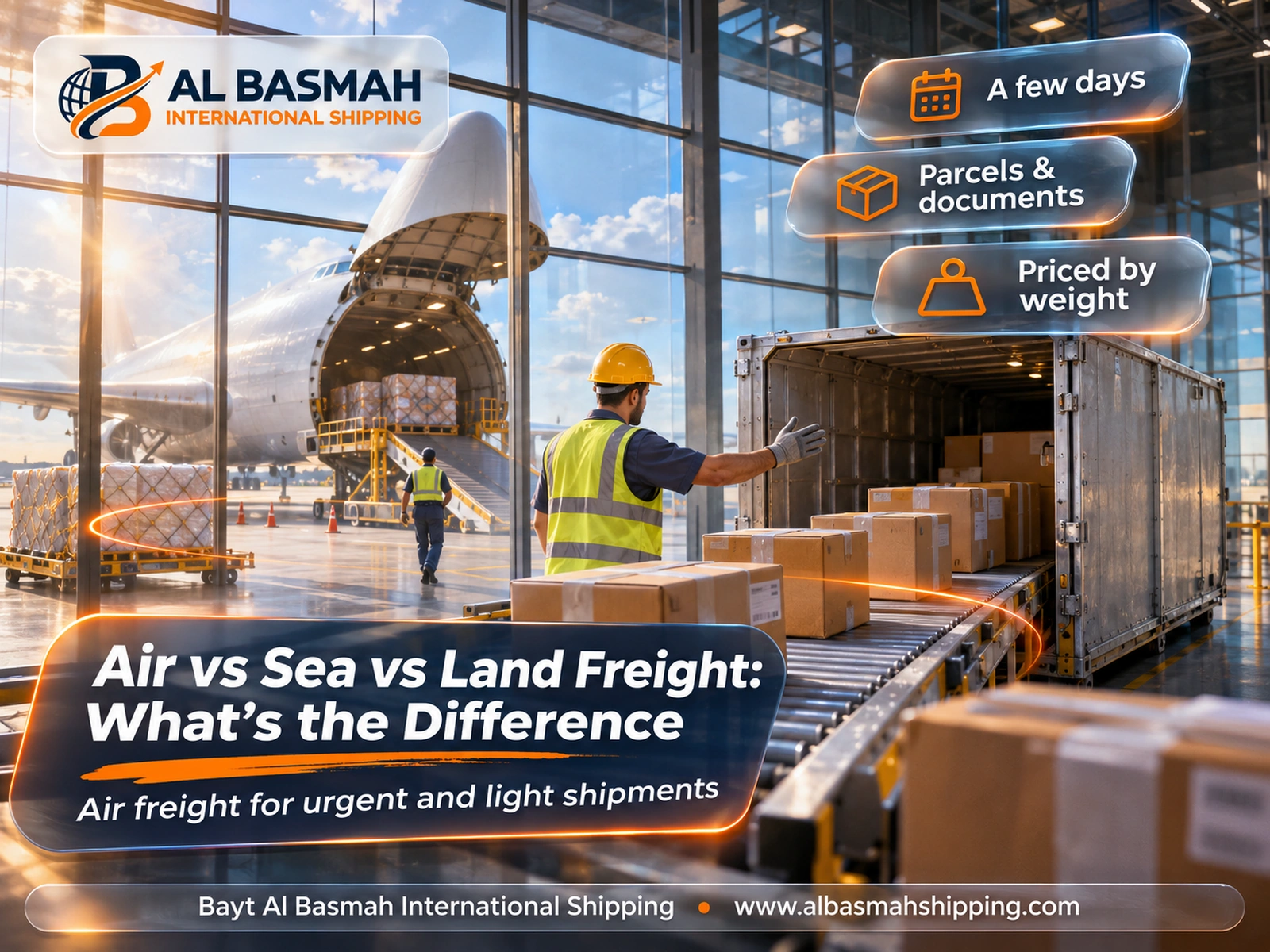
Air wins when time is worth more than the price gap. Official documents, a spare part that a factory or car is waiting on, trade samples, and light clothing and personal items for someone who cannot wait for a container. It also wins for distant countries that road cannot reach, when the load is too small to justify a container.
But air charges you for space, not just weight. Volumetric weight = length × width × height in cm ÷ 6000, and you pay on whichever is higher, that or the actual weight. So light, bulky things such as cushions and plastic toys get very expensive by air. We go through the calculation in our guide to volumetric weight in international shipping.
Warning: Loose lithium batteries, perfumes, aerosols and flammable liquids face strict airline restrictions, and some are banned outright. Tell the company what is in the shipment before packing so it is not turned back at the airport.
Sea freight: when does it win?
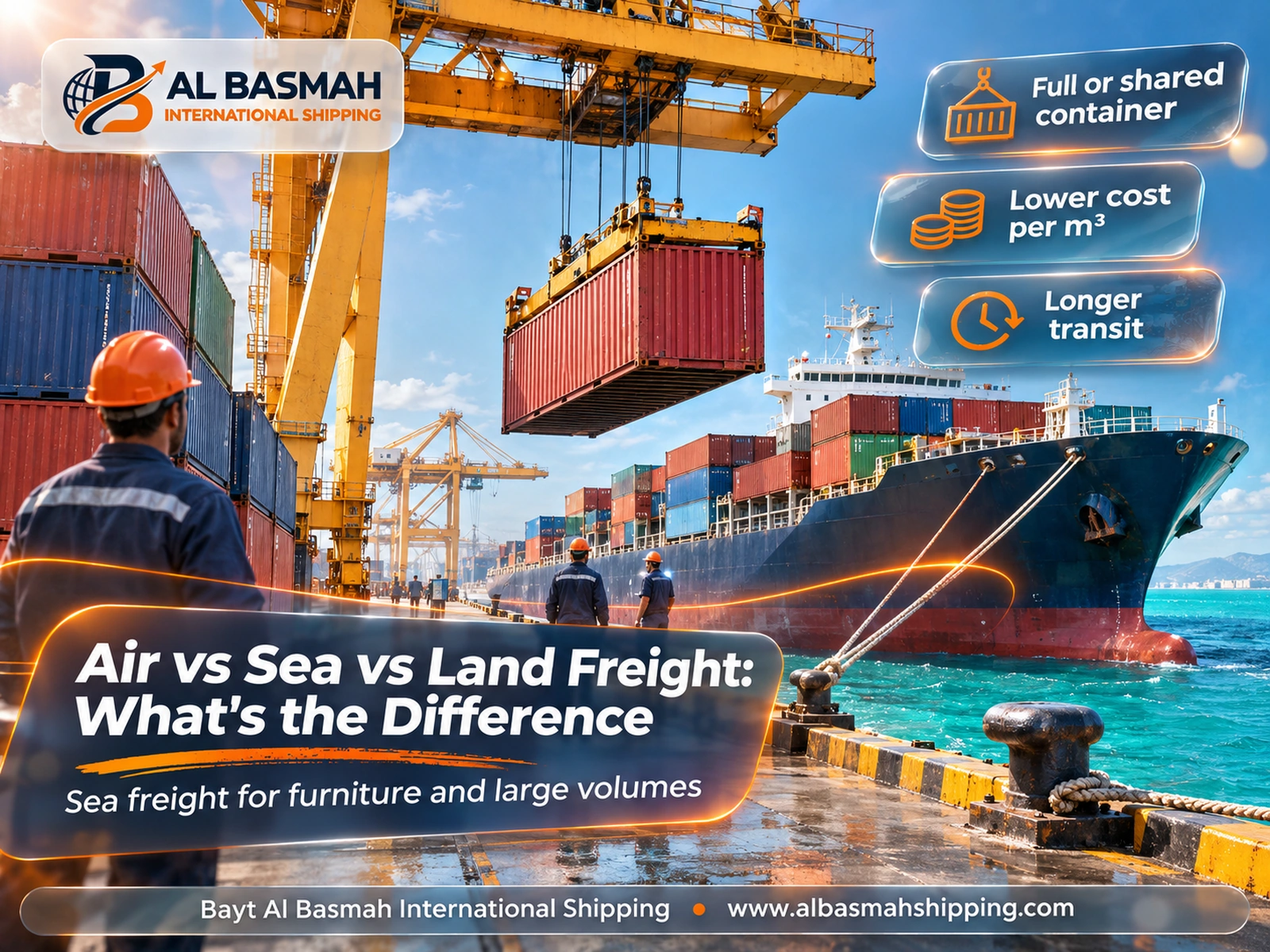
Sea wins as the volume grows and the destination gets farther. A full flat of furniture from Sharjah to Alexandria, or commercial goods to Europe: nothing else comes close on cost. It comes in two forms:
- Full container (FCL): the whole box is yours, sealed at the warehouse and opened only at customs or at your door. Approximate capacities: 20 ft about 33 m³, 40 ft about 67 m³, 40 ft high cube about 76 m³.
- Shared (LCL): you share the container with other cargo and pay per cubic metre or per tonne, whichever is higher. Cheaper for medium loads, but it takes time to consolidate and break down the container.
Sea has fewer restrictions than air, and large, heavy pieces are accepted. Its drawbacks are time and the need for inland transport from the port to the destination city. For more on the two forms, see LCL vs FCL container shipping.
Land freight: when does it win?
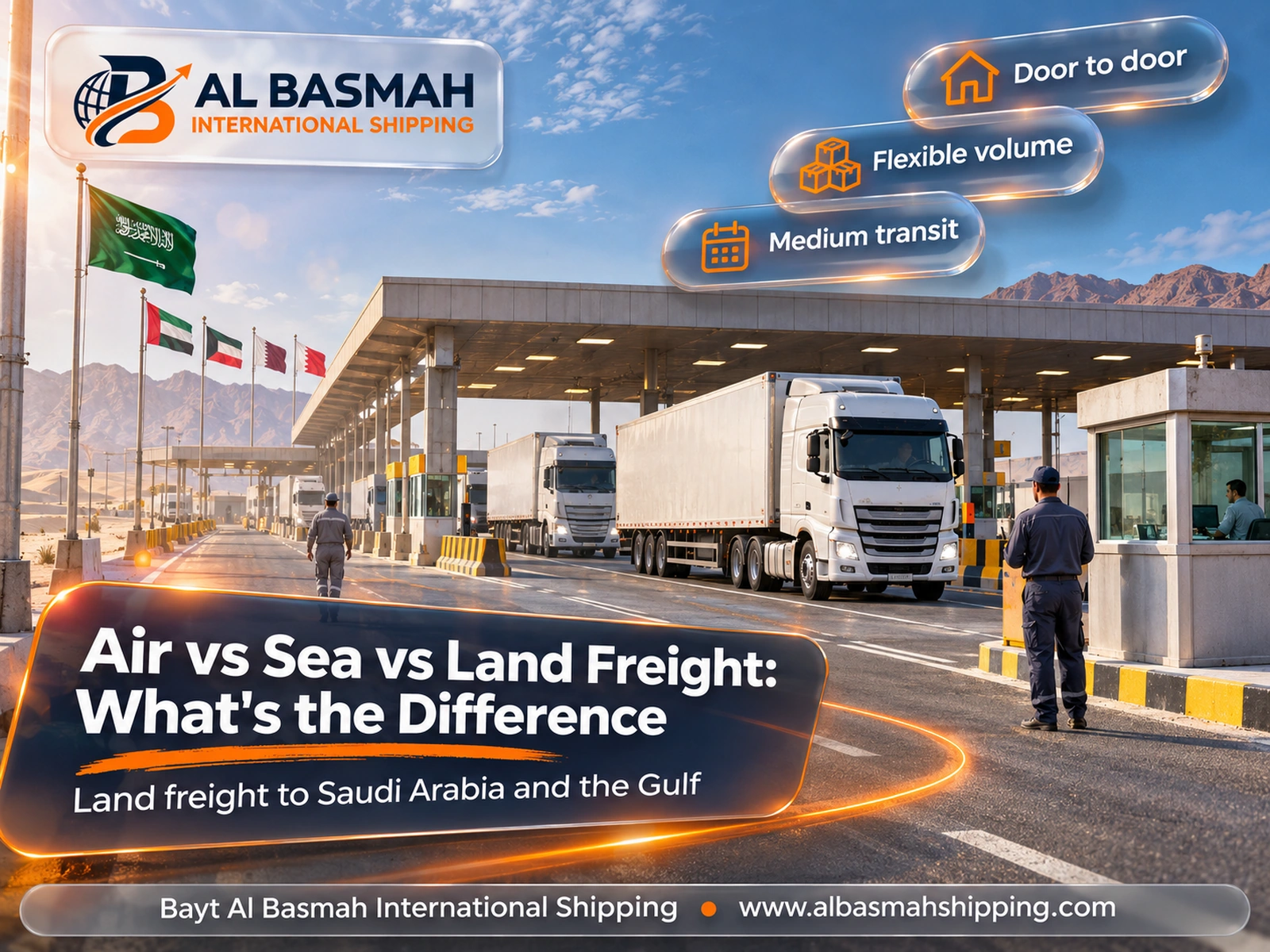
From the UAE, road wins wherever a truck can go: Saudi Arabia, Oman, Qatar, Kuwait, Bahrain, and Jordan through Saudi Arabia. The truck collects from your home or warehouse, crosses the border and delivers in the destination city, with no port, ship and inland leg in between. That makes it usually both the fastest and the cheapest option for these countries, whether the load is a few cartons on a shared truck or a whole household on a dedicated one.
Loads for Saudi Arabia, for instance, leave through the Ghuwaifat crossing, and transit time depends more on the border and clearance slot than on the distance. For this route in detail, see shipping from the UAE to Saudi Arabia.
Worked example: one shipment, three modes
Twelve cartons, each 60×50×50 cm and 15 kg. How is it charged?
| Calculation | Result |
|---|---|
| Total actual weight | 12 × 15 = 180 kg |
| Total volume | 12 × (0.6 × 0.5 × 0.5) = 1.8 m³ |
| Air: volumetric weight per carton | 150,000 ÷ 6000 = 25 kg, 300 kg in total |
| Air: chargeable weight | 300 kg, because it is higher than 180 |
| Road (if the carrier divides by 5000) | 150,000 ÷ 5000 = 30 kg per carton, i.e. 360 kg, or charged per m³ depending on the carrier |
| Shared sea | 1.8 m³ against 0.18 tonnes, so charged on 1.8 units |
The upshot: by air these cartons are billed as 300 kg although they weigh 180, which is why air suits small, relatively heavy items rather than bulky boxes. To Riyadh, road is the sensible choice; to Cairo, shared sea is far cheaper if you are not in a hurry. Send the details on WhatsApp and we will reply with the price for each mode available to your destination.
How to choose for your situation
| Your situation | Best mode | Why |
|---|---|---|
| Papers, a passport or official documents | Air | Little weight and time matters |
| Cartons and personal effects to Saudi Arabia | Road | Door to door on one truck |
| A whole household to Egypt | Sea, full container | Large volume, lowest cost per m³ |
| A single bedroom set or a handful of items going far | Shared sea | No need for a whole container |
| Regular commercial goods to Oman | Road | Frequent departures, short transit |
| Temperature-sensitive medicines or food | Air or refrigerated road | Depends on distance and product |
| A large load with an urgent part | Sea + air | Splitting saves money and covers the urgency |
If your goods need cooling, there is a separate option built for that: see international refrigerated transport from the UAE.
Combining modes
Plenty of shipments do not travel by a single mode from start to finish, and that is normal:
- Sea then road: the container reaches the port, then continues by truck to an inland city far from the coast.
- Road then sea: some loads for Egypt go by truck through Saudi Arabia, then cross the Red Sea by ferry.
- Split shipment: furniture in a sea container; clothes, papers and first-week essentials by air.
- Air then road delivery: the parcel lands at the airport and is delivered to the door.
What decides the price in each mode
| Factor | Air | Sea | Land |
|---|---|---|---|
| Weight and volume | Chargeable weight (the higher) | Per m³ or tonne, or container rate | Volume or weight, by carrier |
| Destination | Airport and its charges | Port and inland transport | Distance and border crossing |
| Type of goods | Restrictions on sensitive items | Dangerous-goods requirements | Each crossing’s requirements |
| Door delivery | Extra service from the airport | Port-to-city haulage | Often part of the trip |
| Speed required | Direct flights cost more | Faster lines or transhipment | Dedicated or shared truck |
Transhipment, or stops at intermediate ports, lengthens transit and changes the price; we explain it in our guide to direct vs indirect shipping.
Common mistakes when choosing a mode
- Sending large, light cartons by air and being surprised by the volumetric weight.
- Choosing sea for a small load to Saudi Arabia when road is faster and cheaper.
- Forgetting the cost of inland transport from the port or airport to the city.
- Putting airline-restricted items in an air shipment.
- Leaving it to the last minute and being forced into air because time ran out.
Tip: If you have two weeks or more before you need your things, road or sea will probably save you a lot. Plan early; urgency is the most expensive thing in shipping.
Measure before you ask
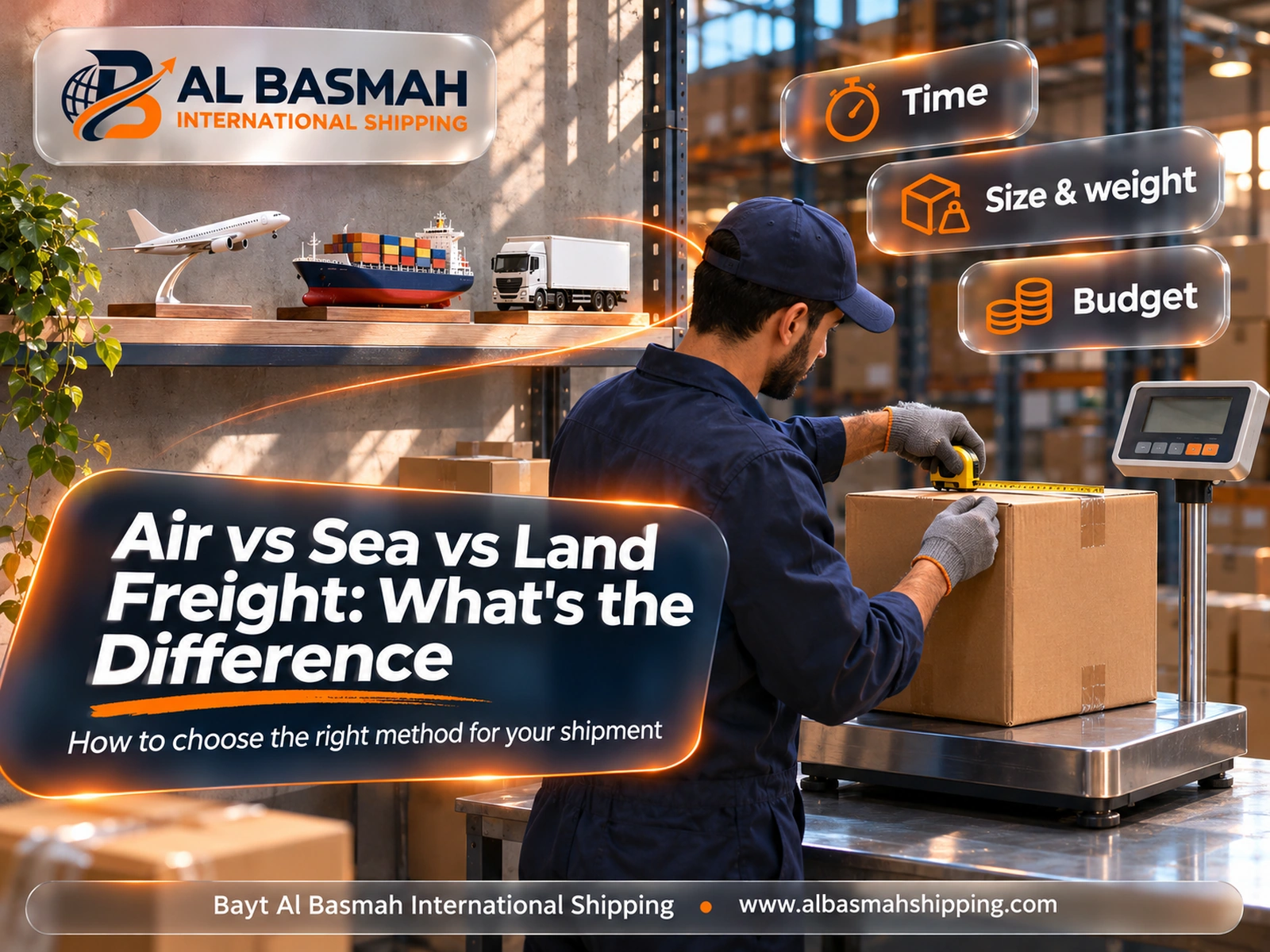
Dimensions and weight per carton get you an accurate price first time.
Split if needed
The urgent part by air, the rest by sea or road.
Ask about the door
Is the price to your door, or only to the port or airport?
How Al Basmah International Shipping helps
- We ship from every emirate to every country by road, sea and air, so we suggest what fits your load rather than the only mode on offer.
- We price your shipment by each mode possible for your destination so you can compare for yourself.
- We take requests on WhatsApp around the clock and prepare shipments at our two branches: Dubai – Deira – Port Saeed Street, and Sharjah – Industrial Area 18.
- You get WhatsApp updates at each stage: collection, departure from the crossing, port or airport, and arrival.
- Ask our team about optional insurance.
To learn what holds shipments up in any mode and how to avoid it, read how to avoid international shipment delays.
Frequently asked questions
Which is cheaper, sea or land freight?
For long distances and large volumes, sea is usually cheaper. To Saudi Arabia and the Gulf, road is normally cheaper and faster because it reaches the door without port fees and inland haulage.
Is air freight suitable for furniture?
Only for a small valuable or urgent piece. Furniture is bulky and air charges on volumetric weight, so the cost climbs far above sea or road.
How long does road freight from the UAE to Saudi Arabia take?
Usually a few days, and the time depends more on the border clearance slot and the final city than on the distance itself. We tell you the expected time for your city when you order.
What is the difference between a full container and shared freight?
A full container is yours alone and priced per container; shared freight splits the space and you pay per cubic metre or tonne, whichever is higher. Shared suits small loads; a full container suits a whole household.
Why is my air shipment charged on more than it weighs?
Aircraft space is limited, so volumetric weight (length × width × height ÷ 6000) is calculated and you pay on whichever is higher, that or the actual weight.
Can I combine sea and air?
Yes, and it is a common solution: furniture and large items in a sea container, and what you need straight away in a small air shipment that arrives first.
What is the best way to ship commercial goods to Egypt?
For large quantities, sea is the most economical, and some loads travel by road through Saudi Arabia and then by ferry. Samples and small urgent orders go by air.
Not sure which mode fits your shipment?
Send the details on WhatsApp and we will reply with the price by the best mode for your destination, with a comparison if you like.
Tags: air vs sea vs land freight, air freight, sea freight, land freight, shipping modes comparison, is sea freight cheaper than air, road freight to Saudi Arabia, sea freight to Egypt, urgent air freight, volumetric weight, FCL and LCL, multimodal shipping, shipping from Dubai, shipping from Sharjah, international shipping from UAE, Al Basmah International Shipping