
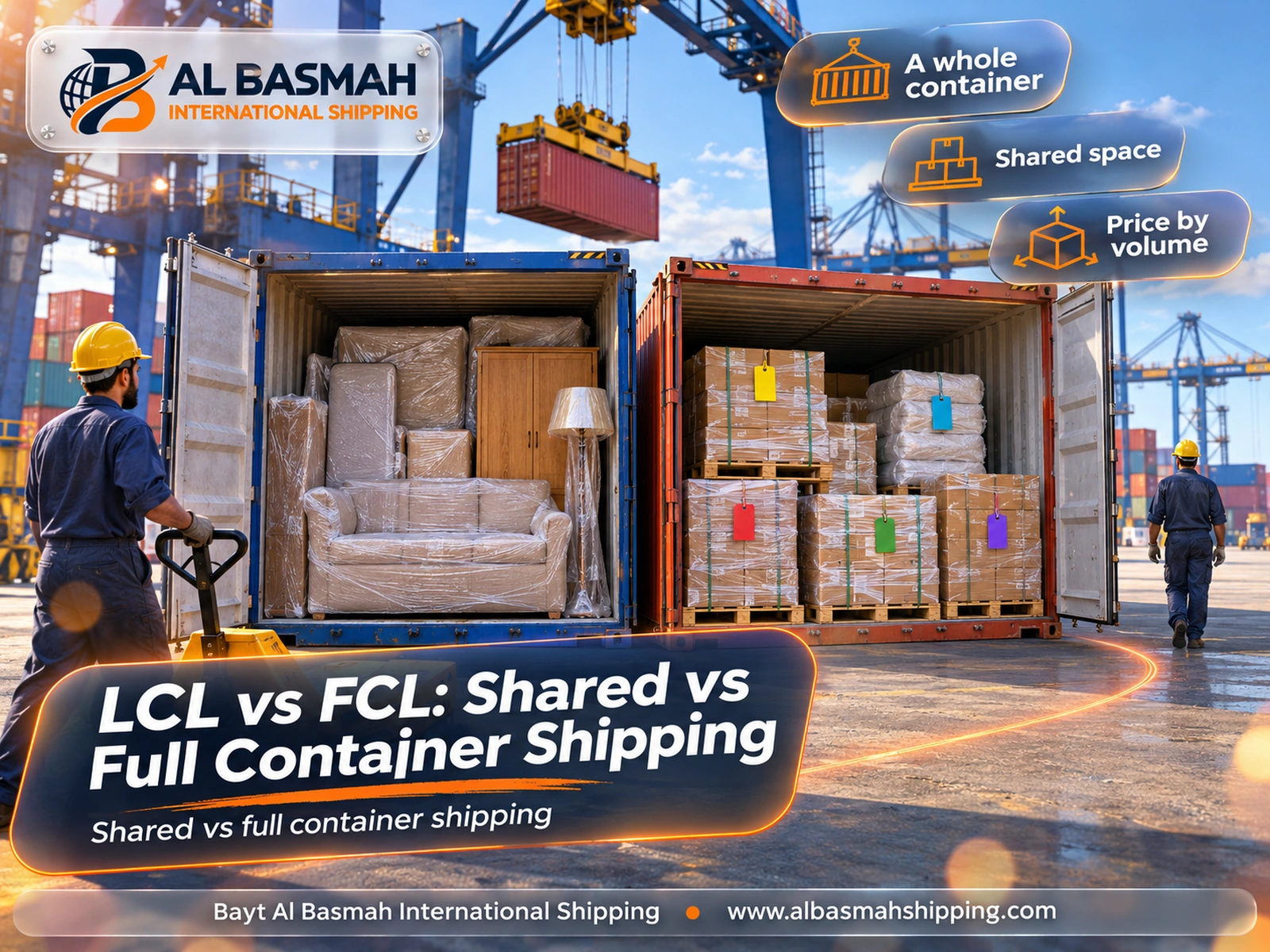
The difference between LCL and FCL is who the container belongs to. With LCL (less than container load) you pay for the space your goods take up inside a container shared by several customers. With FCL (full container load) the whole box is booked for you and you pay for it however much you put inside. As a working rule, shipments up to about 12 to 15 cubic metres are usually cheaper as LCL; above that, a full container becomes cheaper per cubic metre, faster and handled less. The exact break-even point varies by route, and this guide shows you how to work it out with a cubic-metre example.
Stops in this guide15 sectionsShowHide
Your own container or shared space
- LCL: charged per m³ or per tonne, whichever is higher, and you wait for the container to fill.
- FCL: a sealed container just for you, one price for the box, less handling.
- A 20 ft holds about 33 m³, a 40 ft about 67 m³ and a 40 ft high cube about 76 m³ (approximate internal volume).
- Break-even is often 12–15 m³; find it by dividing the container price by the LCL rate per m³.
- For the Gulf the same logic applies by road: a full truck or space on a shared truck.
What is LCL shipping?
LCL, also called groupage or consolidated shipping, means your goods are delivered to a consolidation warehouse and stowed with other customers’ cargo bound for the same country in one container. At the destination the container is unpacked at another warehouse and each consignment is sorted out for its owner.
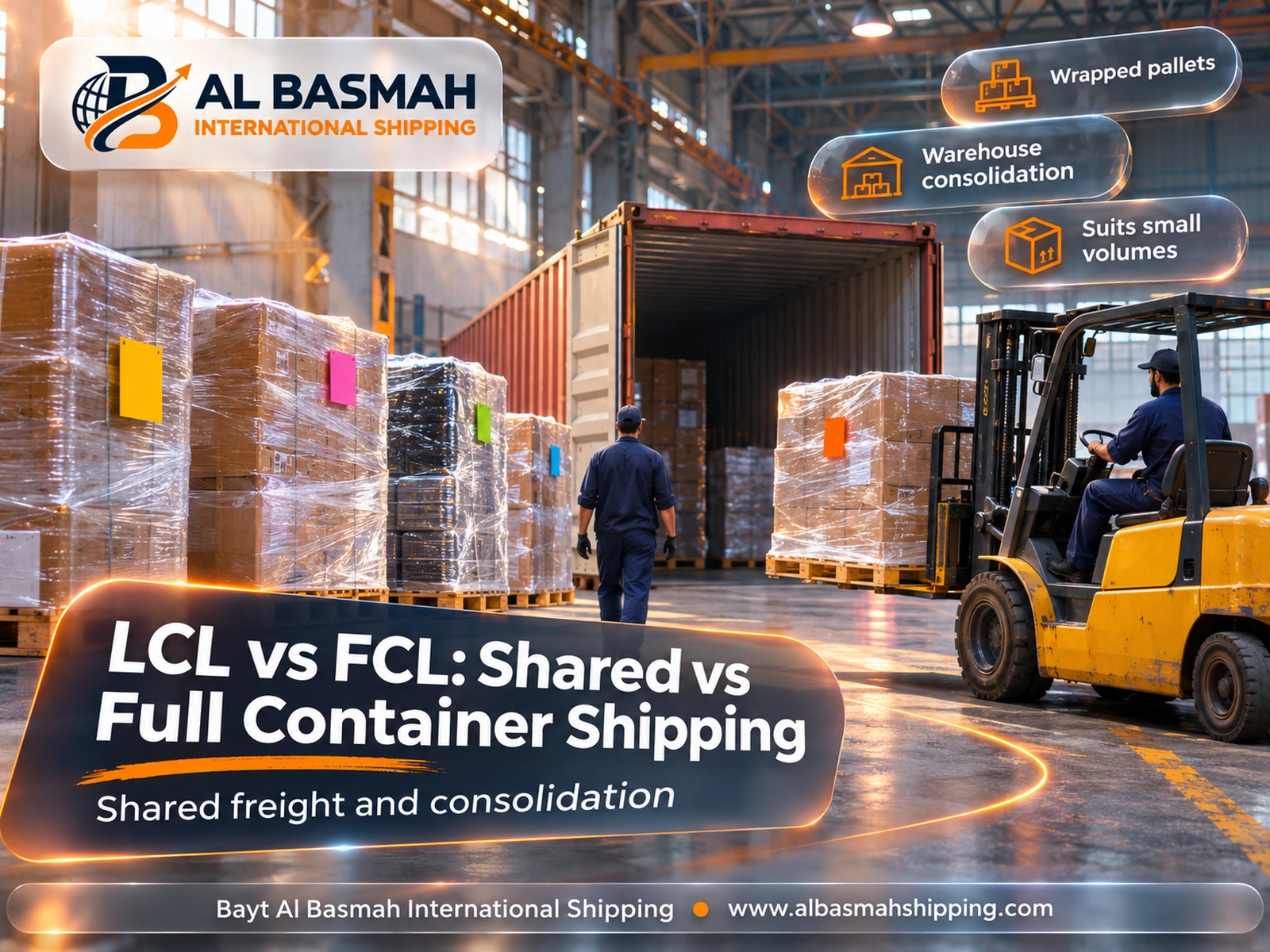
LCL is priced on a weight-or-measure basis (W/M): one cubic metre is treated as one tonne, and you pay on whichever is greater. A 6 m³ shipment weighing 2,500 kg is charged as 6. Three cubic metres of steel spare parts weighing 4,200 kg is charged as 4.2. Most routes also set a minimum of around one cubic metre, so the bill does not go below that even for two cartons.
What is FCL shipping?
With FCL the container is booked in your name from start to finish. It arrives empty at your home or warehouse, or is stuffed at the shipper’s warehouse, loaded only with your goods, then closed with a seal whose number is written on the shipping documents. Nobody opens it until customs at the destination or until it reaches your door.
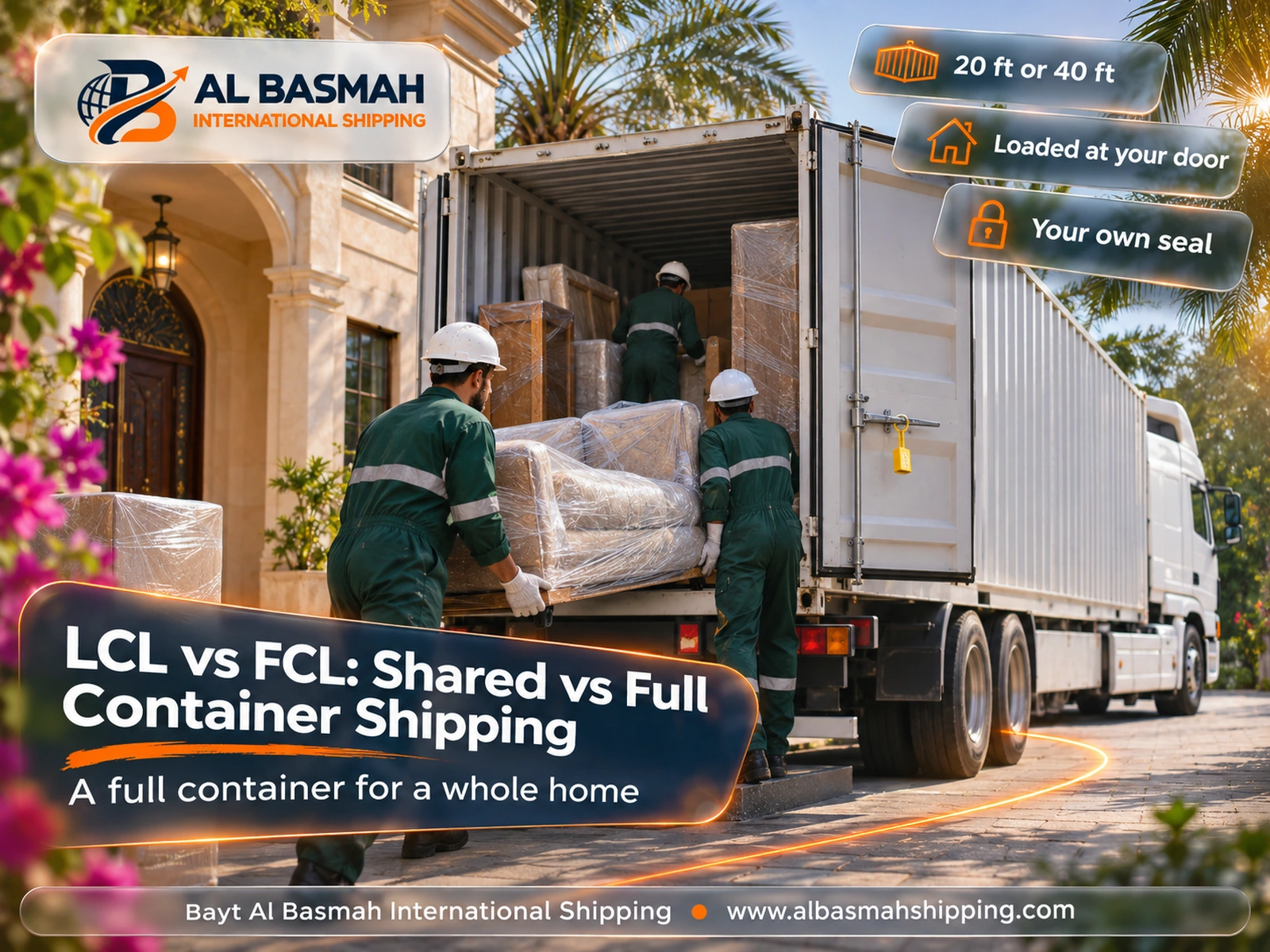
You pay for the container, not the cubic metre. Fill only half and you still pay for all of it, which is why FCL only makes sense when your volume is close to the container’s capacity, or when your goods are worth keeping away from anyone else’s.
Container sizes and real capacity
The quoted capacity of a container is its internal volume, but what you actually load is less, because furniture and cartons never fill every corner. Plan on the practical figure, not the theoretical one.
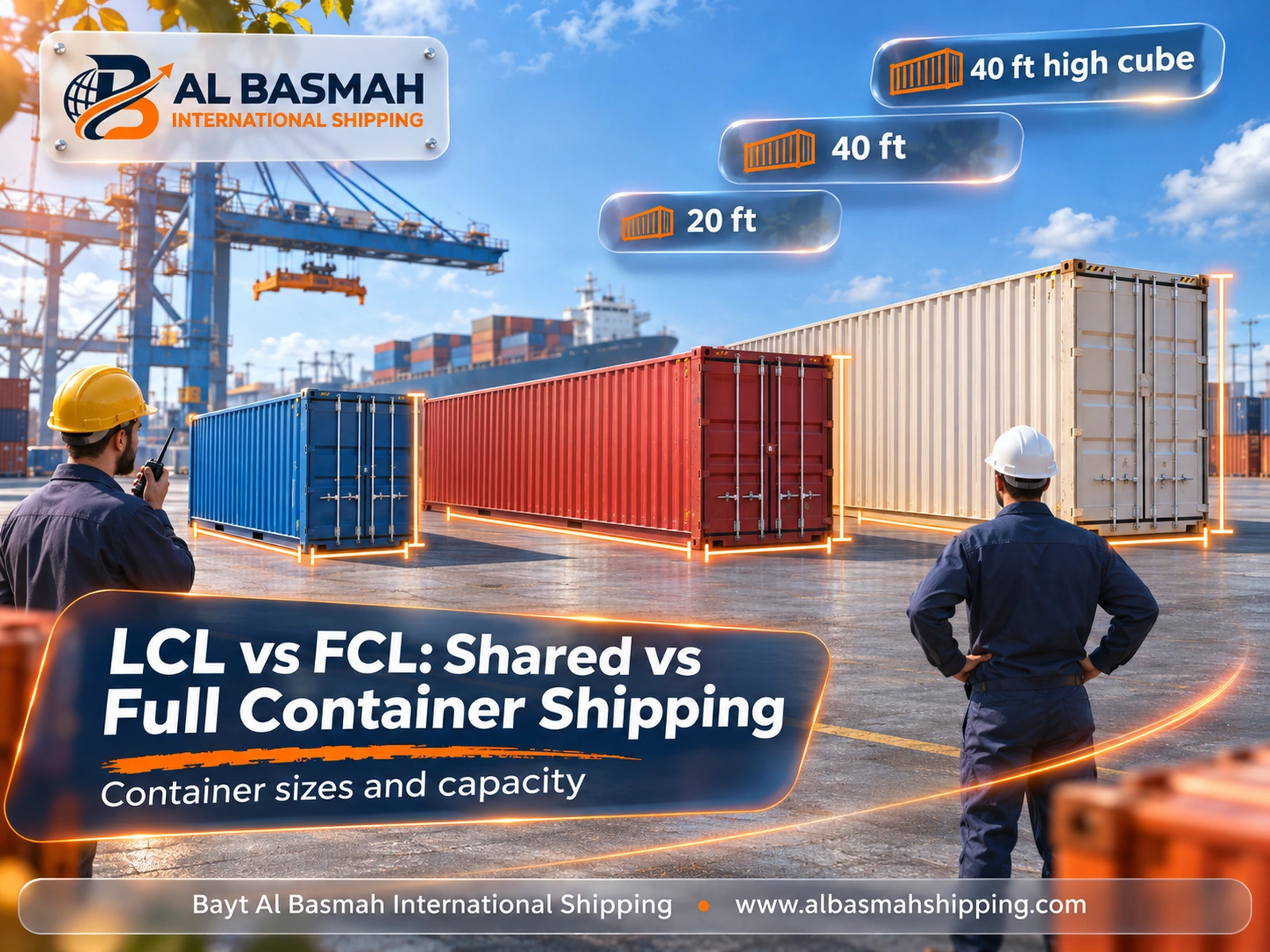
| Container | Approx. internal size (m) | Approx. internal volume | Practical load | Typically suits |
|---|---|---|---|---|
| 20 ft standard | 5.9 × 2.35 × 2.39 | about 33 m³ | 25–28 m³ | A two-bedroom flat, or heavy goods such as tiles and marble |
| 40 ft standard | 12.0 × 2.35 × 2.39 | about 67 m³ | 55–60 m³ | A mid-size villa or a three-to-four-bedroom home |
| 40 ft high cube | 12.0 × 2.35 × 2.69 | about 76 m³ | 65–68 m³ | A large villa, or light bulky goods |
A point many people miss: containers have a weight limit too. Heavy cargo such as tiles, marble, steel and machinery reaches the weight limit of a 20 ft before the space is full, which is why such goods usually travel in 20 ft boxes; a 40 ft would leave half its space unused. Ask about the permitted weight on your route before loading, because road rules in some countries set a lower limit than the container itself.
Doing the maths: when does FCL beat LCL?
The short answer: divide the full-container price by the LCL rate per cubic metre on the same route. The result is the volume at which the two options cost the same. If your shipment is bigger, the container wins.
Worked example in cubic metres
Suppose a 20 ft container on a given route costs the same as 13 cubic metres of LCL, once the consolidation and unpacking charges an LCL customer pays are added. Now take three shipments from Dubai:
| Shipment | Volume | LCL cost (in m³ units) | 20 ft cost | Better option |
|---|---|---|---|---|
| Student moving one room | 4 m³ | 4 units | 13 units | LCL by a wide margin |
| Small family | 13 m³ | 13 units | 13 units | Equal; FCL is faster and safer |
| Two-bedroom flat | 22 m³ | 22 units | 13 units | FCL, with about 4 m³ to spare |
Look at the middle case: when the price is level, FCL wins on time and security. Note too that destination unpacking charges on LCL are usually per cubic metre, which pulls the break-even point lower than most customers expect. So never compare the ocean rate alone; compare the total cost to the front door.
Air freight works on entirely different maths: one cubic metre counts as about 167 kg of volumetric weight (1,000,000 ÷ 6000), so air becomes very expensive as volume grows. The calculation is explained in the volumetric weight guide.
LCL vs FCL comparison table
| Criterion | LCL (shared) | FCL (full) |
|---|---|---|
| Pricing | Per m³ or per tonne, whichever is higher (W/M) | A fixed price per container |
| Best volume | From 1 m³ up to about 12–15 m³ | From about 13 m³ upwards |
| Transit time | Longer: waiting for the box to fill, then sorting on arrival | Shorter: loaded, sealed and sailed on the next departure |
| Handling | Several times: consolidation warehouse, container, sorting warehouse | Once at loading, once at unloading |
| Security | Your goods sit beside other people’s | A sealed container for you alone |
| Customs | The whole box can wait if another consignment is inspected | Only your own procedures |
| Flexibility | Fixed closing dates for the shared container | You choose the loading day |
Timing: why does LCL take longer?
LCL has extra stages that FCL skips. Your goods must reach the consolidation warehouse some days before the container’s cut-off, and if you miss it you wait for the next one. After arrival the box goes to a sorting warehouse to be unpacked, then each consignment is cleared separately. Depending on the route and how often it sails, that usually adds several days to a week or more.
- Before sailing: waiting for the container to fill or reach its closing date.
- At sea: little difference, since both boxes are often on the same vessel.
- After arrival: unpacking, sorting and separate clearance for each customer.
A route may also call at an intermediate port before the destination, which adds days to both types. The difference between direct and transshipment routes is covered in direct vs indirect shipping.
Warning: If customs at the destination find a problem with another customer’s goods in a shared container, the whole box may be held until that inspection is finished. Clean papers on your side cannot prevent this wait, but having them ready early makes sure your shipment is never the cause.
Security and packing in each option
In LCL your goods move more and sit beside cargo you know nothing about, so the packing must be stronger: double-wall cartons, wooden pallets bound with stretch film, and a label with your name and piece count on every side. Glass and marble going LCL need closed wooden crates, not just bubble wrap.
In FCL the crew stows the load their own way: heavy items at the bottom and against the front wall, straps on every row, and gaps filled so nothing shifts at sea. Packing details are in how to ship furniture internationally without damage.
Tip: if your shipment sits in the break-even zone and includes valuable or antique pieces, choose FCL. You pay roughly the same and gain a seal that stays closed until arrival.
Household moves: how many cubic metres do you need?
The figures below are estimates for home moves and vary a lot with the number of large pieces and what is in the kitchen and store room. They help you anticipate before the survey; they do not replace it.
| Home size | Approx. volume | Usually the closer fit |
|---|---|---|
| Room or studio | 5–10 m³ | LCL |
| One-bedroom flat | 10–18 m³ | LCL or 20 ft, depending on the maths |
| Two-bedroom flat | 20–28 m³ | 20 ft container |
| Three-bedroom flat or small villa | 35–50 m³ | 40 ft container |
| Large villa | 55 m³ and above | 40 ft high cube or two containers |
A family moving from Abu Dhabi to Egypt by sea will usually choose a full container, while a family moving to Riyadh normally goes by road. If you need a gap between handing over in the UAE and arrival, furniture storage in Dubai can hold your goods until the sailing date.
Commercial cases: traders, shops and factories
- A trader sending two or three pallets: LCL, charged per m³ or tonne.
- A shop restocking about 18 m³ a month: a 20 ft container is cheaper and faster.
- A supplier of heavy building materials: a 20 ft, because weight runs out before space.
- Light bulky goods such as foam or plastic chairs: a 40 ft high cube.
- Dangerous goods or cargo needing a special permit: some routes do not accept them in LCL at all, so they need their own container.
Road freight to the Gulf: the same logic with trucks
To Saudi Arabia, Oman, Kuwait, Qatar and Bahrain, goods mostly travel by road, and the question shifts from container to truck: a full truck for you alone, or space on a truck carrying several customers. A full truck leaves the day it is loaded and goes straight to your address; a shared truck waits to fill and drops at several addresses. See the details of shipping from the UAE to Saudi Arabia.
What decides your price in LCL and FCL
| Factor | In LCL | In FCL |
|---|---|---|
| Volume and weight | Charged per m³ or tonne, whichever is higher, with a minimum | No effect while you stay within the box’s capacity and weight limit |
| Route and port | How often consolidated boxes sail to the destination | The container rate on the route and the season |
| Warehouse charges | Consolidation, unpacking and sorting, often per m³ | Port handling charges |
| Packing | Stronger and more of it, because handling is heavier | Bracing and straps inside the container |
| Delivery and clearance | Separate clearance per consignment | One clearance for the container |
To know which option is cheaper for your shipment: send the details on WhatsApp and you will receive the price, with an LCL-versus-FCL comparison if you fall in the break-even zone.
When is air freight the answer?
If the shipment is under a cubic metre and urgent, such as trade samples, spare parts for a stopped production line, or the family’s clothes for the first weeks, air may suit better than waiting for a shared container. Air is charged on the higher of actual and volumetric weight and arrives in days rather than weeks. Above that size, sea freight in either form stays the economical choice.
The three modes are compared by time and cost in air vs sea vs land freight.
Common mistakes when choosing
- Estimating volume by eye: five cubic metres either way can move you from LCL to FCL or back.
- Comparing the ocean rate only: LCL sorting-warehouse charges can change the answer.
- Booking a 40 ft for heavy cargo: the weight limit is reached with half the box empty.
- Missing the shared container’s cut-off: an extra week for no reason.
- Light packing for LCL: repeated handling is hard on thin cartons.
How Al Basmah International Shipping helps you choose
At Al Basmah International Shipping we start by measuring your volume after a survey or video call, then tell you in numbers whether you are below the break-even point and LCL is cheaper, or above it and a full container fits better, and which container size suits your volume and weight. We consolidate LCL shipments and pack them on pallets, load full containers at your home or warehouse with proper bracing, and send you WhatsApp updates at loading, sailing, arrival and delivery.
Volume measured
A survey or video call, then a clear figure in cubic metres.
LCL and FCL
20 ft, 40 ft and 40 ft high cube, plus shared space for small loads.
Road to the Gulf
A full truck or shared space to Saudi Arabia and neighbouring countries.
Dubai and Sharjah branches
Deira – Port Saeed Street, and Industrial Area 18.
Frequently asked questions
What is the difference between LCL and FCL in one sentence?
With LCL you pay for the space you use in a shared container; with FCL you pay for a whole container that is yours alone.
At how many cubic metres does FCL become cheaper?
Often 12 to 15 m³ for a 20 ft container, but the real figure is the container price divided by the LCL rate per m³ on your route.
How much furniture fits in a 20 ft container?
Its internal volume is about 33 m³ and the practical load is 25–28 m³, usually enough for a two-bedroom flat.
Is LCL safe for furniture?
Yes, with strong packing on strapped pallets, but it is handled more than FCL, so valuable pieces deserve wooden crates.
Why does LCL take longer than FCL?
It waits for the container to fill or reach its cut-off, then goes through a sorting warehouse and separate clearance for each consignment on arrival.
What does W/M mean in an LCL price?
The shipment is charged on volume in cubic metres or weight in tonnes, whichever is greater; one cubic metre equals one thousand kilos.
Is there shared road freight to Saudi Arabia?
Yes, as space on a shared truck, or a full truck if your volume is large or your date is tight.
Full container or shared space? We’ll work it out
Send the details on WhatsApp and you will receive the price for the option that fits your volume.
Tags: LCL vs FCL shipping, LCL shipping, FCL shipping, 20 ft container, 40 ft container, 40 ft high cube, container capacity in cubic metres, shipping break-even point, sea freight from the UAE, shipping furniture by container, cargo consolidation, shared container, road freight to the Gulf, air freight, W/M pricing, Al Basmah International Shipping