

Volumetric weight in international shipping is a weight the carrier calculates from the size of your package rather than from the scale. You multiply length by width by height in centimetres and divide by a fixed number called the divisor, which is usually 6000 for air freight. The carrier then compares that figure with the actual weight and charges you on whichever is higher. That higher figure is the chargeable weight, and it explains why a light carton of pillows can cost more to fly than a smaller, much heavier box of spare parts.
Stops in this guide12 sectionsShowHide
Work it out yourself
- Measure the outside of the packed carton: length × width × height in cm.
- Divide by 6000 for air freight, or by 5000 with many express and road carriers (it depends on the carrier).
- Compare the result with the scale weight. The larger number is what you pay for.
- In shared sea freight, cubic metres are compared with tonnes and the higher one is billed.
- Send your sizes and weights on WhatsApp +971557643821 and we reply with the chargeable weight and the price before you book.
What volumetric weight is and why carriers use it
Aircraft, trucks and containers all have two limits: a maximum load and a fixed amount of space. If carriers charged on weight alone, holds would fill up with big, light parcels that pay very little while taking up most of the room. Volumetric weight turns the space your package occupies into kilograms so it can be compared fairly with its real weight.
Airlines call it dimensional weight, and invoices often shorten it to DIM or Vol. Weight. A typical bill shows three figures: gross weight, volumetric weight and chargeable weight. Only the last one is multiplied by the rate per kilo.
Actual weight
What the scale shows for the whole package, including carton, padding and any pallet.
Volumetric weight
The space the package takes up, converted to kilograms with the divisor.
Chargeable weight
The higher of the two. It is the basis of the bill for air, road and express.
Sea freight unit
In shared (LCL) shipping, one cubic metre counts as one tonne and the higher figure is billed.
How to calculate volumetric weight step by step
All you need is a tape measure and a calculator. What matters is measuring the package as it will actually travel, not as it was before you packed it.
- Take the longest side as the length, then the width and the height, all measured outside and in centimetres.
- Round each dimension to the nearest whole centimetre; many carriers round up.
- Multiply the three dimensions to get the volume in cubic centimetres.
- Divide by the divisor for the transport mode you have chosen.
- Repeat for each carton, add the results together and compare the total with the total scale weight.
- The larger figure is the chargeable weight, and some carriers round it up to the next half kilo.
If your dimensions are in inches, convert each one first by multiplying by 2.54. Mixing inches and centimetres is one of the most common errors we see in shipments bought from American online stores.
Divisors by transport mode
The divisor is where the difference lies. The smaller it is, the heavier the same package becomes on paper. The table below lists the usual figures, but every carrier sets its own divisor in its terms.
| Mode | Common divisor | One cubic metre equals | Note |
|---|---|---|---|
| Air cargo | 6000 | about 167 kg | The most widely used standard in international air freight |
| Express courier | Often 5000 | 200 kg | Varies by carrier; some use 6000 |
| Road freight | 5000 or a carrier-set ratio | 200 kg or more | Some road carriers use a 1:3 ratio, about 333 kg per m³ |
| Shared sea freight (LCL) | 1000 (1 m³ = 1 tonne) | 1000 kg | Billed on the higher of volume or weight (W/M) |
| Full container (FCL) | Not applicable | — | You pay for the container within its weight limit |
Volumetric weight in air freight: worked examples
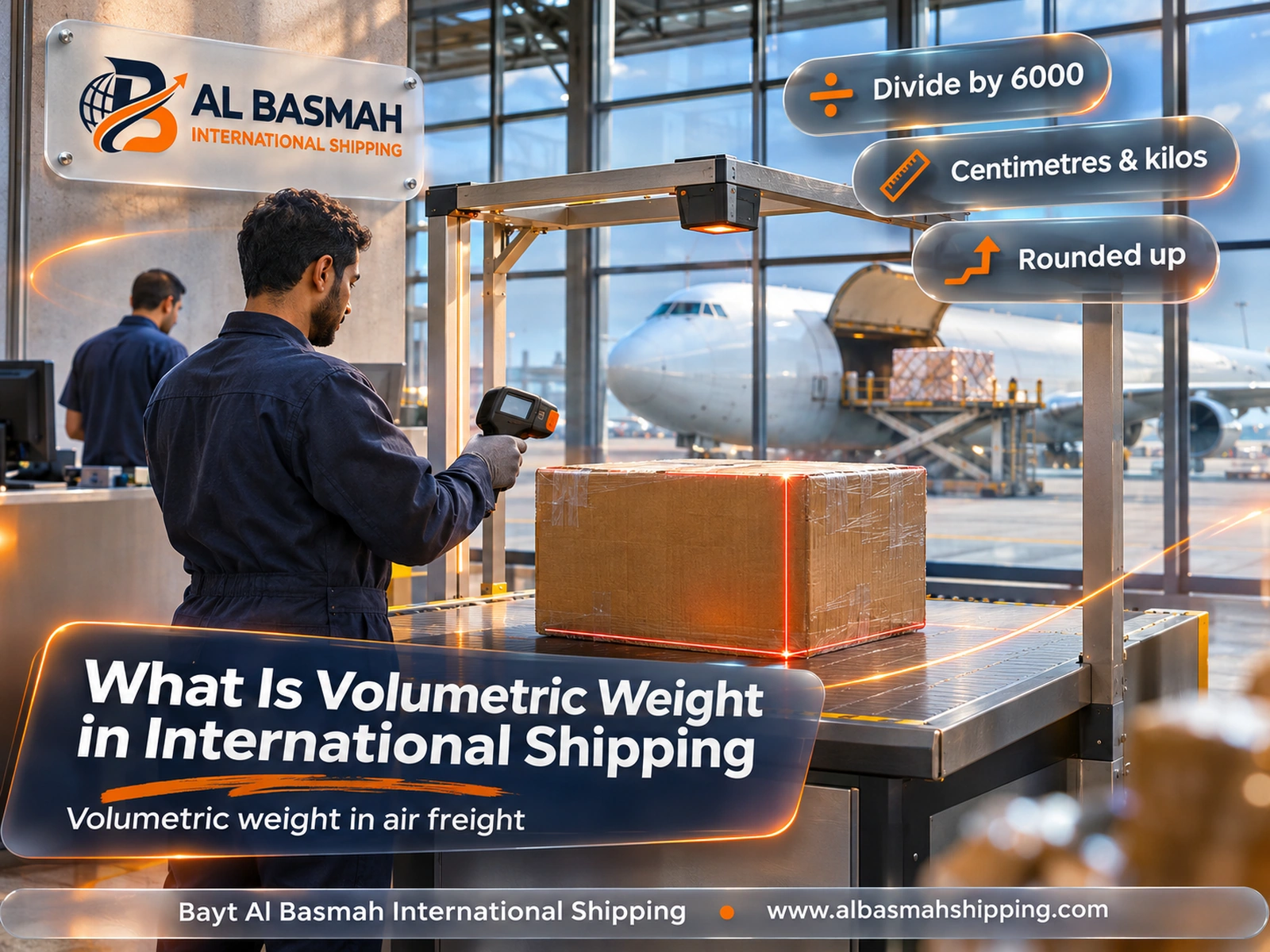
For air freight you divide by 6000. Here are three cases of the kind we receive on WhatsApp every day, all leaving from Dubai or Sharjah.
Example 1: a carton of clothes to Cairo
The carton measures 60 × 50 × 40 cm and weighs 9 kg. Its volume is 120,000 cm³, and divided by 6000 that gives 20 kg. The bill is based on 20 kg, not 9, which is more than double the real weight.
Example 2: spare parts to Riyadh
A small box of 40 × 30 × 25 cm weighs 18 kg. Its volume is 30,000 cm³, so its volumetric weight is only 5 kg. The scale wins and the customer pays for 18 kg. Dense goods such as metal parts, books and tools are rarely pushed up by volumetric weight.
Example 3: a shipment of several cartons
Four cartons, each 55 × 45 × 40 cm and 14 kg. Each one has a volume of 99,000 cm³ and a volumetric weight of 16.5 kg, making 66 kg in total. The combined actual weight is 56 kg, so the chargeable weight for the whole shipment is 66 kg.
| Case | Dimensions (cm) | Actual weight | Volumetric weight (÷6000) | Chargeable weight |
|---|---|---|---|---|
| Clothes | 60 × 50 × 40 | 9 kg | 20 kg | 20 kg |
| Spare parts | 40 × 30 × 25 | 18 kg | 5 kg | 18 kg |
| 4 cartons | 55 × 45 × 40 each | 56 kg | 66 kg | 66 kg |
| Pallet of goods | 120 × 100 × 150 | 250 kg | 300 kg | 300 kg |
Look at the pallet in the last row: 1.8 cubic metres becomes 300 kg by air. The same pallet in shared sea freight is billed on 1.8 units, which is why many large shipments move to sea or road when they are not urgent. For a full comparison of the options, see our guide to air vs sea vs land freight.
Road freight and express courier: why the figure changes
Express courier companies and many road carriers divide by 5000. The same 60 × 50 × 40 cm carton then becomes 24 kg instead of 20. On one carton the gap is small, but on a twenty-carton shipment it adds up. Some road carriers between the UAE and the other Gulf states do not use a divisor at all and price per cubic metre, by a density ratio of their own, or per truck when the load fills one.
The practical lesson: when you compare two quotes, ask which divisor each one uses. A lower rate per kilo can end up more expensive if it comes with a 5000 divisor and the other quote uses 6000. For Gulf routes in particular, such as shipping from the UAE to Saudi Arabia, the road pricing method matters more than the air formula.
Cubic metres and the W/M rule in sea freight
Shared sea freight rarely uses the term volumetric weight, but the principle is the same. The shipment is measured in cubic metres (CBM) and in tonnes, and the higher figure is billed. Quotes write this as W/M, short for weight or measurement, and one cubic metre is treated as one tonne.
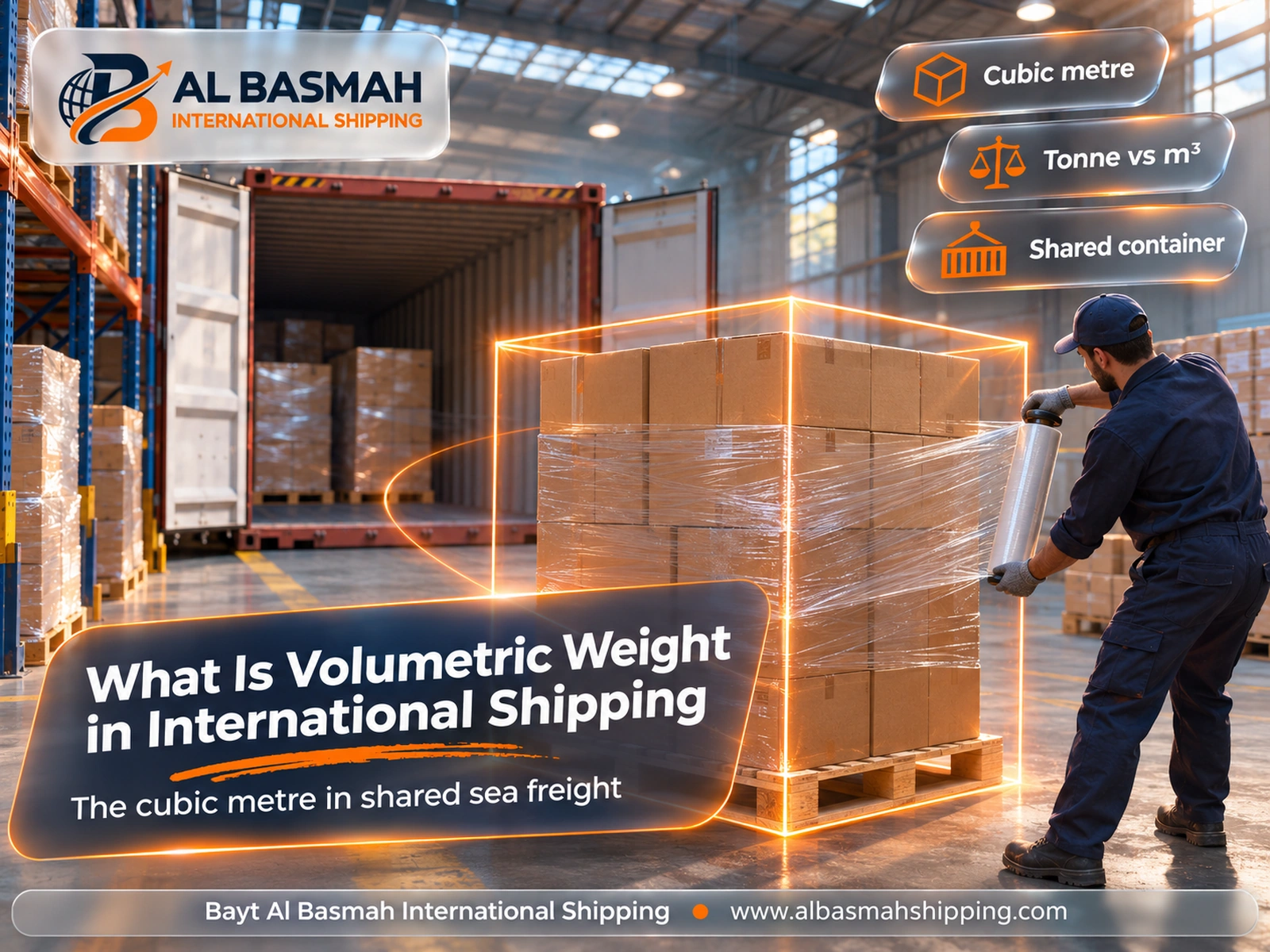
Household goods example: 25 cartons of 50 × 40 × 40 cm each, which is 0.08 m³ per carton and 2 m³ in total. They weigh 375 kg, or 0.375 tonnes. Volume is higher, so the shipment is billed on 2 units.
Heavy goods example: tiles or marble with a volume of 1.1 m³ and a weight of 2,400 kg. The weight is 2.4 tonnes, which beats the volume, so the shipment is billed on 2.4 units.
Once your shipment approaches half a 20 ft container (roughly 33 m³ of space), it makes sense to compare the shared rate with the price of a full container. A 40 ft container holds about 67 m³ and a 40 ft high cube about 76 m³. The details are in our LCL vs FCL guide.
| Approximate shipment volume | Option we suggest comparing | Why |
|---|---|---|
| Under 1 m³ and urgent | Air freight | Volumetric weight stays reasonable and speed matters most |
| 1 to 15 m³ | Shared sea or road | Paying per cubic metre saves a lot compared with air |
| 15 to 33 m³ | Compare LCL with a 20 ft container | A full container can be cheaper and safer |
| Over 33 m³ | 40 ft or 40 ft HC container | More space at a lower cost per cubic metre |
When volumetric weight beats actual weight

A quick rule for air: if one kilo of your goods takes up more than 6000 cm³, meaning a density below about 167 kg per cubic metre, volumetric weight will win. Typical examples on each side:
- Volume wins: pillows, duvets and winter clothes, boxed toys, lamps, plastic chairs, boxed shoes, and electronics in large retail packaging.
- Weight wins: spare parts, books, tightly packed perfumes, metal tools, tinned food, tiles and marble.
Common mistakes that push your bill up
- Measuring the goods before packing, then adding foam and an outer carton that grow each side by several centimetres.
- Forgetting the wooden pallet, whose height of about 15 cm counts in the calculation.
- Using the inner dimensions printed on the carton instead of the outer ones.
- Sending a small item in a large box simply because it was the one at home.
- Comparing rates per kilo between two companies without asking about the divisor.
- Expecting the bill to follow the reading on a bathroom scale.
- Leaving protruding parts such as table legs attached, so one piece turns into a big cube of air.
Warning: If the carrier re-measures the package at the airport or warehouse and finds it larger than declared, the chargeable weight is corrected and the difference is added before the shipment leaves. It may wait until that is settled. Measuring accurately from the start avoids the surprise.
How to cut volumetric weight and save on shipping
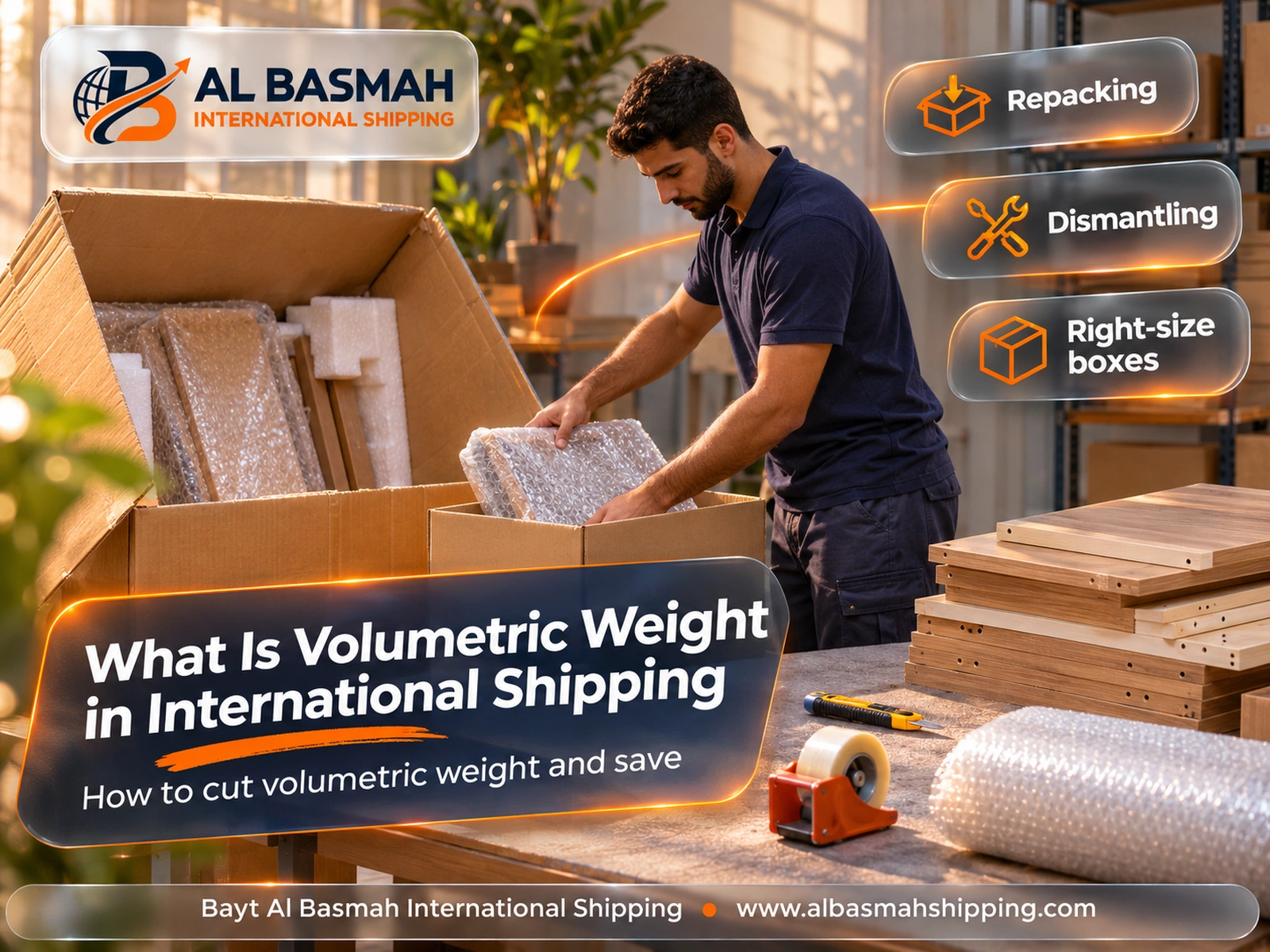
Most of the saving comes from packing, not negotiating. These steps have clearly reduced our customers’ bills:
- Choose a carton that fits the goods, with just enough margin for protection.
- Use vacuum bags for clothes and bedding; they roughly halve the volume.
- Dismantle furniture so legs, drawers and shelves are wrapped flat and separately.
- Combine scattered small parcels into one strong carton instead of ten bags.
- Take products out of bulky retail boxes if the box is not needed for resale.
- If the shipment is not urgent, send big light items by sea or road and keep the small urgent ones for air.
- Stack cartons on the pallet so nothing overhangs its edges.
For furniture in particular, the dismantling and packing method in our guide to shipping furniture internationally without damage also reduces the volume you pay for.
A tip from the warehouse: photograph each carton next to the tape measure before sealing it and send the photo with the weight. Pricing is faster, and any later re-measurement is easy to check.
What decides the shipping price besides weight
Chargeable weight is the base, but it is not the only factor. This table shows what goes into the final price:
| Factor | How it affects the price |
|---|---|
| Chargeable weight or volume | Multiplied by the rate per kilo or per cubic metre |
| Transport mode | Air costs most per kilo; sea costs least per cubic metre |
| Destination and distance | Distant countries and routes with fewer flights cost more |
| Type of goods | Batteries, perfumes and liquids need special packing and paperwork |
| Packing and dismantling | Wooden crates and extra protection add cost and volume |
| Door or port delivery | Door delivery adds inland transport in the destination country |
| Customs and duties | Depend on the country, the goods and their value |
| Season | Peak periods can push up the price of space |
How Al Basmah International Shipping handles volumetric weight
We measure your shipment at our Dubai branch (Deira, Port Saeed Street) or our Sharjah branch (Industrial Area 18), or at pickup from your address, and we write down the actual, volumetric and chargeable weights before anything is booked. If size is what drives the price, we suggest repacking or splitting the shipment between air and sea and show you the difference in numbers so you can choose.
- Real measuring and weighing before confirmation, not a guess by eye.
- A comparison of air, road and sea for the same shipment.
- Packing and dismantling that reduce volume without risking the goods.
- Consolidation of small parcels into one shipment.
- Updates on WhatsApp at every stage from collection to delivery.
If you need somewhere to keep part of your belongings while you decide what flies and what goes by sea, our furniture storage service in the UAE covers that. Send the details on WhatsApp and you will receive the price.
Frequently asked questions about volumetric weight
Does every shipping company use 6000?
No. 6000 is the most common figure for air cargo, while many express couriers use 5000 and some road carriers apply their own ratios. Always ask which divisor applies before comparing prices.
Why is my bill higher than the weight I measured at home?
Because the bill follows the chargeable weight. If your package is large and light, its volumetric weight exceeds the scale weight, and the final measurement after packing may be bigger than yours.
Does volumetric weight apply to sea freight?
For shared (LCL) shipments, yes, in a different form: cubic metres are compared with tonnes and the higher is billed. With a full container you pay for the container and volumetric weight does not come into it.
How do I measure an irregular item such as a bicycle or a sofa?
Measure its largest dimensions as if it sat inside an imaginary box: the greatest length, width and height. That is why removing handlebars and pedals, or sofa legs, saves a lot of volume.
Is volumetric weight calculated per carton or for the whole shipment?
Each carton is calculated and the results are added, then the total is compared with the total actual weight. In most cases the larger of the two totals is the chargeable weight.
My carton sizes are in inches. What do I do?
Multiply each dimension by 2.54 to convert to centimetres, then apply the same formula. Do not divide cubic inches by 6000 directly, as the result will be wrong.
Are vacuum bags safe for international shipping?
They work very well for clothes, bedding and pillows and cut the volume noticeably. Avoid them for genuine leather or delicate embroidered garments that can crease badly.
Can you work out the chargeable weight before I bring the shipment?
Yes. Send the number of cartons with each one’s dimensions and approximate weight on WhatsApp, and we calculate the chargeable weight for each transport mode and send you the price.
Work out your shipment with us before you pay
Send the sizes, weights and destination, and we reply with the chargeable weight and the best way to ship.
Tags: volumetric weight, volumetric weight in international shipping, how to calculate volumetric weight, chargeable weight, dimensional weight, divisor 6000, air freight from the UAE, LCL sea freight, cubic metre shipping, W/M rule, road freight from the UAE, reduce shipping costs, packing for shipping, shipping from Dubai, shipping from Sharjah, Al Basmah International Shipping