

If you trade from Sharjah and need to send goods to Turkey, the usual route is by sea: a full container (FCL) when your cargo fills a 20 ft or 40 ft box, or a shared part-load (LCL) consolidated with other traders’ goods and priced per cubic metre. Containers normally reach Istanbul’s Ambarlı port, Mersin or Izmir in roughly three to five weeks port to port, followed by clearance and trucking to your warehouse. Al Basmah International Shipping is a shipping company from Sharjah to Turkey with a branch in Industrial Area 18. We collect from your shop or warehouse anywhere in the emirate, check the commercial invoice, packing list and certificate of origin with you before booking, and send urgent parcels and samples by air.
Stops in this guide16 sectionsShowHide
FCL or LCL?
- Under roughly 13–15 m³: a shared LCL load is cheaper in most cases.
- From about 15 m³ up, heavy cargo, or goods that should not be handled repeatedly: a full FCL container.
- A full container is loaded at your door, sealed and not opened until Turkish customs; LCL passes through a consolidation warehouse here and a devanning warehouse there.
- Either way, the Turkish importer needs a tax number, and the goods pay customs duty plus KDV (VAT).
- A pickup truck is not booked until the team has checked whether it can enter Turkey and what it will cost.
What we ship from Sharjah to Turkey
Most of what leaves Sharjah for Turkey is commercial cargo: wholesale stock for shops in Istanbul, auto spare parts and equipment from the industrial areas, packaging materials, fabrics and garments, household goods, electronics and accessories, and used workshop or kitchen equipment sold to buyers in Turkey. We also ship exhibition samples and small urgent orders, plus pickup trucks once we have confirmed they can be imported.
- Wholesale and retail stock: numbered cartons on pallets, shipped FCL or LCL depending on volume.
- Spare parts and equipment: fixed to wooden pallets and strapped so nothing moves inside the container.
- Raw materials and light building materials: need an accurate description and correct HS code, because Turkish duty is calculated on it.
- Samples and urgent parcels: by air to Istanbul Airport within days.
- Personal effects and furniture: for people relocating to Turkey, with the residence paperwork personal effects require.
- Pickup trucks: in a container or by RoRo after an eligibility check.

Pickup areas in Sharjah
We collect across the whole emirate, and the Industrial Area 18 branch is our consolidation and packing point for part-loads. If your goods sit in a free-zone warehouse, the team arranges the exit paperwork the zone requires before the loading date. Areas we collect from every day include:
- Industrial Areas 1 to 18 and Al Sajaa Industrial.
- Sharjah Airport International Free Zone (SAIF Zone) and Hamriyah Free Zone.
- Muwaileh, Al Nahda, Al Taawun, Al Khan, Al Majaz, Abu Shagara, Al Qasimia, Al Nabba and Rolla.
- Al Rahmaniya, Al Tay, Al Badie, and the east-coast towns of Khor Fakkan and Kalba.
When you book a collection, tell us the number of cartons or pallets with rough dimensions, whether the warehouse has a forklift, and any time restrictions on truck access. Those details decide the truck type and crew size from the start.
Full container or part-load: how to choose
The rule of thumb most traders use: under roughly 13 to 15 cubic metres, LCL is cheaper because you only pay for the space you take. Above that, a 20 ft container usually works out better, since its price is about the same whether you fill all of it or two thirds. Volume is not the only factor, though. Fragile, valuable or moisture-sensitive goods benefit from a full container because it is only opened at Turkish customs.
20 ft container
About 28–30 m³ of usable space. Suits a mid-size shop’s stock or a spare-parts order.
40 ft container
About 55–60 m³ in practice. For light, bulky goods such as furniture and fabrics.
40 ft High Cube
Extra height gives about 65–70 m³; useful for stacked cartons and light cargo.
LCL part-load
Charged per m³, with a minimum charge on most consolidation services, and passes through two warehouses.
How consolidation works
With a part-load, your goods come to our Industrial Area 18 warehouse, where they are measured, weighed and labelled carton by carton with the consignee’s name and piece count. They are then grouped with other traders’ cargo heading to the same Turkish port and loaded into one container. On arrival the container goes to a bonded devanning warehouse, the shipments are separated, and each importer clears their own goods. That is why the carton marks must match the packing list exactly; otherwise sorting is delayed.
Consolidation also lets you combine goods from several suppliers in Sharjah and Dubai into one shipment. Each supplier delivers to the warehouse, the team tells you on WhatsApp as each part arrives, and everything ships together on a single bill of lading.
The sea route from Sharjah to Turkish ports
Containers sail from Port Khalid in Sharjah or from Khor Fakkan on the east coast, or are trucked within the UAE to Jebel Ali when a sailing from there fits better. The vessel goes up the Red Sea and through the Suez Canal into the eastern Mediterranean, discharging at Mersin on the south coast or continuing to Ambarlı in Istanbul or to Izmir. The voyage usually takes three to five weeks port to port and may include a transhipment stop. Which port to use depends on where your warehouse is: Istanbul and its surroundings suit Ambarlı, while Gaziantep, Adana and the south-east suit Mersin.
Transit times and method comparison
| Method | Approximate time | Best for | Notes |
|---|---|---|---|
| Sea, full container (FCL) | 3–5 weeks port to port + clearance | 15 m³ and up, heavy or sensitive cargo | Loaded and sealed at your door, not opened until customs |
| Sea, part-load (LCL) | About 4–6 weeks, as it waits for the consolidation box to fill | Small and mid-size volumes, traders combining suppliers | Priced per m³, with a minimum charge |
| Air | About 2–5 days door to door including clearance | Samples, documents, urgent parts, light goods | Actual or volumetric weight, whichever is higher; batteries and liquids restricted |
These times are estimates and shift with sailing schedules, port congestion and how quickly the Turkish importer’s paperwork is ready. The team sends you the expected sailing date and every update along the way on WhatsApp.
Air freight from Sharjah to Turkey
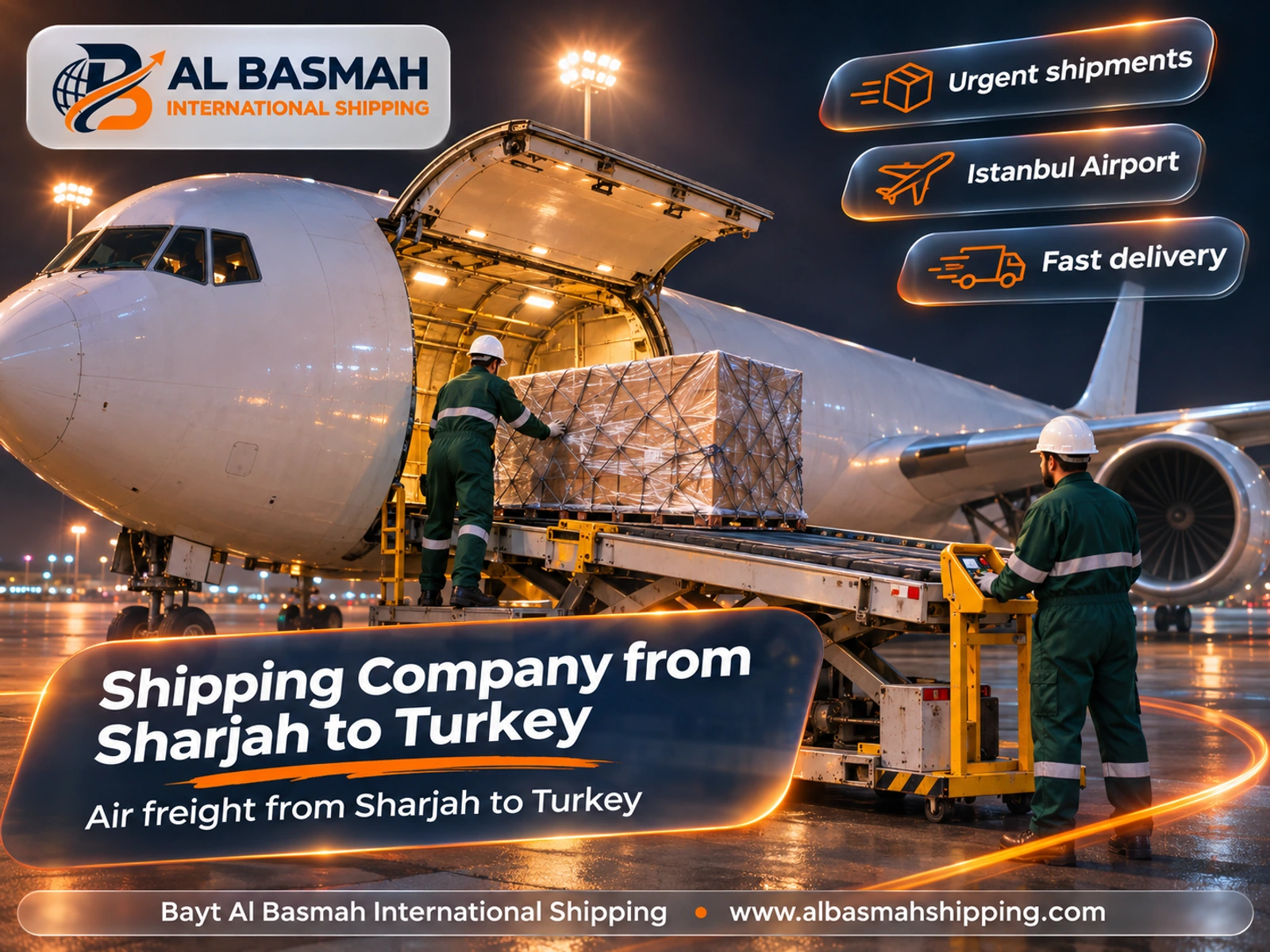
For samples and rush orders, air cargo leaves Sharjah or Dubai airport for Istanbul Airport, with Sabiha Gökçen, Ankara or Antalya possible when needed. It usually takes two to five days door to door including clearance. The charge is based on actual weight or volumetric weight, whichever is higher, where volumetric weight = length × width × height in cm ÷ 6000. A 60×50×40 cm carton, for example, counts as 20 kg even if it weighs 8 kg, so cutting empty space inside the box pays off.
- Good for exhibition samples, parts that are holding up a production line, original documents, and small quantities of light goods.
- Not suited to furniture or heavy cargo; the price gap with sea freight is large.
- Lithium batteries, liquids and perfumes are restricted and need special approval and packing, or are refused.
- Commercial air parcels pay Turkish duty and KDV just like sea cargo.
Documents for commercial goods
Turkish customs calculates duty and decides on inspections from the paperwork, so any error in description, value or weight means delay or a fine. The team reviews the documents with you before loading, not after the container lands.
- Commercial invoice: in the Turkish importer’s name, address and tax number, with a clear description, quantity, price and currency for each line.
- Packing list: number of cartons or pallets, contents of each, net and gross weight, and dimensions.
- Certificate of origin: issued by the Sharjah Chamber of Commerce and Industry, stating the real country of manufacture.
- Bill of lading or air waybill: issued by the carrier to the consignee shown on the invoice.
- Turkish importer registration: the importer needs a Turkish tax number, and some goods need extra licences.
- Conformity documents: toys, batteries, protective equipment and electrical goods may go through the TAREKS electronic safety check, and a declaration of conformity or CE marking may be requested.
Customs duty and KDV
Commercial goods pay Turkish customs duty according to their HS code, then KDV (Turkish VAT) at the standard rate of 20%, with lower rates for some items. Shipping from Sharjah does not make goods exempt by default. The UAE–Türkiye Comprehensive Economic Partnership Agreement reduces duty on some goods of genuine UAE origin only if they meet the rules of origin and carry a correct certificate of origin; goods made elsewhere and re-exported from Sharjah are treated according to where they were made. The team estimates the expected duty with the customs broker in Turkey before shipping so there are no surprises.
If the shipment is personal effects
Someone moving household goods to Turkey usually needs a valid residence or work permit, a Turkish tax number, a detailed inventory listing brand and serial numbers of electrical items, a bill of lading in their own name, and a rental contract of 12 months or more or a property deed. Returning Turkish citizens have their own conditions. The team checks your case before booking; no exemption is guaranteed for every situation.
Shipping pickup trucks from Sharjah to Turkey
Many Sharjah traders ask about sending a pickup with their goods or on its own. Turkey restricts imports of used vehicles by individuals and levies a special consumption tax (ÖTV) based on engine size and value; many private vehicles cannot be imported at all, or only temporarily by foreign residents. So we do not book space for any vehicle until the team has confirmed it can enter and what it is likely to cost in your specific case.
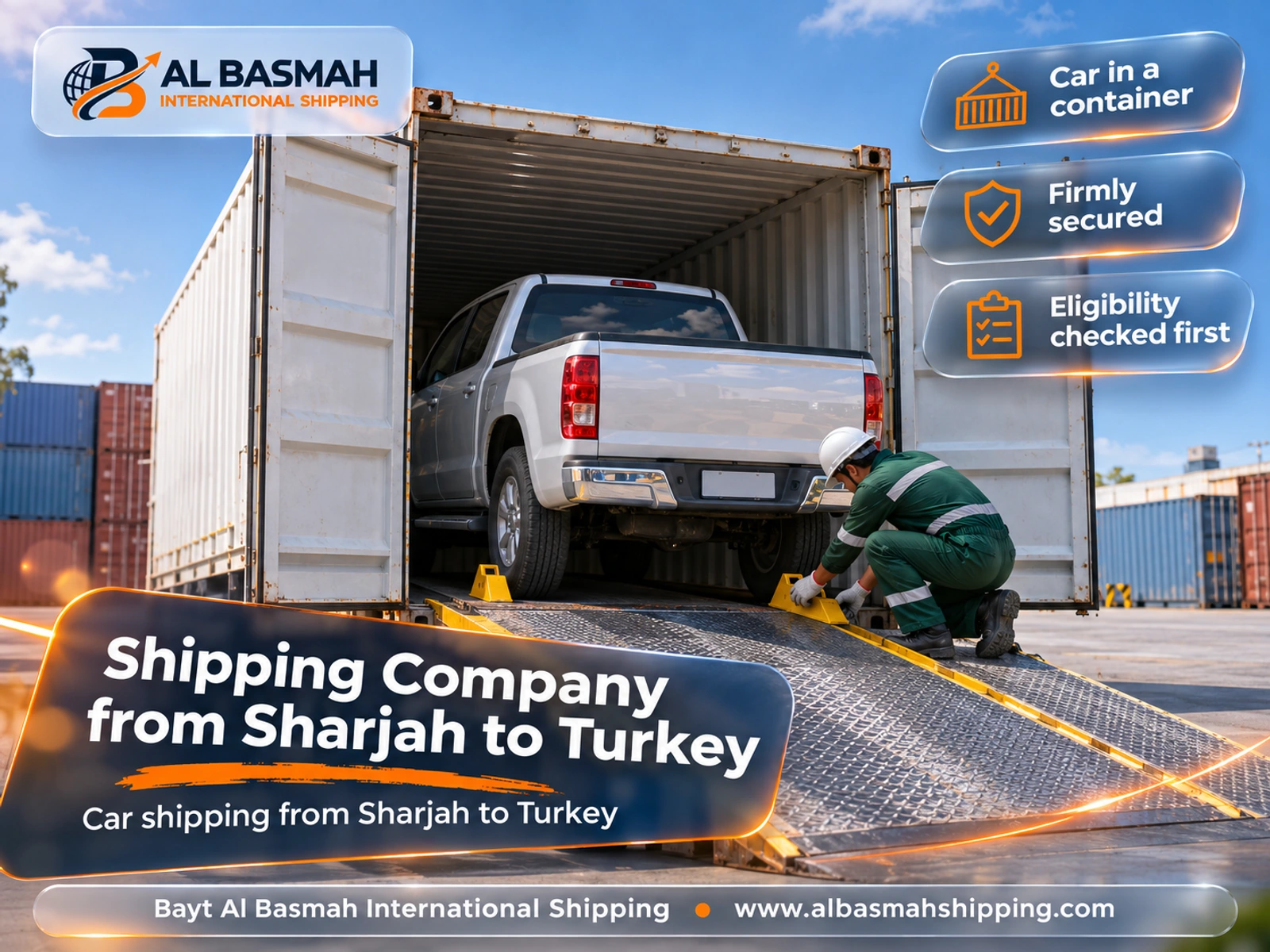
- In a container: the pickup is secured with straps and wheel chocks, and cargo can sometimes fill the remaining space as long as it is declared.
- By RoRo: the pickup is driven aboard and lashed on deck, uncovered, with nothing left in the bed or cab.
- Documents: vehicle ownership, UAE export certificate from the relevant authority, the owner’s passport, and whatever the Turkish side requests.
- Before loading, the pickup is photographed from every side and the odometer recorded; the photos are sent to you on WhatsApp.
Packing commercial goods for sea freight
A container goes through high humidity, stacking and crane handling, and poorly packed cargo arrives with collapsed cartons. What we do at the Industrial Area 18 warehouse:
- Cartons go on heat-treated wooden pallets stamped ISPM 15, which Turkey requires for wood packaging.
- Pallets are stretch-wrapped with cardboard corner protectors on the edges.
- Desiccant bags go into full containers, especially for fabrics and electronics.
- Every carton carries the same number as the packing list, plus the consignee’s name and destination city.
- Heavy goods go at the bottom and fragile items on top, clearly marked.
Prohibited and restricted goods
- Strictly prohibited: narcotics, weapons and ammunition, counterfeit goods and fake brands.
- Prior permit required: drones, some medicines and supplements, some foods.
- Mobile phones in commercial quantities: IMEI registration is required in Turkey, and larger quantities go through importer procedures.
- Dangerous goods such as loose lithium batteries and flammables need proper classification and packing.
Warning: Do not under-declare the invoice value to cut duty. Turkish customs compares prices against product databases, and a mismatch means a fine and the container held at the port with daily storage charges.
Shipping prices from Sharjah to Turkey
Rates to Turkey move with carrier pricing, shipment size and arrival port, so no single figure fits everyone. Send the details on WhatsApp and you will get the price: type of goods, count and dimensions or volume in m³, weight, pickup area in Sharjah and delivery city in Turkey. You can also use the quote page.
What decides the price
| Factor | How it affects the cost |
|---|---|
| Method: sea FCL, LCL or air | Air costs far more per kg; LCL is per m³; FCL is per container |
| Container size | 20 ft, 40 ft or 40 ft HC; the price gap is smaller than the size gap |
| Volume and actual weight | LCL charges the higher of volume or weight equivalent; air the higher of actual or volumetric |
| Arrival port and city | Ambarlı, Mersin or Izmir, then trucking distance inside Turkey |
| Packing and pallets | ISPM 15 pallets and extra packing add cost but protect the cargo |
| Documents and clearance | Certificate of origin, TAREKS checks, broker fees in Turkey |
| Turkish duty and taxes | Duty by HS code + KDV; paid by the importer |
| Vehicle or pickup | Container or RoRo, plus ÖTV and import charges where permitted |
Delivery in Turkey: from port to your warehouse
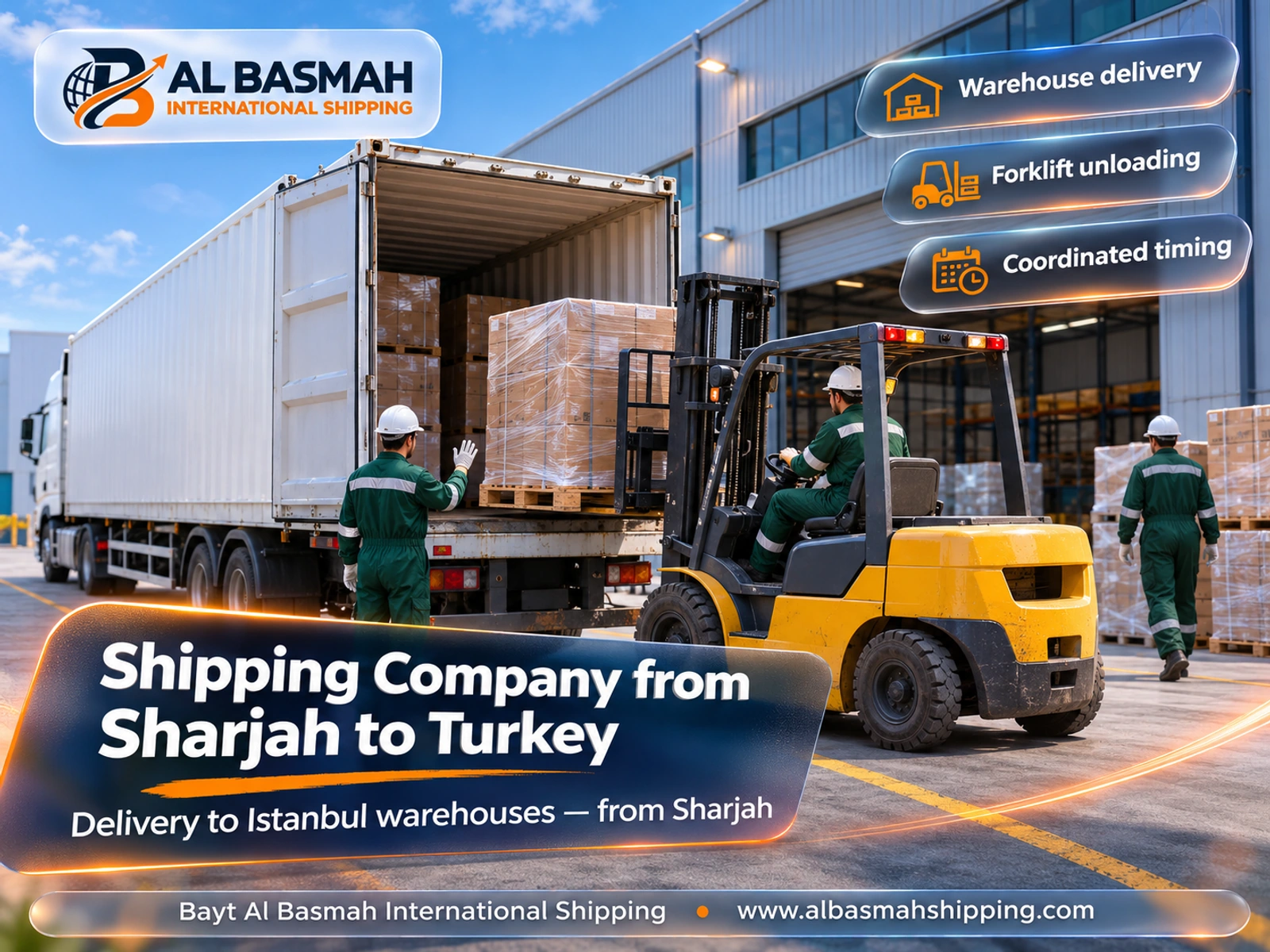
After clearance the goods are trucked to the importer’s address. Most Sharjah traders’ cargo goes to the logistics zones around Istanbul: İkitelli, Hadımköy and Esenyurt on the European side, and Tuzla and Gebze in Kocaeli on the Asian side. Warehouses there usually receive container trucks at set slots, so the team agrees the delivery time with the consignee in advance and confirms that a forklift or crew will be there to unload.
| City / area | Usual arrival port | Note |
|---|---|---|
| Istanbul – European side | Ambarlı | İkitelli, Hadımköy, Esenyurt, Başakşehir, Beylikdüzü |
| Istanbul – Asian side | Ambarlı or Kocaeli ports | Tuzla, Ataşehir, Kadıköy, Üsküdar |
| Ankara | Ambarlı or Mersin | Then inland trucking |
| Bursa & Yalova | Ambarlı or Gemlik | Industrial and textile zones |
| Trabzon | Ambarlı then trucking, or Trabzon port | North coast |
| Antalya & Izmir | Izmir or Mersin | Depends on the line and schedule |
| Mersin & Gaziantep | Mersin | Closest port to the south-east |
If the shipment is furniture or personal effects for a flat in a high-rise complex, the furniture is often lifted to the balcony with an external furniture lift, and building management may need notice. The team arranges this with the receiver. Remember that personal effects need the residence permit and Turkish tax number in place before clearance.
How to ship from Sharjah to Turkey, step by step
- Send the type of goods, quantity, dimensions, pickup area and delivery city on WhatsApp.
- The team recommends FCL, LCL or air and sends the price and expected sailing date.
- The draft commercial invoice and packing list are reviewed, and the certificate of origin is issued.
- The Turkish importer confirms their tax number and any licence or conformity document the goods need.
- Collection from your site, or the container is loaded at your door, with the cargo photographed before sealing.
- Export clearance in Sharjah, then sailing, with WhatsApp updates at every stage.
- Clearance in Turkey, with duty and KDV paid by the importer, then trucking to the warehouse and delivery.
Tips for traders before shipping
- Ask the Turkish importer to confirm the HS code before the invoice is written; a wrong code changes the duty.
- In a part-load, do not mix goods for different importers on one document.
- If your supplier is outside the UAE and you re-export from Sharjah, state the real country of origin.
- Photograph the pallets before loading and keep the photos with the packing list.
- Ask the team about optional cargo insurance if the goods are high value.
- If you also supply neighbouring markets, see shipping from Sharjah to Syria.
For a wider view of routes, ports and personal-effects paperwork, the UAE to Turkey shipping guide helps. If your goods are in Dubai, see shipping from Dubai to Turkey, and for apartment belongings in a shared load see shipping from Ajman to Turkey.
Frequently asked questions
How long does sea freight take from Sharjah to Istanbul?
Usually three to five weeks port to port for a full container; LCL takes a little longer because it waits for the consolidation box to fill. Add clearance in Turkey and trucking to the warehouse. All of these are approximate.
When is a full container cheaper than a part-load?
Usually once the cargo goes past roughly 13 to 15 cubic metres, or when it is heavy or sensitive. Send the volume and weight on WhatsApp and the team will compare both prices for you.
Are goods from Sharjah duty-free in Turkey?
Not automatically. Commercial goods pay customs duty and KDV. Some goods genuinely made in the UAE may get a reduction under the partnership agreement between the two countries if they meet the rules of origin and a correct certificate of origin is presented.
Does the receiver in Turkey need to be registered?
Yes. The Turkish importer needs a tax number, and some goods need a licence or a conformity check such as TAREKS. The team confirms this before booking.
Can I combine goods from several suppliers in one shipment?
Yes. Each supplier delivers to our Industrial Area 18 warehouse, the team tells you as each part arrives, and everything ships together on one document.
Can a used pickup be shipped to Turkey?
It depends on your case; Turkey restricts used-vehicle imports and charges ÖTV. We do not book until the team has confirmed whether the pickup can enter and the expected cost.
How do I know where my shipment is during transit?
The team messages you on WhatsApp at loading, sailing, arrival, clearance and delivery, and you can ask at any time.
Do you ship by air from Sharjah?
Yes, for samples, documents and urgent parts to Istanbul Airport and other airports, in roughly two to five days, charged on actual or volumetric weight, whichever is higher.
Ready to ship your goods from Sharjah to Turkey?
Send the quantity, dimensions and delivery city, and the team will reply with the right method and the price.
Tags: shipping company from Sharjah to Turkey, commercial goods to Turkey, FCL container, LCL part-load, Sharjah to Istanbul shipping, Industrial Area 18, certificate of origin, Turkish KDV, Turkey customs clearance, pickup truck shipping to Turkey, Ambarlı port, Mersin port, air freight from Sharjah, Istanbul warehouses, cargo consolidation, Al Basmah International Shipping