

The direct answer for anyone looking for a shipping company from UAE to the Netherlands: Al Basmah International Shipping ships commercial cargo in full or shared containers from Jebel Ali, Khalifa Port and the Sharjah and Fujairah ports to Rotterdam, Europe’s largest port, then clears it and delivers to your Dutch warehouse or lets it continue to another European country. We also move household furniture to Amsterdam, Rotterdam, The Hague, Utrecht and every Dutch city, and fly urgent parcels to Schiphol. There is no road route from the UAE to the Netherlands: sea for volume, air for urgent items.
Stops in this guide13 sectionsShowHide
The Netherlands is not an ordinary destination for a UAE trader. Much of the cargo bound for Germany, Belgium and northern France enters the EU through Rotterdam, because the port connects by road, river and rail to the heart of Europe. So three things matter here: the cost and time difference between full and shared containers, what you need at customs in terms of EORI and VAT, and how belongings get into an old Dutch canal house whose stairs no sofa will pass.
Rotterdam, your gateway
- Rotterdam: the main port for most shipments, onward to all of the Netherlands and the rest of Europe.
- FCL if you fill a 20 ft or 40 ft container; LCL per cubic metre for smaller volumes.
- Approximate sea time: about 20 to 30 days port to port, then clearance and delivery.
- Traders: EORI number, Dutch VAT of 21% on most goods, with the option of deferring it under a special licence.
- Canal houses: an external furniture lift takes items in through the windows.
- Price: send the details on WhatsApp and you will receive the price.
Why Rotterdam, and why traders prefer it
Rotterdam is the largest port in Europe, with regular direct or transshipped services from UAE ports. Its value to a trader is not size alone but what happens after arrival: the container can be cleared in Rotterdam and unloaded at a nearby warehouse, moved under customs transit to Germany, Belgium or elsewhere for clearance there, or stored in a customs warehouse without paying duty until the goods are sold. Those options help anyone distributing to more than one European market.
Clearance in Rotterdam
Goods enter the Dutch market directly and are delivered to your warehouse or customer.
Transit to another country
The container moves under customs transit and is cleared in the final destination country.
Customs warehouse
Goods stored without duty until released to the market, useful for distribution in batches.
Rotterdam is not the only option. The port of Amsterdam handles some general cargo, and sometimes a nearby European port followed by trucking is faster or cheaper. We set the route once we know the cargo and the delivery point.
What we ship to the Netherlands
- Palletised commercial goods: packaged dry food, dates, textiles, packaging materials, spare parts, household goods.
- Equipment and machinery: workshop, factory and restaurant equipment, braced and weight-balanced in the container.
- Re-export from free zones: goods from Jebel Ali or other free zones to a Dutch importer.
- Household furniture: for people relocating for work or study, from a small flat to a villa.
- Parcels and personal effects: for students and families, by shared sea freight or air.
- Cars: once eligibility is confirmed, by container or RoRo.
Food needs extra attention: some products face health checks and documents at the EU border, and labels must meet EU labelling rules. We go through that with the importer before booking so the container is not held.
Collection from every emirate
| Emirate | Notes |
|---|---|
| Dubai | Warehouses and the Jebel Ali free zone, Al Quoz and Al Qusais, with the container loaded at the warehouse or door. |
| Abu Dhabi | Musaffah, industrial areas and homes, exported from Khalifa Port or Jebel Ali. |
| Sharjah | Industrial areas, with drop-off at our Industrial Area 18 branch for shared loads. |
| Ajman and Umm Al Quwain | Factories, small warehouses and homes. |
| Ras Al Khaimah | Industrial areas and the free zone. |
| Fujairah | Export from Fujairah or Khor Fakkan when the line calls. |
| Al Ain | Collection and transfer to Abu Dhabi or Dubai for export. |
Full or shared container to Rotterdam?
A working rule: once your cargo approaches 13 or 14 cubic metres or more, a full 20 ft container is often equal to or cheaper than shared freight, with the advantage that it is sealed and not mixed with anything else. A 20 ft container holds roughly 25 to 30 m³ of well-stowed goods, a 40 ft about 55 to 65, and a 40 ft high-cube slightly more. Small volumes go shared, priced per cubic metre, or by weight if heavy.
- FCL: loaded at your warehouse and sealed, arrives as it left and can be unloaded straight at the importer.
- LCL: delivered to a consolidation warehouse in the UAE, unloaded at a warehouse in the Netherlands, then delivered. Cheaper for small volumes but slower.
- Heavy goods: such as steel or stone may reach the weight limit before the volume limit, so we work out the allowed payload.

Times and uses table
Times are approximate and vary with the line, the vessel’s routing, transshipment and port congestion. Add, as a rule, 3 to 7 days for clearance, then the inland leg.
| Method | Approximate time | Best for | Notes |
|---|---|---|---|
| Full container (FCL) | About 20–30 days port to port | A trader filling a container, a whole home | Sealed from the warehouse, unloaded straight at the importer |
| Shared (LCL) | About 28–40 days with consolidation | A few pallets, a flat’s furniture | Per m³, passes through two warehouses |
| Air | About 3–6 days door to door | Samples, spare parts, documents, parcels | Actual or volumetric weight |
| City | Usual arrival port | Note |
|---|---|---|
| Rotterdam | Rotterdam | Closest; often same-day delivery after clearance |
| Amsterdam | Rotterdam or Amsterdam | Canal houses need a lift and a parking permit |
| The Hague | Rotterdam | Close to the port |
| Utrecht | Rotterdam | Narrow old centre, bicycles everywhere |
| Eindhoven | Rotterdam | Industrial and tech hub, suits equipment |
| Groningen | Rotterdam or Amsterdam | Longer road leg to the north |
Air freight to the Netherlands
Air cargo to the Netherlands mostly goes through Amsterdam Schiphol, one of Europe’s biggest cargo airports, and sometimes Maastricht. It leaves Dubai International, Al Maktoum, Abu Dhabi or Sharjah, and door to door usually takes 3 to 6 days including clearance. This is for samples a buyer needs before ordering a container, spare parts, documents and student boxes.
- Priced on actual or volumetric weight, whichever is higher; volumetric weight = length × width × height in cm ÷ 6000.
- A 50 × 40 × 40 cm carton has a volumetric weight of 13.3 kg; if it actually weighs 6 kg, it is charged at 13.3.
- Lithium batteries, liquids, perfumes and pressurised items are restricted and checked before booking.
- Furniture does not suit air because of the cost.
- Commercial cargo by air needs the invoice, packing list and EORI, as by sea.

Packing for the damp Dutch climate
The Netherlands is damp and rainy for most of the year, with cold winters. A container that leaves the UAE heat and arrives in northern European humidity is prone to condensation, which ruins ordinary cartons and leaves moisture on wood and fabric. So we use double-wall cartons, stretch-wrapped pallets, desiccant bags hung on the container walls, and we lift sensitive goods off the container floor.
- Commercial goods: heat-treated pallets stamped to ISPM 15, stretch wrap, corner guards and clear labels on every pallet.
- Furniture: dismantled and numbered, fabric blankets for wood, bubble wrap for glass, board on corners.
- Appliances: water drained from washing machines and fridges, washing-machine drums locked.
- Delivery day: rain is likely, so items are covered between the truck and the door.
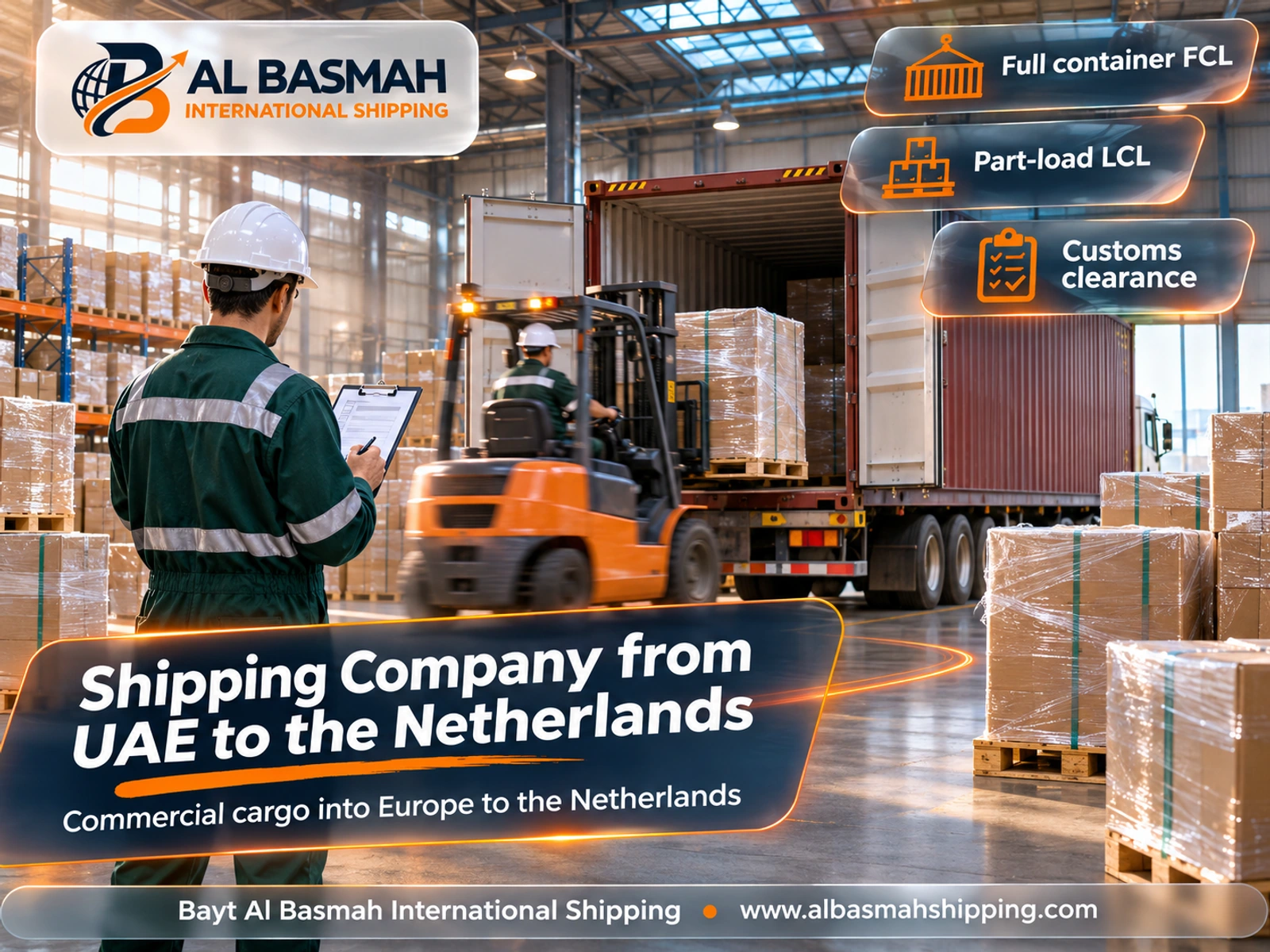
Documents and customs in the Netherlands
The Netherlands is in the EU. The rules below are what usually applies; Dutch customs has the final say, and our team reviews your papers before loading.
Commercial goods
The importer needs an EORI number. Dutch import VAT is 21% on most goods and 9% on categories such as much of food, calculated on the value of the goods plus freight and duty, and duty follows the EU tariff and commodity code. What sets the Netherlands apart is that eligible businesses can hold a import VAT deferment licence, commonly called the “23 licence” after the provision that created it, which lets them account for import VAT on their VAT return instead of paying it in cash at clearance; non-resident companies usually obtain it through a Dutch fiscal representative. That eases cash flow for the trader.
- A commercial invoice with value, currency and precise description.
- A packing list with number of pallets, weights and dimensions.
- The HS tariff code for each item.
- The importer’s EORI and VAT numbers.
- A certificate of origin if required.
- Health certificates for food, and EU conformity papers for electrical goods and toys.
An illustrative import VAT calculation
Say the goods are worth EUR 10,000, freight and insurance to Rotterdam cost EUR 1,000, and the duty rate for the item is 4%. Duty is charged on EUR 11,000, so EUR 440. VAT at 21% is then charged on the total (EUR 11,440), roughly EUR 2,402. This is only an example: duty rates differ by commodity code and can be zero for some items, and VAT may be 9% for some categories. The point is that VAT is calculated on the value plus freight and duty, not on the goods alone.
That is why traders care about the right commodity code from the start. A wrong code can raise the duty, trigger an inspection, or bring a penalty later if it is discovered after clearance. We ask the importer to confirm the code with their Dutch broker before loading, and when a shipment has many lines we arrange the packing list by item so it matches the invoice.
Furniture of people moving residence to the Netherlands
Relief from duty and VAT on removal goods has the usual conditions: at least 12 consecutive months living outside the EU, the goods owned and used for at least 6 months, imported within 12 months of settling in the Netherlands, and not sold, rented or lent for 12 months. You do not file it yourself: the removal company or broker claims it in the customs declaration under a special relief code.
- A signed inventory.
- A Dutch municipal registration certificate showing the date you settled.
- Failing that, proof of deregistration in the UAE plus a supporting document such as an employment contract, work permit or tenancy agreement.
- Passport copy and residence permit.
Cars
A car needs its own customs declaration with the registration certificate and proof of ownership, followed by Dutch vehicle tax (BPM), inspection and registration. Someone moving residence whose car receives customs relief can also apply for a BPM exemption. GCC-spec cars may need conformity work before registration, so we do not book before the team confirms eligibility. Cars go by RoRo, driven aboard, or inside a container.
Warning: Do not mix commercial goods with personal furniture in the same container if you are claiming residence relief, and do not describe goods in vague terms on the invoice. Imprecise descriptions are among the most common causes of inspections and delays in Rotterdam.
Prohibited and restricted items
- Meat, dairy and their products from outside the EU in personal shipments.
- Plants, soil and seeds without phytosanitary certificates.
- Weapons, ammunition, fireworks and flammables.
- Counterfeit goods.
- Products of protected species.
- Alcohol and tobacco within relieved belongings.
- Dangerous goods without proper classification, packing and declaration.
Shipping prices to the Netherlands
The price differs widely between a full container from a Jebel Ali warehouse to a Rotterdam warehouse and three pallets going shared to Utrecht. Send the details on WhatsApp and you will receive the price: the type of goods, number of pallets or cubic metres, weight, collection point, delivery city, and whether you need clearance in the Netherlands or transit to another country. Or fill in the quote request form.
What decides the price
| Factor | How it affects the price |
|---|---|
| Full, shared or air | FCL per container, LCL per m³ or tonne, air per actual or volumetric kilogram |
| Container size | 20 ft, 40 ft or 40 ft HC; heavy goods are counted against the payload limit |
| Volume and weight | On shared loads the higher of volume or weight is charged |
| Delivery city | Rotterdam and The Hague are closer, the north is farther |
| Packing | Pallets and stretch wrap for cargo, full packing for furniture |
| Documents and clearance | Clearance in the Netherlands, transit to another country or a customs warehouse |
| Access at the address | External lift and parking permit for canal houses |
| Car | RoRo or container, its papers and eligibility |
Steps to ship to the Netherlands
- Send on WhatsApp the type of goods or photos of the furniture, the volume, the emirate and the Dutch city.
- The team chooses full, shared or air and the port, and sends the price.
- Traders send the invoice, packing list and the importer’s EORI; people moving residence send the relief papers.
- We collect from the warehouse or home, pack and load the container, or deliver it to the consolidation warehouse.
- Sailing from the port, with updates from the team on WhatsApp at every stage.
- Clearance in Rotterdam or transit to the destination, then trucking and delivery to the address.
Delivery in Amsterdam and Rotterdam: canal houses and lifts
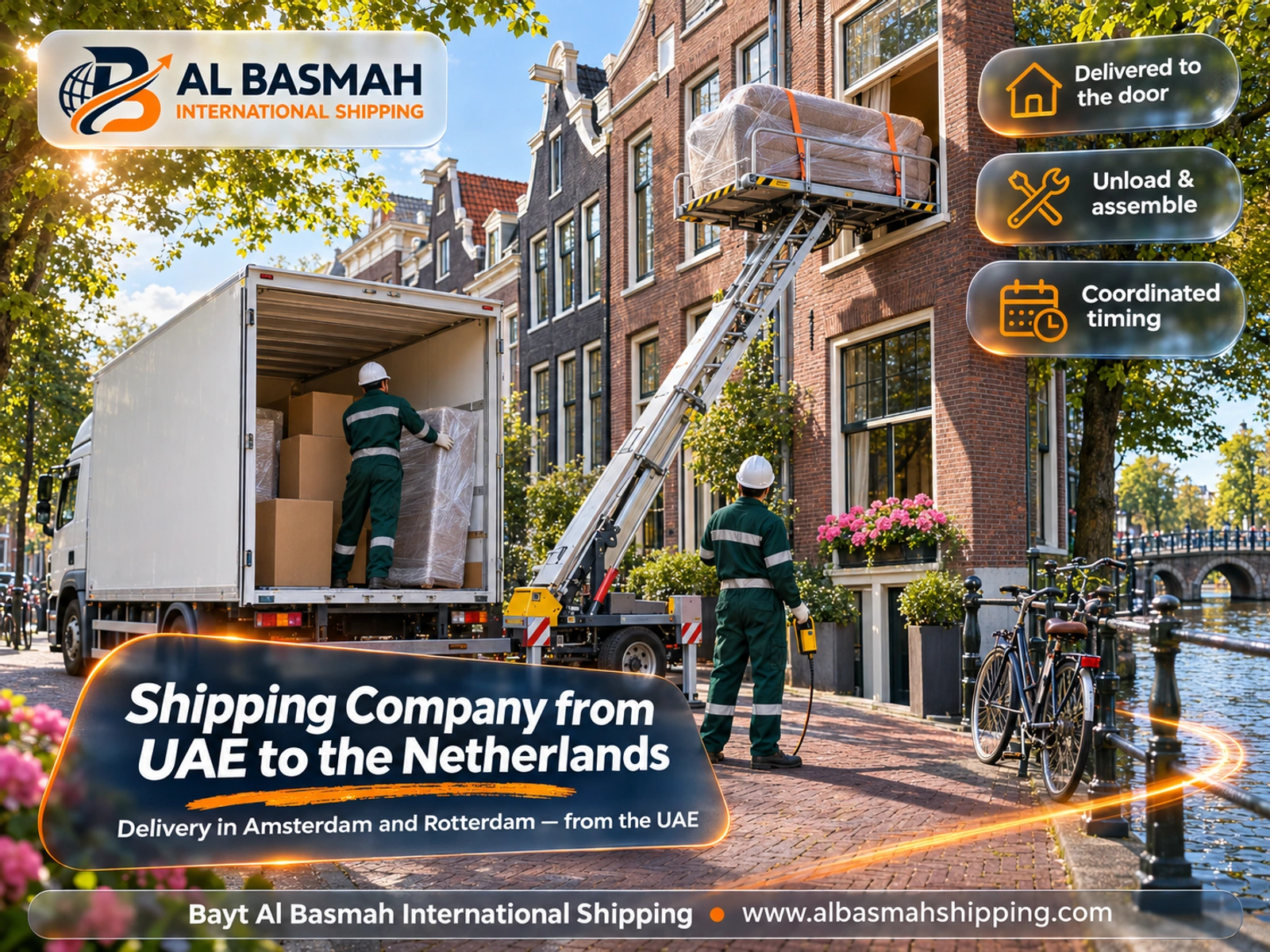
Old houses on the canals of Amsterdam, Leiden and Utrecht are narrow at the front and tall, with stairs so steep and tight that sofas and beds will not pass. That is why many have a wooden beam with a hook at the top, once used to hoist goods. Today an external furniture lift, a moving ladder mounted on a truck, raises items straight to the window instead, and the large windows in these houses are sometimes removed to bring furniture in.
- Parking in front of the house on narrow streets usually needs a temporary municipal permit, requested days in advance.
- Some canal bridges have weight limits, so a smaller truck comes instead of the container truck.
- Bike lanes are everywhere and must not be blocked during unloading.
- Modern flats in Rotterdam have lifts, but we check the size in advance.
- Send us a photo of the façade, the windows, the stairs and the floor number.
If your goods will continue from Rotterdam to Germany or elsewhere, see the guide to shipping from the UAE to Europe, and the guides for the UK and Sweden if you distribute across northern Europe.
Tips for traders and people moving home to the Netherlands
- Get the importer’s EORI and VAT number before loading and make sure it is correct on the invoice.
- If you distribute to several European countries, ask about customs transit or a customs warehouse before shipping.
- Declare the right weight for each pallet; a mismatch on the scale delays the container.
- If you are moving residence, register with the Dutch municipality early; the registration certificate is the main proof for relief.
- Ask the team about optional insurance for cargo or furniture.
- Keep original documents and small valuable devices with you.
Frequently asked questions about shipping from the UAE to the Netherlands
How long does a container take from Jebel Ali to Rotterdam?
Usually about 20 to 30 days port to port depending on the line and transshipment, then 3 to 7 days for clearance and inland delivery.
When is a full container cheaper than shared?
Once your cargo approaches 13 to 14 m³ or more, a 20 ft container is often equal or cheaper, with the advantage of a seal and no mixing with other shipments.
Do I need an EORI number to import into the Netherlands?
Yes, every importer into the EU needs an EORI number. We also check the VAT number and whether import VAT can be deferred.
Can the container continue from Rotterdam to Germany or Belgium?
Yes, under customs transit with clearance in the destination country, or cleared in Rotterdam and then trucked on.
Is used furniture exempt from tax?
If you are moving residence to the Netherlands and meet the usual conditions, relief is possible and the broker claims it under a special code. Otherwise duty and VAT are due. The team reviews your case.
How does furniture get into an old Amsterdam house?
Usually with an external furniture lift to the window, plus a municipal parking permit.
Which airport is used for air freight?
Usually Amsterdam Schiphol, sometimes Maastricht, about 3 to 6 days door to door.
Do you collect from Ras Al Khaimah and Al Ain?
Yes, from every emirate and Al Ain, and you get updates on WhatsApp at every stage.
Rotterdam is waiting for your container
Send the invoice and packing list or photos of the furniture, and the city. Send the details on WhatsApp and you will receive the price.
Tags: shipping company from UAE to the Netherlands, shipping from Dubai to the Netherlands, commercial cargo to the Netherlands, full container to Rotterdam, shared container to the Netherlands, port of Rotterdam, shipping to Amsterdam, furniture moving to the Netherlands, air freight to the Netherlands, Schiphol cargo, EORI number, Dutch import VAT, customs transit Europe, car shipping to the Netherlands, canal houses, external furniture lift, Al Basmah International Shipping