

If you are looking for a shipping company from Ras Al Khaimah to Jordan that can move ceramic tiles, sanitary ware and building materials on strapped pallets, or an off-road 4×4 in an enclosed carrier, from Ras Al Khaimah to a doorstep in Amman, Salt or Irbid, that is the work of the Al Basmah International Shipping team. The load is collected in Ras Al Khaimah, travels by road in customs transit across Saudi Arabia to the Al Omari border, is cleared by Jordan Customs and arrives in roughly 6–10 days depending on the city. Full containers can also go by sea to Aqaba, and urgent small items by air to Queen Alia International Airport.
Stops in this guide19 sectionsShowHide
Many of the people who contact us from Ras Al Khaimah are not moving a whole home. They are building or finishing a house in Jordan and want to take tiles, basins and mixers bought from the emirate’s showrooms, or send their 4×4 ahead of them. This guide is written for exactly that case: weight before volume, protection before loading, and paperwork before the road.
The ceramics load
- Tiles are heavy: a truck reaches its weight limit long before it is full, so the price follows weight and pallets.
- Every pallet is wrapped, corner-protected and strapped; sanitary ware travels in padded cartons on top of or beside the tiles, never under them.
- Route: Ras Al Khaimah → Al Ghuwaifat → Al Batha → Riyadh → Al Haditha → Al Omari → Amman, roughly 6–10 days by city.
- A certificate of origin helps UAE-made goods benefit from the customs-duty exemption; Jordan’s sales tax still applies.
- 4x4s travel in an enclosed carrier after the model year is checked against Jordan’s rules.
- Price: send the details on WhatsApp and you will receive the price.
What do we ship from Ras Al Khaimah to Jordan?
We ship building and finishing materials, household goods, cars, commercial cargo and parcels from Ras Al Khaimah to every city in Jordan. The emirate’s character means one type of load comes up more than any other: floor and wall tiles, porcelain, basins, toilets and bathtubs, mixers, insulation and tile adhesive. Ras Al Khaimah is known for its ceramics industry, its showrooms and warehouses sell enough to finish a whole house, and so the question we hear is: how do I get all of this to Jordan in one piece?
- Tiles, ceramics and porcelain: on wrapped wooden pallets, from one room’s worth to a whole house.
- Sanitary ware: basins, wall-hung and floor toilets, bathtubs, shower cabins, mixers and accessories.
- Building and finishing materials: tile adhesive, insulation, doors, flat-packed kitchens, light fittings.
- 4x4s and regular cars: in an enclosed carrier, with documents and an import-rules check.
- Furniture and household goods: for residents ending their stay in the UAE and returning to Jordan.
- Commercial cargo: for a Jordanian trader or contractor buying from the emirate’s factories and warehouses, as a shared load or a full truck.
Shipping ceramics and sanitary ware: weight before volume
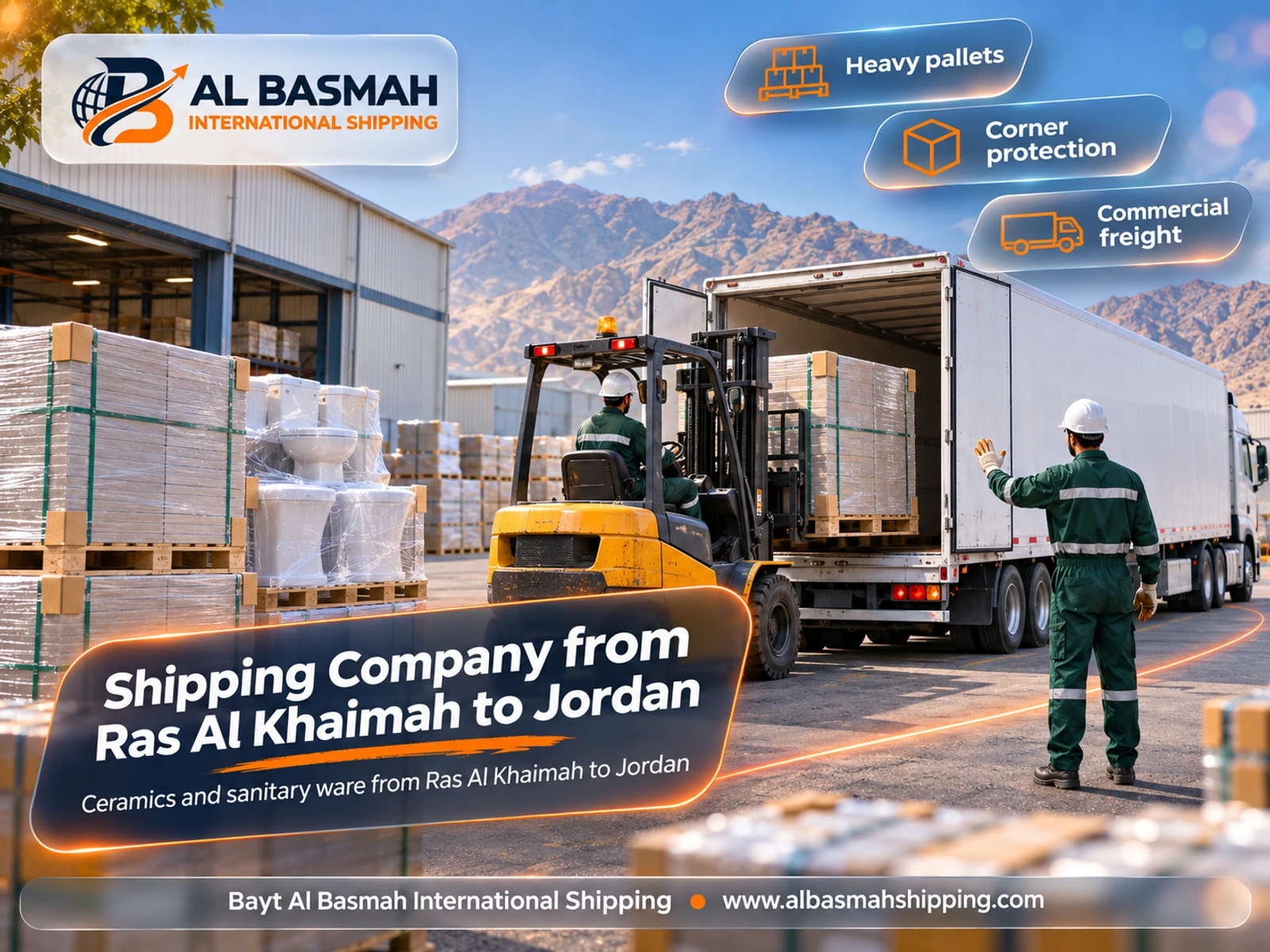
The common mistake is to price tiles by the cubic metre, like furniture. Tiles are very heavy for their size, and a single pallet of porcelain can weigh more than a tonne, so the truck reaches its permitted load well before its box is full. Every truck has a permitted gross weight in each country it crosses, there are weighbridges along the way, and an overloaded truck can be stopped, fined or made to offload part of its cargo. That is why, before booking, we ask for the number of pallets and their weight as written on the showroom invoice, not just the number of square metres.
In practice, if your load is only tiles for an average house, it usually needs a small part of the truck’s space but a large part of its weight, so it is priced by weight. If you combine it with light, bulky furniture, the load balances weight and volume, and sometimes a dedicated full truck works out cheaper than paying for two separate shipments. The team calculates both options and tells you which costs less.
How we protect tiles and sanitary ware
- A sound, strong pallet: we do not load a pallet with broken feet or a lean; we restack it on a new pallet if needed.
- Protected corners: cardboard or plastic corner guards on the carton edges, because tile breakage usually starts at the edge.
- Wrapping and strapping: stretch film from bottom to top, then ratchet straps tying the cartons to the pallet.
- Placement in the truck: heavy pallets on the floor over the axles, tight together with no gaps; basins and toilets on top or beside them, never underneath.
- Padding for sanitary ware: each ceramic piece in its original carton or in bubble padding; mixers and accessories in a sealed, labelled carton.
- Clear labels: “Fragile” and “This way up” on pallets and cartons.
A tip from experience: ask the showroom for 5–10% extra from the same batch (shade and grade). If a tile breaks or you run short in Jordan, you will not easily find the same batch there, and shipping one box later costs more than adding it to the first load.
Certificate of origin and Jordanian standards for building products
If the tiles or sanitary ware are made in the UAE, a certificate of origin from the emirate’s chamber of commerce helps the goods benefit from the Greater Arab Free Trade Area exemption from customs duty in Jordan. A product made in another country and sold from a UAE warehouse has the origin of its country of manufacture, not the UAE, and its duty is assessed on that basis. In both cases Jordan’s general sales tax (usually 16%) and other fees still apply.
One point many people miss: the Jordan Standards and Metrology Organization (JSMO) checks imported goods at customs centres and border crossings against Jordanian technical regulations and standards, and tiles, ceramics, marble and sanitary ware are among the categories it covers. Non-compliant goods can be ordered re-exported or destroyed. So for commercial loads, keep the manufacturer’s product data (size, grade, country of manufacture and any conformity certificates available), and the team reviews with the clearing agent before loading what your particular product needs.
Warning: Do not assume a load counts as “personal” if it could finish more than one house. Large quantities of tiles and sanitary ware may be treated as commercial goods and need a commercial invoice and a Jordanian importer’s details. Tell the team the real quantity before booking.
Delivery in Salt and the hillside towns: narrow lanes and stone stairs
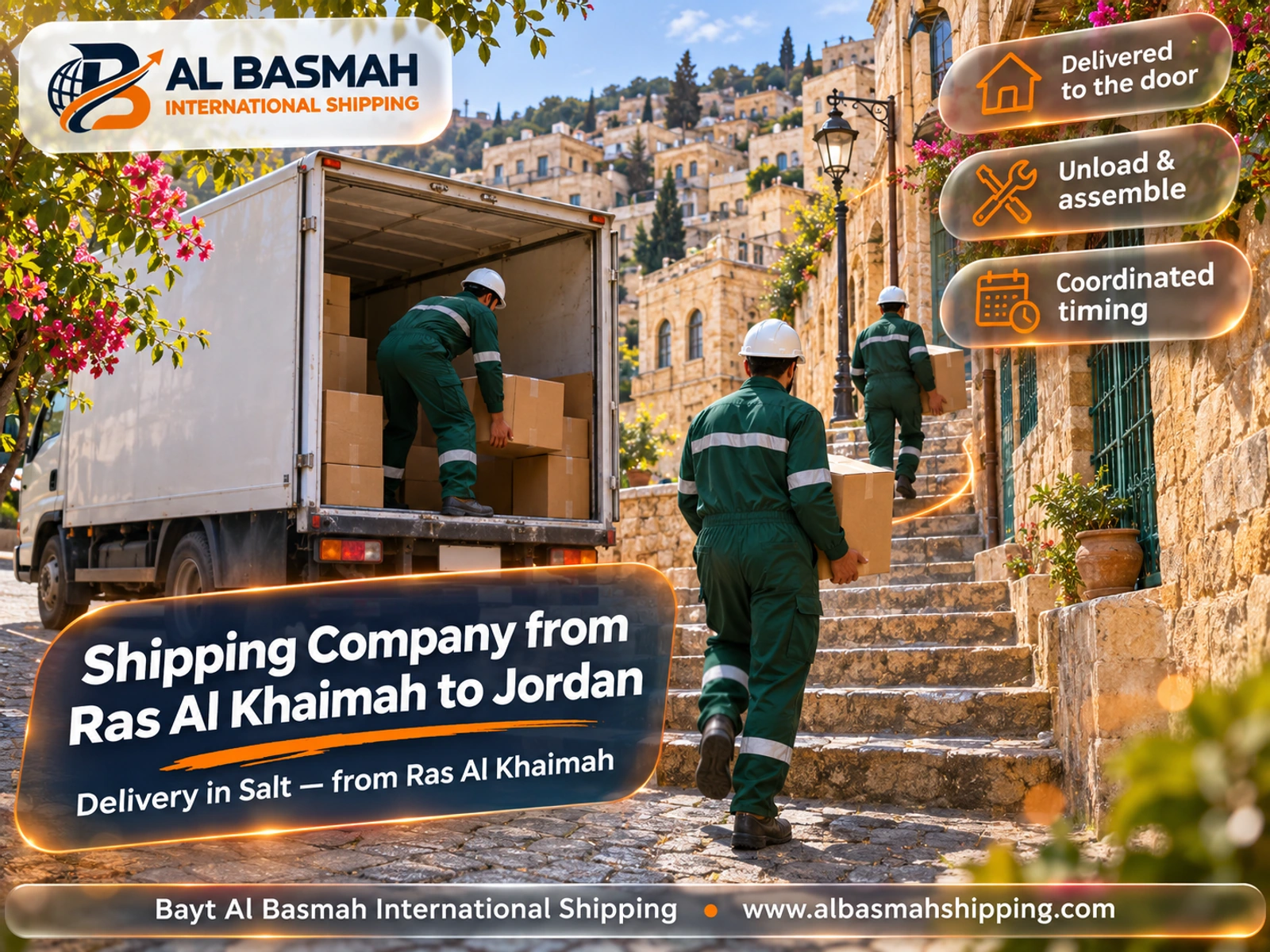
Many of the houses being finished with materials from Ras Al Khaimah are in hill towns such as Salt and Ajloun and on the edges of Amman. Salt is an old town built on terraced slopes, with yellow-stone houses, narrow lanes and long flights of stairs between streets, and a large truck cannot reach many of its homes. The same goes for parts of Amman such as Jabal Amman, Tla’ Al Ali and Abu Nseir, where slopes are steep and parking is hard.
So before loading we ask: does a truck-accessible street reach the house? Is there space in front to put the pallets down? Is the house still a site with a safe place to store materials? If the street is narrow, the load is transferred at a nearby point to a smaller vehicle, and the pallets may be broken down and the tiles carried in by hand. This is agreed in advance with the receiver, because moving a few tonnes of tiles up stairs takes workers and time, and it is part of the price.
The exact location
Send the map pin and a photo of the street in front of the house so the team can choose the right vehicle size.
The unloading spot
Pick a flat, dry place for the pallets, away from rainwater and building rubble.
Someone on site
Have a person present to count the pallets and cartons and sign once they are checked.
Winter in the hills
Salt, Amman and Ajloun get rain, cold and sometimes snow; unloading is arranged on a clear day where possible.
You can read more about the town on the Salt, Jordan page on Wikipedia.
Shipping 4x4s from Ras Al Khaimah to Jordan
Ras Al Khaimah’s mountains and wadis have made 4x4s popular among its residents, and many are kitted out for rough terrain: a front winch, oversized tyres, a roof rack, extra lights. A car like this travels in an enclosed car carrier, because the road to Jordan is long and crosses desert and dust, and an enclosed carrier protects the paint, the glass and the exterior accessories.
Before booking, the team checks the car’s model year and specifications against Jordan’s current import rules for cars, because Jordan sets conditions on vehicle age and specifications, and the taxes vary by engine and fuel type and change from time to time. We do not advise shipping a car before this check. As for modifications, major add-ons may be questioned at registration in Jordan, so ask about them before shipping.
- Ownership in the shipper’s name, a UAE export certificate and plate cancellation.
- A copy of the owner’s passport.
- The car completely empty of personal belongings; it cannot be loaded with cartons or tools.
- Removable accessories (roof rack, extra lights) taken off and wrapped, or firmly secured.
- Clear photos of the car from every side before loading, including the odometer reading.

Pickup areas in Ras Al Khaimah
We collect from every part of Ras Al Khaimah, north to south, from homes, warehouses, showrooms and industrial areas. Small loads can also be dropped at our Sharjah branch in Industrial Area 18 to join the Jordan consolidation.
- The city and around it: Al Nakheel, Julphar, Al Dhait, Khuzam, Al Qusaidat, Al Mairid, Seih Al Harf, Al Dhaisah.
- The south: Al Hamra, Al Jazirah Al Hamra and its industrial area, Al Ghail.
- The north: Al Rams, Shaam, Al Jeer, Khor Khwair and Saqr Port.
- Inland: Digdagga, Khatt, Al Huwailat, Wadi Al Bih.
- Free zones and industrial areas: the Ras Al Khaimah free zone and its industrial parks, plus building-materials and ceramics warehouses and showrooms.
The road route from Ras Al Khaimah to Jordan
The truck leaves Ras Al Khaimah heading south on the coastal road or the Emirates Road, through Dubai and on towards Al Ghuwaifat on the Saudi border. There it enters Saudi Arabia at Al Batha under customs transit: the load is sealed and not cleared into Saudi Arabia, only carried across it. It passes Riyadh, then heads north through Qassim and Al Jouf to the Al Haditha crossing, enters Jordan at Al Omari where Jordanian clearance begins, and continues to Amman and on to the delivery city.
The distance from Ras Al Khaimah is a little longer than from Dubai, roughly 2,500–2,700 km to Amman. Because the transit load is sealed, documents cannot be added or changed halfway, so the truck does not move until the paperwork is complete. If part of your load is going to Saudi Arabia itself, see our shipping company from Ras Al Khaimah to Saudi Arabia guide.
- Loading in Ras Al Khaimah after packing and inventory.
- UAE export clearance, then the Al Ghuwaifat border.
- Al Batha border and entry into Saudi Arabia in sealed transit.
- Crossing via Riyadh, Qassim and Al Jouf to Al Haditha.
- Al Omari: inspection and Jordanian customs clearance, plus a standards check for regulated items.
- Arrival in Amman and distribution to the delivery city.
Transit times from Ras Al Khaimah to Jordan’s cities
The times below are approximate, door to door including clearance, counted from the day the truck departs. A shared load leaves when the truck fills; a dedicated truck leaves on your date.
| City | Approximate time by road | Note |
|---|---|---|
| Amman | 6–9 days | Hilly districts; a smaller vehicle may be needed for the last leg |
| Zarqa and Salt | 6–9 days | Salt has narrow lanes and stairs; unloading is agreed in advance |
| Irbid and Mafraq | 7–10 days | Northern Jordan, after distribution from Amman |
| Madaba and Karak | 7–10 days | South of Amman, usually wider roads |
| Aqaba | 7–10 days | Or by sea for full containers via Aqaba port |
Delays usually come from a missing document, an extra inspection of the goods at Al Omari, or winter weather. The team sends you a WhatsApp update at loading, at the Al Ghuwaifat crossing, on arrival at Al Omari, after clearance and before delivery.
Sea freight to Aqaba for building-material containers
If the quantity is large, such as a full container of tiles for a contractor or trader, sea freight can make sense: the container ships from Jebel Ali or Khalifa Port to Aqaba port via the Red Sea, in roughly 2–3 weeks of sailing, then port handling and clearance, then road delivery to the city. Sea is slower than road, but for very heavy loads it eases the problem of road weight limits. The team compares a full truck with a container for you based on weight and delivery city.
Air freight from Ras Al Khaimah to Jordan
Air freight does not suit tiles, sanitary ware or furniture, because the weight makes it very expensive. It does suit small urgent items: a tile sample you want the contractor to see before the load arrives, a missing mixer part, documents or car spare parts. These fly from Dubai, Sharjah or Abu Dhabi airport to Queen Alia International Airport in Amman, usually arriving in 2–4 days door to door including clearance.
The price is based on actual weight or volumetric weight, whichever is higher, where volumetric weight = length × width × height in cm ÷ 6000. Lithium batteries, liquids and perfumes are restricted on air freight, so mention them to the team before packing.

Packing the rest of the load
If household goods travel with the building materials, cartons are sealed tightly against rain and cold, because Jordan’s winter is wet and the load may arrive on a cold day. Wooden furniture is wrapped in blankets and then film, mattresses go in sealed bags, and glass and mirrors in cardboard frames. Each carton is labelled with its room and contents to make unloading easier. In a mixed load, nothing light is ever placed under the heavy pallets.
Required documents
Building materials and commercial cargo
- A commercial invoice listing items, quantities and value.
- A packing list with the number of pallets and the weight of each.
- A certificate of origin for UAE-made products.
- The Jordanian importer’s details, plus any approvals or conformity certificates the product needs.
Personal effects and used furniture
A returning Jordanian who has lived abroad for more than 12 months can usually import used personal effects once per family with an exemption, presenting a passport copy, proof of ending residence abroad such as a cancelled residence visa, a detailed contents list and the family book. Foreigners, new items and commercial quantities are dutiable. The team checks your case before shipping, because the exemption is not automatic, and a whole house’s worth of new tiles usually does not count as used personal effects.
Cars
Ownership, the UAE export certificate and plate cancellation, the owner’s passport and a car empty of belongings, with the model year and Jordan’s current conditions checked before shipping.
Prohibited and restricted items
- Narcotics, weapons and ammunition without permits, counterfeit goods and gambling equipment are prohibited.
- Drones, some medicines and wireless devices need prior permits.
- Flammable chemicals, such as some solvents and paints, must be declared to the team before loading as they may need special handling.
- New electrical appliances, food and cosmetics may need approvals from the Jordanian authorities.
Shipping prices from Ras Al Khaimah to Jordan
There is no fixed price that fits every load on this route, because a tile load is very different from a furniture load, and a car is not a parcel. Send the details on WhatsApp and you will receive the price: the type of goods, the number and weight of pallets, the pickup area in Ras Al Khaimah, the delivery city in Jordan and whether you need a dedicated truck. You can also fill in the quote request on the site.
What decides the price?
| Factor | How it affects the price |
|---|---|
| Weight and number of pallets | Tiles and sanitary ware are usually priced by weight, since weight runs out before space |
| Volume in cubic metres | For furniture and light, bulky goods |
| Shared or dedicated truck | Dedicated leaves on your date and can be cheaper for large loads |
| Delivery city and street access | Salt and Amman’s hilly districts may need a smaller vehicle and hand carrying |
| Packing and corner protection | New pallets, corner guards, straps and padding for sanitary ware |
| Documents and clearance | Certificate of origin, commercial invoice and a standards check if required |
| Car type | A large 4×4 in an enclosed carrier differs from a small car |
| Road, sea or air | Sea for full containers, air only for light urgent items |
How to ship from Ras Al Khaimah to Jordan, step by step
- Send a photo of the showroom invoice or your item list on WhatsApp, with the number and weight of pallets, or the car details.
- Send the pickup location in Ras Al Khaimah and the delivery location in Jordan, with a photo of the street.
- The team reviews the documents and any car conditions, and confirms whether the load is personal or commercial.
- You receive the price and date, and choose between a shared and a dedicated truck.
- Packing, corner protection and loading on pickup day, with a written inventory of pallets and pieces.
- WhatsApp updates at each stage through clearance at Al Omari.
- Delivery in the city; the receiver counts the pallets and checks them before signing.
Tips and warnings before you ship
- Take pallet weights from the showroom invoice; do not estimate them by eye.
- Order extra tiles from the same batch in case of breakage or shortfall.
- Do not put personal belongings inside the car being shipped.
- Do not book the car until the team has checked its import conditions for Jordan.
- Pick a dry unloading spot, especially in winter; wet cardboard weakens and tears.
- If the house is in Salt or a hilly district, tell the team at booking, not on delivery day.
Warning: An overweight load is not just the truck’s problem; the whole shipment can be held at a weighbridge. Declaring the correct weight from the start saves you days.
Delivery inside Jordan: what to know
After clearance at Al Omari, the load usually reaches Amman and is then distributed to the other cities. Amman is built on hills, most districts have sloping streets, and some homes are reached by stairs, so the team confirms access with the receiver before delivery. Districts such as Abdoun, Dabouq, Khalda and Sweifieh are relatively wide, while Jabal Amman and parts of Tla’ Al Ali, Abu Nseir and Tabarbour need more coordination. Zarqa is flatter, Irbid and Mafraq are in the north, Madaba and Karak are south of the capital, and Aqaba sits on the Red Sea in the far south.
The choice between road, sea and air follows the load: road suits most building-material and car shipments from Ras Al Khaimah, sea suits heavy full containers to Aqaba, and air suits samples and urgent parts. Winter in the highlands is cold and rainy, with occasional snow in Amman, while summer is dry. If you are shipping from another emirate, see the main guide shipping company from UAE to Jordan, the shipping company from Sharjah to Jordan guide near our branch, or the shipping company from Fujairah to Jordan guide for the east coast.
Frequently asked questions
How long does a shipment take from Ras Al Khaimah to Amman?
Roughly 6–9 days by road, door to door including clearance, from the day the truck departs. Irbid, Madaba, Karak and Aqaba take about 7–10 days.
Are tiles priced by cubic metre or by weight?
Usually by weight and number of pallets, because tiles reach the permitted load before they fill the truck. The team calculates both and picks the cheaper option for you.
Do I pay customs duty on UAE-made ceramics in Jordan?
With a UAE certificate of origin the goods can usually benefit from the Arab free-trade exemption from customs duty, but general sales tax and other fees still apply. Products made elsewhere are treated according to their country of manufacture.
Does JSMO inspect tiles and sanitary ware?
Yes, the Jordan Standards and Metrology Organization checks imported goods at the borders, and tiles, ceramics and sanitary ware are among the covered categories. Keep the manufacturer’s product data, and the team reviews what your product needs.
Can you deliver to a house in Salt on a narrow street?
Yes, once the unloading method is agreed in advance; the load may be moved to a smaller vehicle or carried by hand up the stairs, which is part of the price.
Can I ship a modified 4×4?
Yes, in an enclosed carrier, after the model year and Jordan’s conditions are checked. Removable accessories are taken off and wrapped, and the car must be empty of belongings.
Can I send a tile sample quickly before the main load?
Yes, by air to Queen Alia International Airport in roughly 2–4 days, priced on actual or volumetric weight, whichever is higher.
How do I know where my shipment is?
The team sends WhatsApp updates at loading, at the Al Ghuwaifat crossing, on arrival at Al Omari, after clearance and before delivery.
Ready to ship your load from Ras Al Khaimah to Jordan?
Send the showroom invoice or pallet photos and the house location in Jordan, and Al Basmah International Shipping will reply with the price and date.
Tags: shipping company from Ras Al Khaimah to Jordan, ceramics shipping to Jordan, tile shipping from Ras Al Khaimah, sanitary ware shipping to Jordan, building materials shipping to Jordan, 4×4 shipping to Jordan, car shipping from Ras Al Khaimah to Jordan, land freight to Jordan, Al Omari border, Saudi transit, shipping to Salt, shipping to Amman, shipping to Irbid, sea freight to Aqaba, air freight to Jordan, Jordan customs, certificate of origin, Al Basmah International Shipping