

If you trade out of Sharjah and need a shipping company from Sharjah to Morocco to move stock to a warehouse in Casablanca or to a customer in Tangier or Fes, the practical route is by sea: a full 20 ft or 40 ft container loaded at your warehouse, or space in a shared container priced by the cubic metre when the quantity is small. Containers usually reach Casablanca port or Tanger Med in roughly three to five weeks, then Moroccan customs clearance and trucking to the warehouse follow. Samples and urgent spare parts go by air to Mohammed V Airport in a few days. At Al Basmah International Shipping we take orders at our Sharjah branch in Industrial Area 18 and prepare the shipment paperwork with you before the container is sealed, because most of what holds up commercial cargo in Morocco starts with a missing paper here.
Stops in this guide15 sectionsShowHide
The Moroccan importer’s file
- Route: by sea from UAE ports to Casablanca or Tanger Med; there is no road route to Morocco.
- Approximate time: 3–5 weeks port to port, plus clearance and inland delivery.
- FCL (full container) for large volumes; LCL (shared container) priced per m³ for small ones.
- Core documents: commercial invoice, packing list, certificate of origin and a registered Moroccan importer.
- Charges in Morocco: import duty by tariff code, and VAT (TVA) at the standard 20% on most goods.
- Air for urgent items only: about 2–5 days to Casablanca and other cities.
- Price: send the details on WhatsApp and the price comes back to you.
What do we ship from Sharjah to Morocco?
Sharjah is a big wholesale market, and many Moroccan traders buy there for the Casablanca market and then distribute to other cities. Most of what we ship is commercial cargo of varying size, alongside family belongings and vehicles:
Spare parts and tyres
New and used car parts from Sharjah’s industrial markets, and tyres strapped on pallets.
Building and finishing materials
Sanitary ware, lighting, tiles, doors, panels and small equipment, usually in a full container.
Textiles, clothing and shoes
Numbered bales and cartons, among the most common LCL shipments.
Appliances and equipment
Household and electrical appliances and workshop tools; some fall under Moroccan conformity control.
Furniture and showroom stock
New office or showroom furniture, wrapped and stowed so pieces do not rub in transit.
Cars and pickups
Sedans on RoRo vessels; pickups in containers once their import eligibility is checked.
If your shipment is a family’s household goods heading home, the details are in our UAE to Morocco shipping guide. This guide is for the trader who wants to know how goods travel from Sharjah to the warehouse door in Morocco.
Full container or shared container?
It depends on volume, value and how fast you need the goods. Above roughly 15 cubic metres a full 20 ft container usually becomes cheaper and safer than LCL, because the goods are loaded at your premises, sealed, and not opened until Morocco. A 20 ft container takes about 28–33 m³ depending on how it is stowed, a 40 ft about twice that, and a 40 ft high cube adds useful height for light, bulky goods.
LCL suits a trader testing the market with a small quantity: the goods are delivered to a consolidation warehouse, stowed with other shipments in one container and priced per cubic metre. It costs less for small volumes, but it waits for the container to fill and is unpacked at a devanning station in Morocco before release, which usually adds days.
| Method | Approximate time | Best for | Notes |
|---|---|---|---|
| Sea – full container (FCL) | 3–5 weeks port to port + clearance | Commercial loads from 15 m³, heavy cargo | Loaded at your warehouse and sealed; fixed price per container |
| Sea – shared container (LCL) | About 4–6 weeks including consolidation and devanning | Small volumes, trial orders, bales and cartons | Priced per m³; unpacked at a station before delivery |
| Air | About 2–5 days door to door including clearance | Samples, urgent spare parts, documents | Charged on actual or volumetric weight, whichever is higher; battery and liquid limits |
Pickup areas in Sharjah
We collect from traders’ warehouses and shops across Sharjah, or you can drop goods at our branch in Industrial Area 18. The areas we cover most often:
- Industrial Areas 1 to 18, home to most spare-parts and building-material warehouses.
- Hamriyah Free Zone and Sharjah Airport International Free Zone (SAIF Zone), with free-zone exit paperwork arranged.
- Al Jubail market, Abu Shagara, Al Qasimia and Al Rolla for smaller shops.
- Al Nahda, Al Taawun, Al Majaz and Al Khan for office or small storeroom moves.
- Muwaileh, Al Sajaa, the eastern parts of the emirate and Khor Fakkan on the east coast.
For a full container we send the box to your warehouse door; a forklift helps if the goods are palletised. If there is none, we arrange manual loading with our crew.
The sea route from Sharjah to Morocco
There is no road route from the UAE to Morocco, so shipping is by sea or air only. Containers leave Khalid Port in Sharjah, Khor Fakkan or Jebel Ali depending on the line and sailing date, then pass through the Red Sea, the Suez Canal and the Mediterranean to Tanger Med, or continue to Casablanca on the Atlantic. Some lines discharge at Tanger Med and feed the container on a smaller vessel to Casablanca; some reach Agadir.
For Casablanca warehouses it is usually best for the container to arrive at Casablanca port directly, while Tanger Med suits deliveries to Tangier, Tetouan and the north. We pick the line that combines an early sailing with the arrival port closest to your warehouse.
Time to Moroccan cities
| City | Usual arrival port | Approximate sea time |
|---|---|---|
| Casablanca | Casablanca port | 3–5 weeks + clearance |
| Rabat and Kenitra | Casablanca, then truck | 3–5 weeks + clearance and 1–2 days trucking |
| Tangier and Tetouan | Tanger Med | About 3–4 weeks + clearance |
| Fes and Meknes | Tanger Med or Casablanca | 3–5 weeks + clearance and inland trucking |
| Marrakech | Casablanca, then truck | 3–5 weeks + clearance and trucking |
| Agadir | Agadir or Casablanca | About 4–6 weeks depending on the line |
| Oujda | Tanger Med, then truck | 3–5 weeks + clearance and trucking |
These are approximate and move with vessel schedules, port congestion and clearance time. We give you the expected date at booking and then update you on WhatsApp at each stage: loading, sailing, arrival and clearance.
Commercial cargo documents from Sharjah to Morocco
Moroccan customs looks at a commercial shipment through its papers first. When the documents are clear and match the container, the goods come out quickly; when a description or a number differs, the queries and storage days begin. These are the documents we ask for before loading:

Commercial invoice
An invoice in the Moroccan importer’s name and address, with an exact description of each item, its quantity, price, payment currency and total value, preferably in French or with a French translation and the HS code per line. Vague wording such as “general goods” is one of the most common causes of delay.
Packing list
A list showing the number of cartons or pallets, what is in each, gross and net weight and volume. The package count must match the container and the bill of lading.
Certificate of origin and the Arab free trade area
The certificate of origin is issued by the Sharjah Chamber of Commerce and states where the goods were made. The UAE and Morocco are both members of the Greater Arab Free Trade Area (GAFTA) and also have a bilateral free trade agreement, so goods of Arab origin may get a duty exemption or reduction if they meet the rules of origin and travel with a valid certificate. Note: goods made in China or India and re-exported from Sharjah do not become Arab-origin because they left a UAE port; Morocco charges them the normal duty for their country of manufacture.
Importer registration in Morocco
Commercial imports into Morocco are made in the name of a registered company or trader with a trade register entry and an ICE number (Identifiant Commun de l’Entreprise), and are declared through a licensed customs broker in the Moroccan customs electronic system. Get these details from your importer before shipping and make sure the name on the invoice matches the registered name.
Duties and VAT (TVA)
Import duty depends on the tariff line and country of origin, and VAT (TVA) is then charged at the standard 20%, with reduced rates for some goods. The VAT base includes the goods value, freight and duty, so remember that an undervalued invoice can be rejected or reassessed at customs.
Conformity control for some goods
Some industrial products in Morocco, such as electrical appliances, toys and certain building materials, fall under a conformity control programme overseen by the Ministry of Industry and Trade. Food goes through ONSSA, the national food safety office, and radio equipment needs ANRT approval. Ask your importer or broker before you buy whether your goods are in these categories, because a conformity certificate sometimes has to be ready before shipping, not after the container lands.
Warning: Do not load counterfeit goods or unlicensed branded items. Moroccan customs seizes them, and the whole container, legitimate goods included, can be held with them.
Air freight from Sharjah to Morocco
Air freight is for when speed matters more than cost: samples for a new customer, a part that is stopping a workshop, original documents, or a small batch of high-value goods. Shipments leave Sharjah or Dubai airport for Mohammed V International Airport in Casablanca, and can also reach Marrakech, Rabat or Tangier, usually within two to five days door to door including clearance.
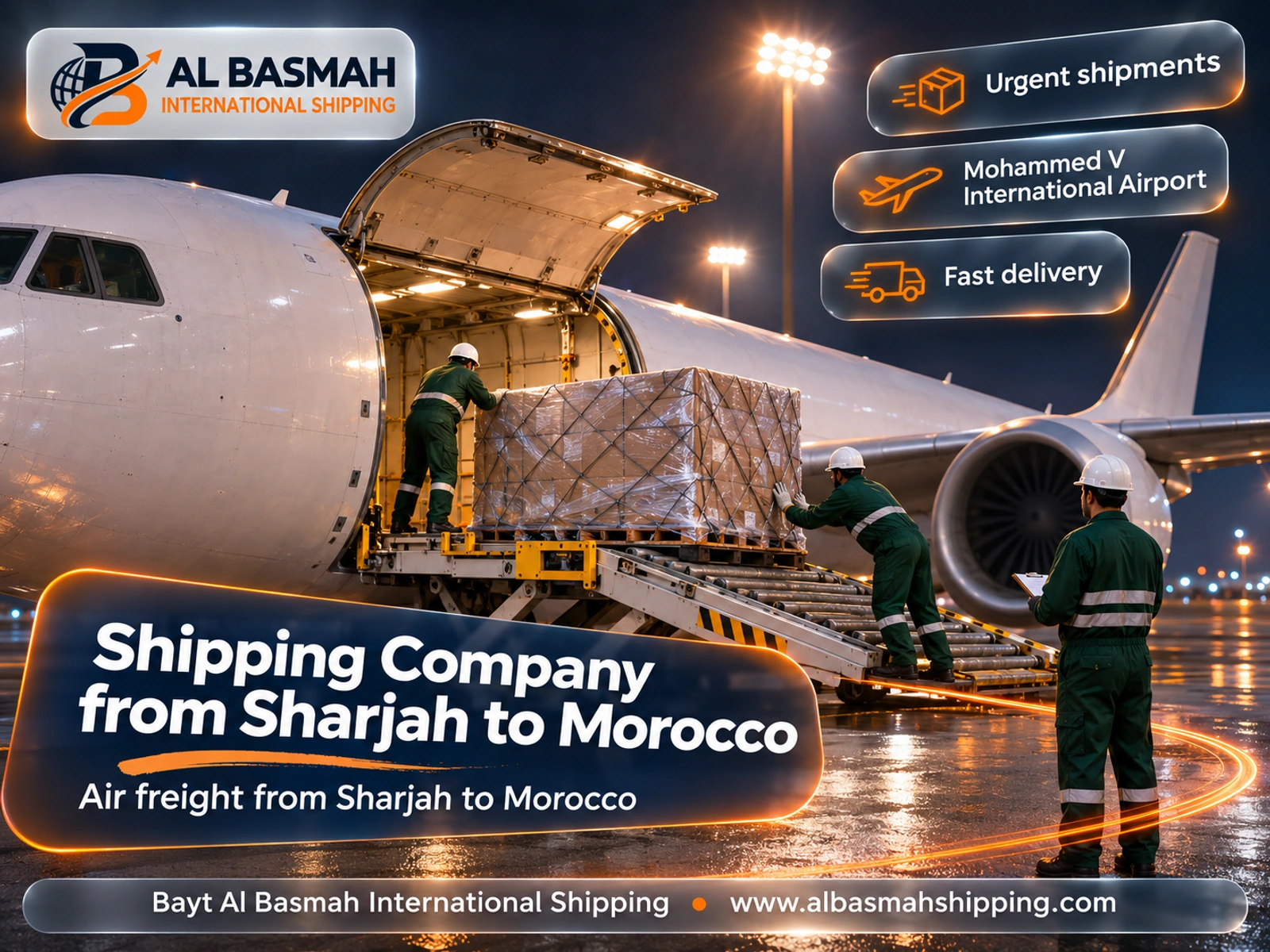
Air is charged on actual weight or volumetric weight, whichever is higher; volumetric weight = length × width × height in cm ÷ 6000. A 60×50×50 cm carton has a volumetric weight of 25 kg even if it really weighs 12 kg, which is why air does not suit light, bulky goods or furniture.
- Lithium batteries and devices containing them are restricted and need special packing.
- Liquids, perfumes and flammables are restricted or banned by air.
- Commercial air cargo needs the same papers: invoice, packing list and importer details.
Shipping cars and pickups from Sharjah to Morocco
Sedans usually travel on RoRo vessels: the car is driven up the ramp into the ship, lashed on deck and driven off at the arrival port. Pickups and small commercial vehicles we ship in a container, well secured, after checking their import eligibility in Morocco, because the vehicle rules there depend on the owner: Moroccans living abroad have a temporary admission scheme and a definitive import scheme with conditions, and commercial vehicle imports have their own requirements.

Before booking we ask for the registration card, year of manufacture, engine type and the consignee in Morocco, and the team checks the case before you pay anything. We do not quote duty rates or age limits from memory, because they change and differ from case to case.
Packing and loading commercial cargo
A commercial container spends weeks at sea and is handled in more than one port. Good packing saves you shortages and damage you cannot recover:
- Wooden pallets must be heat-treated and stamped ISPM-15, or they may be rejected or treated at your cost in Morocco.
- Stretch-wrap and strap pallets, and add corner boards to heavy cartons.
- Number every package to match the packing list, with the importer’s name and city.
- Spread the weight across the container floor, heavy goods low and central, and stay within the container payload.
- Put desiccant bags in containers carrying textiles, cardboard or electronics; condensation forms under the roof at sea.
Photograph the open container from the back before sealing, and photograph the seal number. Those pictures settle any later dispute about package count or condition when it is opened in Morocco.
Prohibited and restricted items for Morocco
- Prohibited: narcotics, weapons and ammunition, counterfeit goods.
- Drones are banned or need prior authorisation.
- Some medicines, electronics and radio devices need permits.
- Food and cosmetics are subject to health control and labelling rules.
- Chemicals and dangerous goods need classification, special packing and shipping-line approval.
Shipping prices from Sharjah to Morocco
We do not publish a fixed price, because a full container is priced differently from LCL and rates move with the line, the sailing and the arrival port. For every service, sea, air or cars: send the details on WhatsApp and the price comes back to you. Include the type of goods, volume or pallet count, approximate weight, pickup area in Sharjah, the Moroccan city, and a photo of the packing list if it is ready.
What decides the shipping price?
| Factor | How it affects the price |
|---|---|
| Shipping method | FCL has a fixed container rate, LCL is per m³, air is per kg of actual or volumetric weight |
| Container size | 20 ft, 40 ft or 40 ft HC; bigger is cheaper per m³ but needs the volume to fill it |
| Volume and weight | Cubic metres for LCL and kilos for air; heavy cargo may need a bigger container |
| Arrival port and city | Casablanca, Tanger Med or Agadir, then the trucking distance to the warehouse |
| Packing | Treated pallets, stretch wrap and wooden crates for sensitive equipment |
| Documents | Certificate of origin, attestations and conformity certificates where required |
| Vehicle | RoRo or container, and the type and size of vehicle |
How to ship from Sharjah to Morocco, step by step
- Send us on WhatsApp the type and quantity of goods, the pickup location and the Moroccan city.
- We suggest FCL, LCL or air and send you the price and the next sailing.
- You prepare the commercial invoice, packing list and certificate of origin; your importer sends their details and ICE number.
- We review the papers before loading and fix any mismatch between description and quantity.
- The container arrives at your Sharjah warehouse, or you drop LCL goods at the Industrial Area 18 branch.
- Loading, photos and sealing, then export and sailing, with an update on WhatsApp.
- On arrival, the importer’s broker clears the goods and pays duty and VAT.
- The goods are trucked to the warehouse in Casablanca or any other city.
Delivery to Casablanca warehouses and other Moroccan cities
Most traders’ shipments end in Casablanca, in industrial districts such as Ain Sebaa and Bouskoura. After clearance a full container goes out on a truck to the warehouse door, the warehouse team unloads it, and the empty box goes back to the line within its free days. So have your unloading crew ready before the truck arrives; late container return means detention charges for the importer.

If your warehouse is in Tangier or Tetouan, arrival at Tanger Med is closer; Fes, Meknes, Marrakech and Rabat are reached by truck after clearance at the arrival port. If the goods are for a shop inside an old medina with narrow lanes, the truck stops at the nearest gate and packages are moved by handcart, so plan for that when arranging delivery.
If some of your customers are Moroccan families returning for good, Moroccans living abroad can usually import their used household goods with a one-time customs exemption under conditions, including a period of residence abroad, proof of definitive return and a detailed contents list; the team checks each case.
To compare emirates, see shipping from Dubai to Morocco, shipping from Ajman to Morocco and shipping from Abu Dhabi to Morocco.
Tips for traders before the first container to Morocco
- Start with a small LCL shipment if the importer is new, to test how fast they clear before a full container.
- Agree the delivery term with the importer: do you pay freight to the port or to the warehouse?
- Do not mix two customers’ goods in one container under one importer’s name without a clear agreement.
- Ask about conformity certificates before you buy, not after the container lands.
- Keep copies of every document, and ask the team about optional cargo insurance.
FAQ: shipping from Sharjah to Morocco
How long does a container take from Sharjah to Casablanca?
About three to five weeks port to port, plus clearance in Morocco and delivery to the warehouse. LCL usually takes longer because of consolidation and devanning.
Is there road shipping from Sharjah to Morocco?
No. Shipping from the UAE to Morocco is by sea or air only, and sea is the norm for commercial goods and cars.
Will my goods benefit from the Arab free trade agreement?
Goods of Arab origin that meet the rules of origin and travel with a valid certificate of origin can benefit; goods made outside Arab countries and re-exported from Sharjah pay the normal duty.
Can I ship in my own name if I have no company in Morocco?
Commercial imports need a registered importer with an ICE number. Personal and household goods follow a different path, and the team will explain what fits your case.
Is there a minimum for LCL?
It depends on the consolidation warehouse and line, and there is usually a minimum in cubic metres. Send your volume and the price comes back to you.
Do you follow the shipment after sailing?
Yes. The team follows it and updates you on WhatsApp at loading, sailing, arrival and clearance.
Should a pickup go in a container or by RoRo?
We usually ship pickups in a container after checking import eligibility, and sedans by RoRo, where the car is driven aboard.
Get your Sharjah to Morocco shipment file ready
Send the type of goods, the volume and the Moroccan city, and you will get the price and the next sailing.
To order through the site: request a shipping price.
Tags: shipping company from Sharjah to Morocco, commercial cargo to Morocco, container Sharjah to Casablanca, LCL to Morocco, FCL to Morocco, certificate of origin Morocco, GAFTA Morocco, Morocco customs, Morocco VAT TVA, air freight Sharjah to Morocco, car shipping Sharjah to Morocco, Casablanca port, Tanger Med, Ain Sebaa warehouses, Industrial Area 18 Sharjah, Al Basmah International Shipping